Loading subject page…


157,146 views

Video Summary: What Is Phosphoinositides and Pips
Did you know that your cell membranes contain specialized lipid molecules that act like molecular "ZIP codes," directing proteins to their precise cellular destinations? Phosphoinositides and PIPs are these remarkable membrane-bound signaling lipids that control everything from how neurons communicate in your brain to how cells at the NIH laboratories transport vital cargo. These phosphorylated derivatives of phosphatidylinositol create unique membrane domains through rapid enzymatic modifications, enabling cells to coordinate complex trafficking pathways with remarkable precision. Watch the full video on JoVE Coach to master this concept with expert-led visuals and step-by-step explanations.
Phosphoinositides and PIPs represent one of cell biology's most elegant signaling systems, functioning as dynamic molecular markers that give each cellular membrane its unique identity. These specialized lipids derive from phosphatidylinositol (PI), a common membrane component that becomes functionally transformed through strategic phosphorylation events.
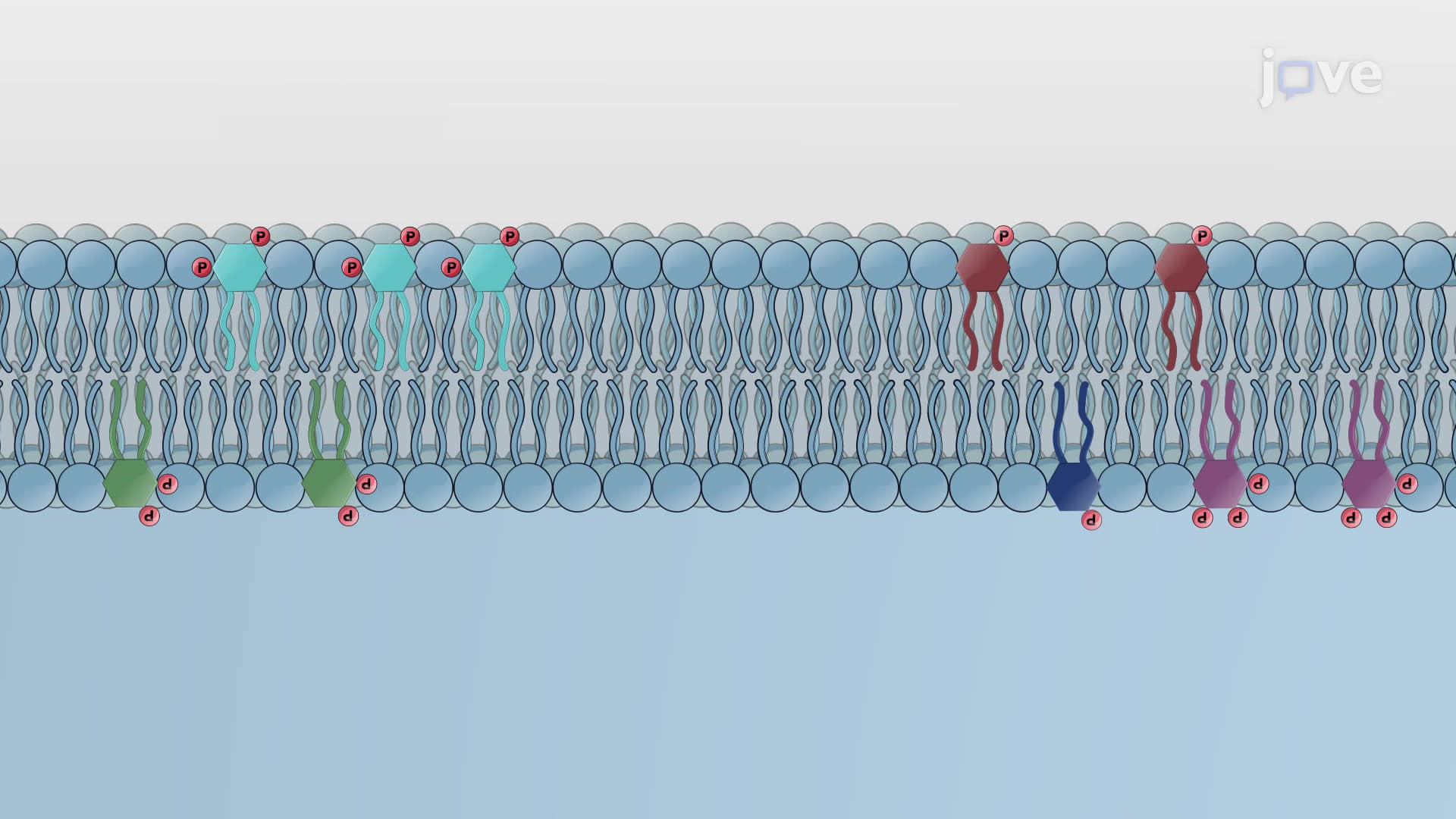
The inositol head group of phosphatidylinositol contains three hydroxyl groups at positions 3, 4, and 5 that serve as phosphorylation targets. This creates seven possible PIP variants: PI(3)P, PI(4)P, PI(5)P, PI(3,4)P₂, PI(3,5)P₂, PI(4,5)P₂, and PI(3,4,5)P₃. Each variant carries a distinct cellular "address," much like how ZIP codes direct mail to specific neighborhoods. For students preparing for the MCAT or AP Biology exams, understanding this phosphorylation pattern is crucial for questions involving membrane dynamics and cellular signaling.
The beauty of the PIP system lies in its dynamic nature. Specialized kinases add phosphate groups while phosphatases remove them, creating rapid on-off switches that control protein recruitment. For example, PI 4-kinase converts PI(4)P to the critical signaling lipid PI(4,5)P₂ at the plasma membrane. This enzymatic control allows cells to respond to stimuli within seconds-a concept frequently tested in college-level cell biology courses and medical school examinations.
At major US research institutions like Johns Hopkins and Stanford, scientists study how PIP dysregulation contributes to diseases. Cancer researchers investigate how altered PI3K (phosphoinositide 3-kinase) signaling drives tumor growth, while neurobiologists at the Allen Institute examine how PIP₂ depletion affects neurotransmitter release in synapses. These connections between basic PIP biology and human disease make this topic highly relevant for pre-med students and USMLE preparation.
Understanding phosphoinositides and PIPs proves essential for students pursuing healthcare careers. Many FDA-approved drugs target PIP-related pathways, including PI3K inhibitors used in cancer treatment and lithium's effects on inositol metabolism in bipolar disorder. This knowledge becomes particularly important for nursing students taking the NCLEX or HESI A2 exams, where understanding cellular signaling mechanisms underlies pharmacology questions.
Related Micro-courses