Loading subject page…


18,853 views

Video Summary: Problem Solving with Pappus Guldinus Theorems
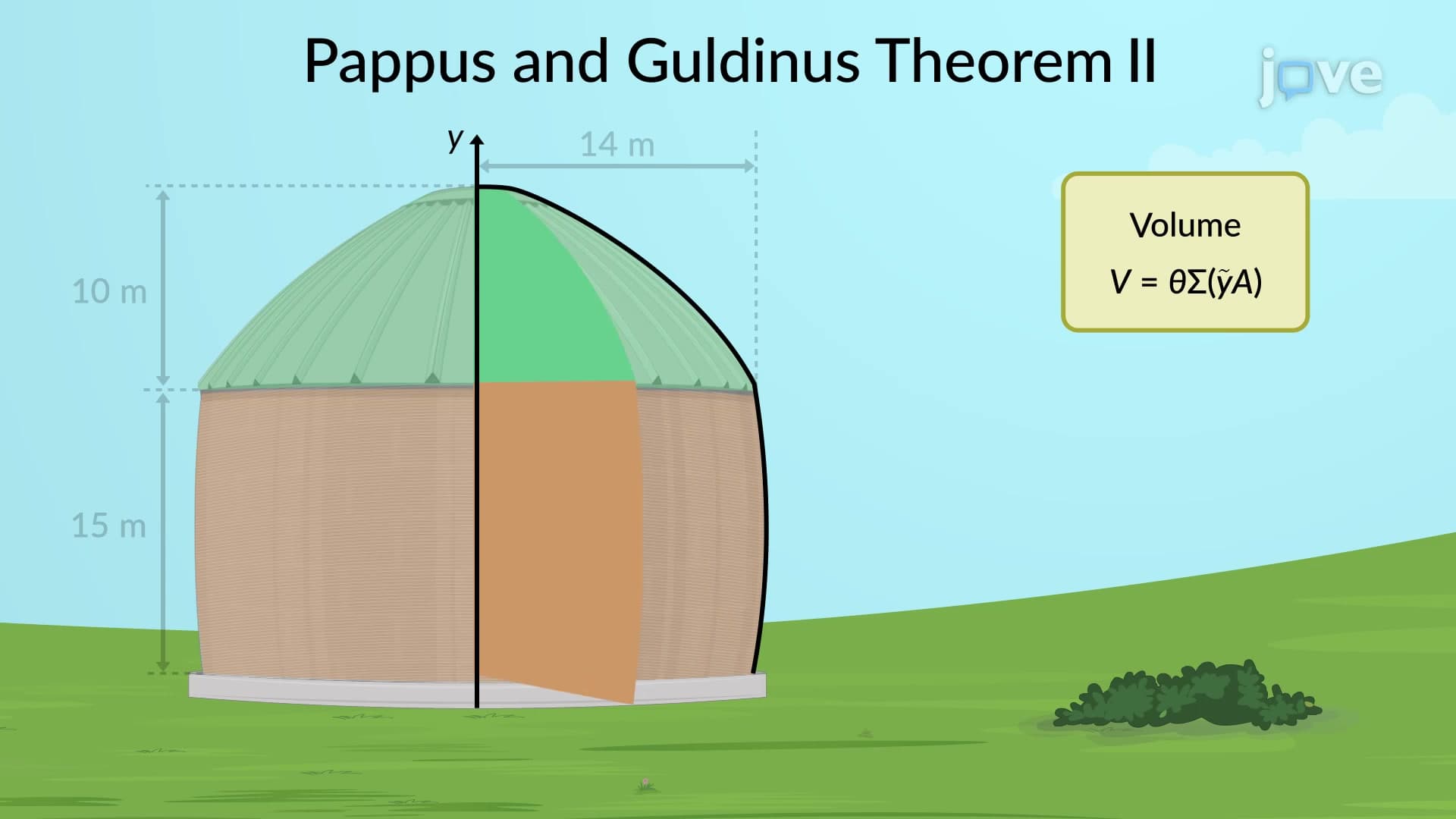
Ever wonder how engineers calculate the exact surface area of NASA's rocket fuel tanks or the volume of water towers dotting American cities? Problem-solving with Pappus-Guldinus theorems provides the mathematical framework to tackle these real-world engineering challenges involving bodies of revolution. These powerful theorems allow us to break down complex composite shapes-like cylindrical storage tanks with conical tops-into simpler components, then calculate their surface areas and volumes by analyzing the paths traced by centroids during rotation. Watch the full video on JoVE Coach to master this concept with expert-led visuals and step-by-step explanations.
The Pappus-Guldinus theorems represent one of mathematics' most elegant solutions to complex three-dimensional problems. Named after ancient Greek mathematician Pappus of Alexandria and 17th-century Swiss mathematician Paul Guldin, these theorems provide shortcuts for calculating surface areas and volumes of bodies created by rotating curves or areas around an axis.
The beauty of problem-solving with Pappus-Guldinus theorems lies in their ability to transform complex 3D calculations into manageable 2D problems. Instead of using challenging integration techniques, these theorems rely on two key concepts: the length or area of the generating shape, and the distance traveled by its centroid during rotation.
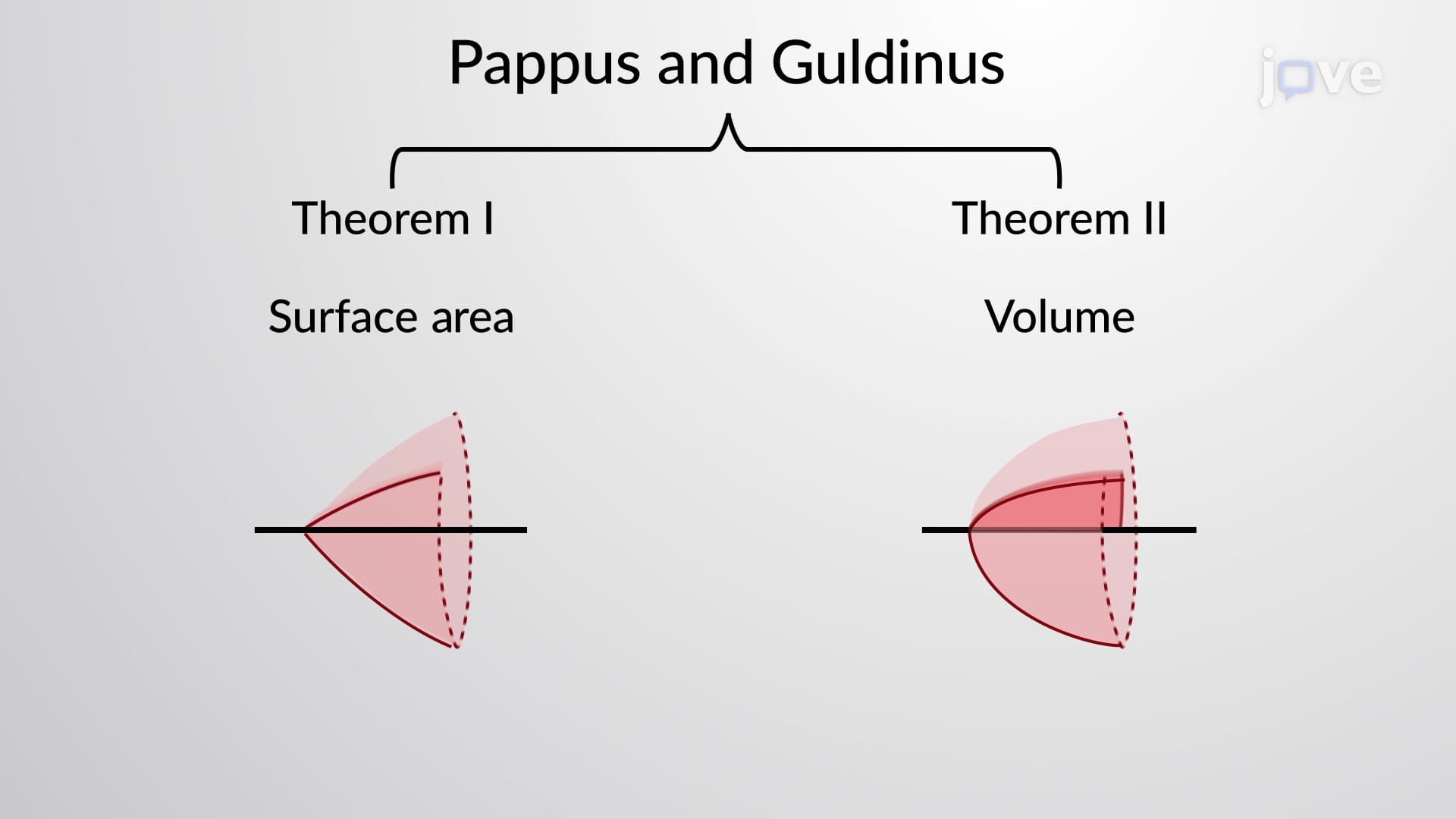
The First Pappus-Guldinus Theorem addresses surface area: when a plane curve rotates around an external axis, the surface area equals the curve length multiplied by the distance traveled by the curve's centroid. Mathematically, this appears as: Surface Area = 2π × R × L, where R represents the distance from the centroid to the axis of rotation, and L represents the curve length.
The Second Pappus-Guldinus Theorem handles volume calculations: when a plane area rotates around an external axis, the volume equals the area multiplied by the distance traveled by the area's centroid. The formula becomes: Volume = 2π × R × A, where A represents the generating area.
These theorems prove invaluable in numerous American industries. Aerospace engineers at companies like Boeing and SpaceX use them to calculate fuel tank capacities and structural loads. Civil engineers apply them when designing water towers, storage silos, and architectural domes. The theorems appear frequently in mechanical engineering coursework at institutions like MIT and Georgia Tech, particularly in statics and dynamics courses.
Students encounter problem-solving with Pappus-Guldinus theorems in AP Calculus BC, where they complement integration techniques for volumes of revolution. College-level engineering statics courses extensively cover these theorems, and they frequently appear on Fundamentals of Engineering (FE) exam questions. The concepts also surface in SAT Subject Tests and various engineering graduate school entrance examinations, making thorough understanding essential for academic success.
Related Micro-courses