201,021 views
Video Summary: Poiseuilles Law and Reynolds Number Explained
Why does your IV drip slow to a crawl when the needle gets slightly bent? Poiseuille's law and Reynolds number explain how tiny changes in tube radius dramatically affect fluid flow rates. In hospital settings across the US, understanding these principles helps medical professionals optimize IV therapy and catheter placement. Poiseuille's Law And Reynolds Number Explained reveals the mathematical relationship between pressure, viscosity, and flow patterns that govern everything from blood circulation to water pipes. Watch the full video on JoVE Coach to master this concept with expert-led visuals and step-by-step explanations.
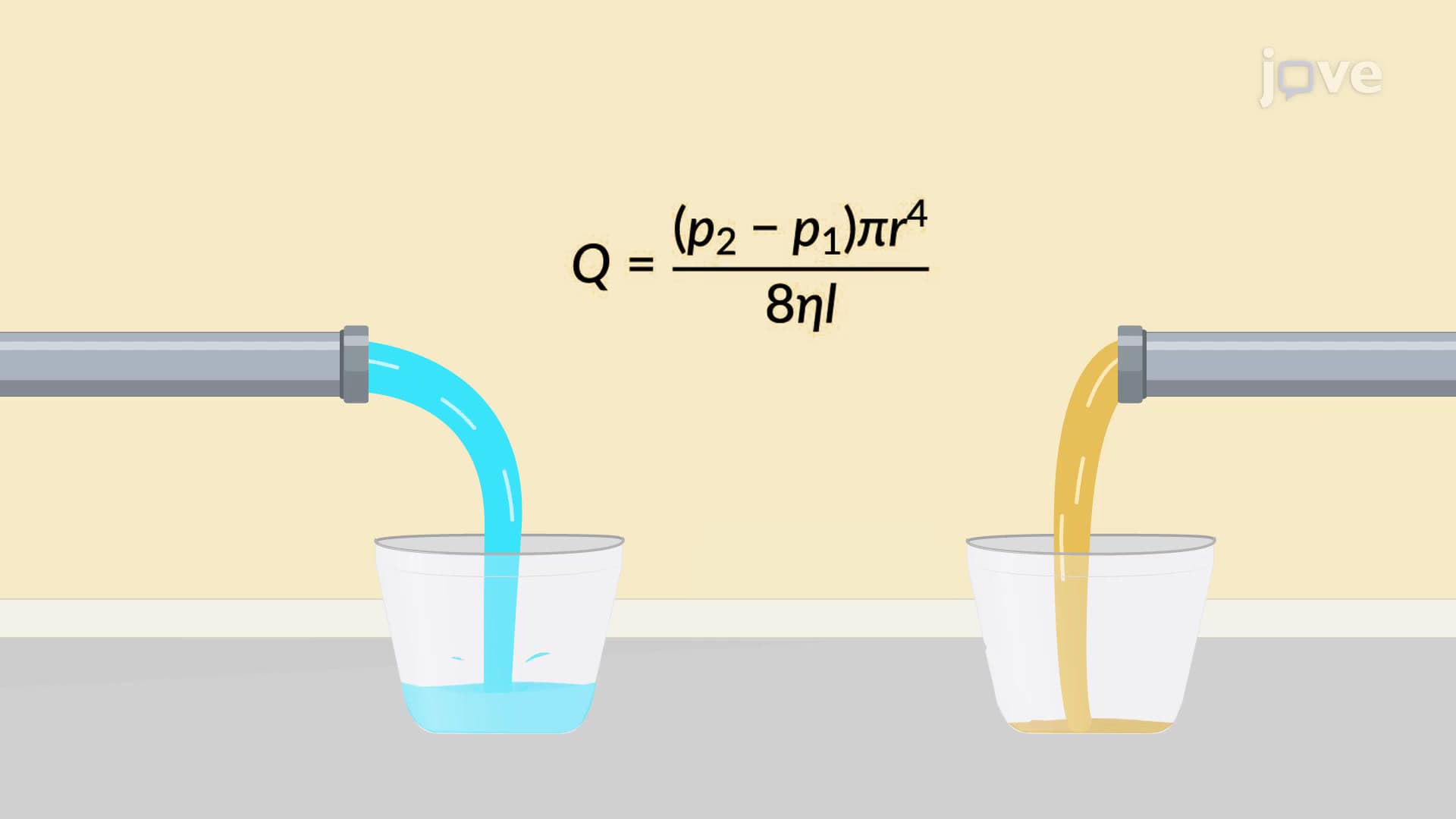
Poiseuille's law describes laminar flow through cylindrical tubes, establishing that flow rate equals pressure difference divided by flow resistance. This fundamental relationship, developed by French physician Jean Poiseuille in the 1840s, reveals how tube geometry and fluid properties control flow behavior. The law specifically applies to steady, laminar flow of incompressible fluids through straight, rigid tubes.
The mathematical expression shows flow resistance depends directly on fluid viscosity and tube length, while varying inversely with the fourth power of tube radius. This fourth-power relationship means halving tube radius reduces flow rate by 16 times-a critical insight for medical professionals managing IV lines and catheters in US hospitals.
Reynolds number determines whether fluid flow remains laminar or becomes turbulent. This dimensionless value, named after British engineer Osborne Reynolds, compares inertial forces to viscous forces within flowing fluids. When Reynolds number stays below 2,000, flow remains laminar with smooth, predictable streamlines. Above 3,000, turbulence dominates with chaotic mixing and energy loss.
The transition zone between 2,000 and 3,000 represents unstable flow that may switch unpredictably between laminar and turbulent patterns. This knowledge helps engineers design efficient pipeline systems and medical device manufacturers optimize catheter performance.
US medical facilities rely on these principles daily. Emergency room physicians understand that IV flow rates depend critically on needle diameter-using larger-gauge needles for rapid fluid resuscitation. Similarly, anesthesiologists consider tube resistance when selecting endotracheal tubes, knowing that smaller tubes significantly increase breathing resistance.
Industrial applications include oil pipeline design, where engineers calculate optimal pipe diameters to minimize pumping costs while maintaining required flow rates. Water treatment plants use these principles to design distribution systems that efficiently serve municipal areas.
AP Physics and college-level fluid mechanics courses frequently test Poiseuille's law calculations. Students encounter problems involving pressure drop calculations, flow rate predictions, and system optimization scenarios. MCAT preparation includes cardiovascular physiology applications, where blood flow through arteries follows modified Poiseuille relationships.
Typical exam problems ask students to calculate how flow rate changes when tube radius decreases by specific percentages, or determine required pressure increases to maintain constant flow through narrowed vessels. Understanding the fourth-power radius dependency often represents the key insight for solving these quantitative problems correctly.
Related Micro-courses