Loading subject page…


235,304 views

Video Summary: What Is Enzyme Kinetics
Did you know that a single enzyme molecule can process thousands of substrate molecules per second? Enzyme kinetics reveals the fascinating science behind how quickly biochemical reactions occur in living systems, from the lactase breaking down milk sugar in your digestive system to the catalase protecting your cells from hydrogen peroxide damage. Understanding what is enzyme kinetics helps explain why some people are lactose intolerant while others aren't. Watch the full video on JoVE Coach to master this concept with expert-led visuals and step-by-step explanations.
Enzyme kinetics forms the cornerstone of biochemical analysis, measuring how quickly enzymes convert substrates into products under specific conditions. This field emerged from pioneering work by Leonor Michaelis and Maud Menten at Johns Hopkins University, whose mathematical model still guides modern enzymology. Unlike simple chemical reactions, enzyme-catalyzed processes show unique saturation behavior that reveals critical insights about biological efficiency and regulation.
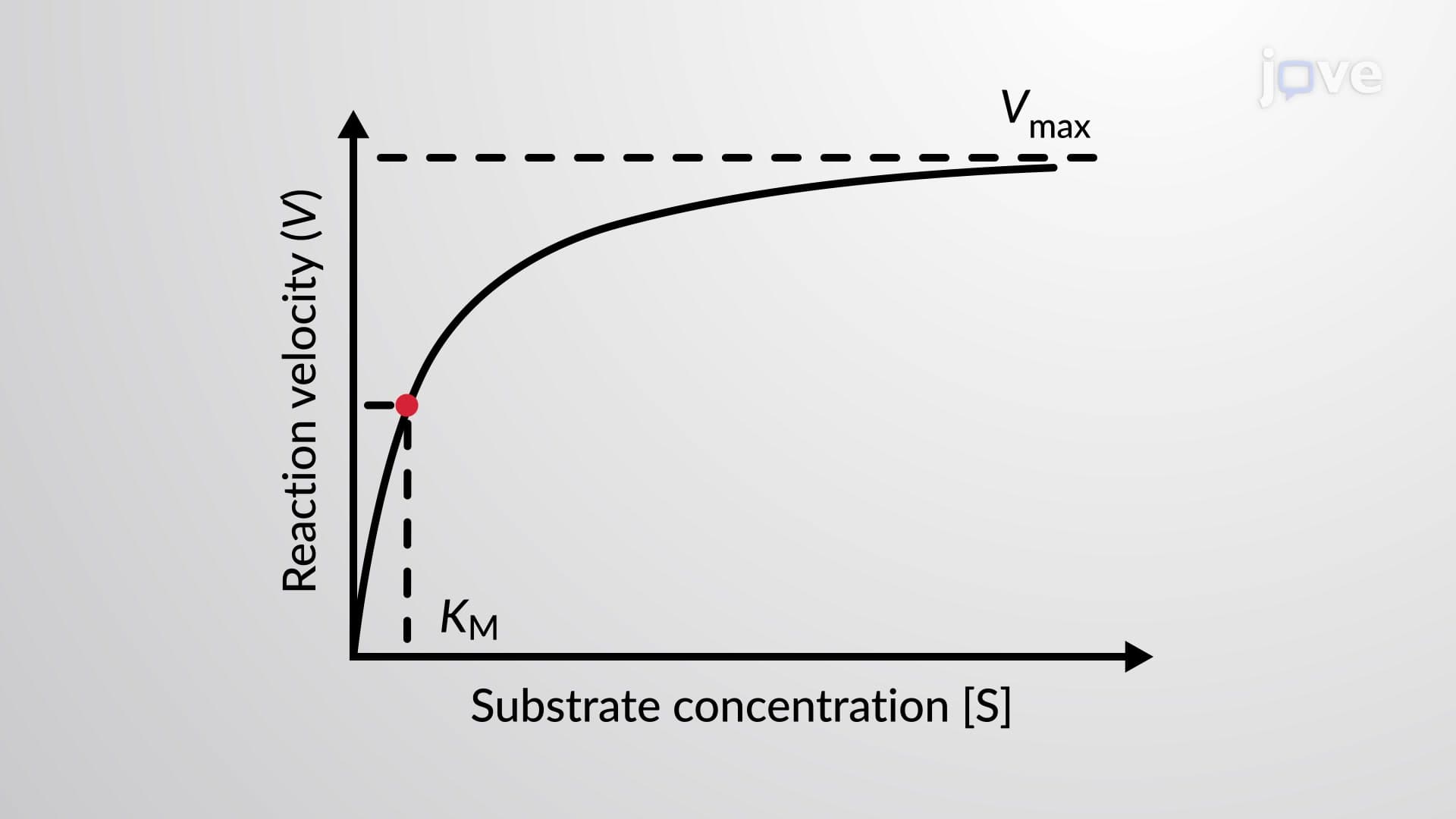
The relationship between substrate concentration and reaction velocity follows a predictable hyperbolic curve. At low substrate concentrations, doubling the substrate nearly doubles the reaction rate-a linear relationship. However, as substrate concentration increases, the curve begins to flatten, approaching a maximum velocity (Vmax) where further substrate addition produces minimal rate increases. This saturation occurs because all enzyme active sites become occupied, creating a bottleneck that limits overall reaction speed.
The Michaelis constant (KM) represents the substrate concentration at which reaction velocity reaches 50% of Vmax, serving as an inverse measure of enzyme affinity. Enzymes with low KM values (high affinity) bind substrates tightly and achieve half-maximal velocity at low substrate concentrations. For example, hexokinase in human muscle cells has a KM of approximately 0.1 mM for glucose, indicating high affinity that enables efficient glucose utilization even when blood sugar levels are low. Conversely, glucokinase in liver cells has a KM of 10 mM, acting as a glucose sensor that increases activity only when glucose concentrations rise significantly.
Enzyme kinetics principles appear prominently on the MCAT biochemistry section and AP Biology exams, particularly in questions about competitive and non-competitive inhibition. Medical diagnostics rely heavily on enzyme kinetics-elevated serum levels of creatine kinase indicate heart attack damage, while abnormal cholinesterase activity suggests organophosphate poisoning. Pharmaceutical companies use kinetic analysis to develop drugs that inhibit specific enzymes, such as statins that block HMG-CoA reductase to lower cholesterol production.
Understanding these concepts prepares students for advanced coursework in biochemistry, pharmacology, and clinical laboratory science, where kinetic analysis guides everything from drug dosing to disease diagnosis.
Related Micro-courses