Loading subject page…


39,014 views


Video Summary: What Is the Carnot Cycle
Why can't car engines achieve perfect efficiency despite decades of engineering advances? The Carnot cycle represents the theoretical maximum efficiency any heat engine can achieve, making it crucial for understanding why real engines like those in Ford F-150 trucks or Tesla vehicles still waste energy as heat. This idealized thermodynamic cycle involves four distinct processes that define the upper limit of engine performance. Watch the full video on JoVE Coach to master this concept with expert-led visuals and step-by-step explanations.
The Carnot cycle represents one of the most fundamental concepts in thermodynamics, establishing the theoretical upper limit for heat engine efficiency. Named after French physicist Sadi Carnot, this idealized cycle demonstrates why no real engine-whether in your car, a power plant, or industrial machinery-can achieve 100% efficiency. The cycle operates on the principle that maximum efficiency requires all processes to be reversible, meaning they can be run backward without any energy loss to the surroundings.
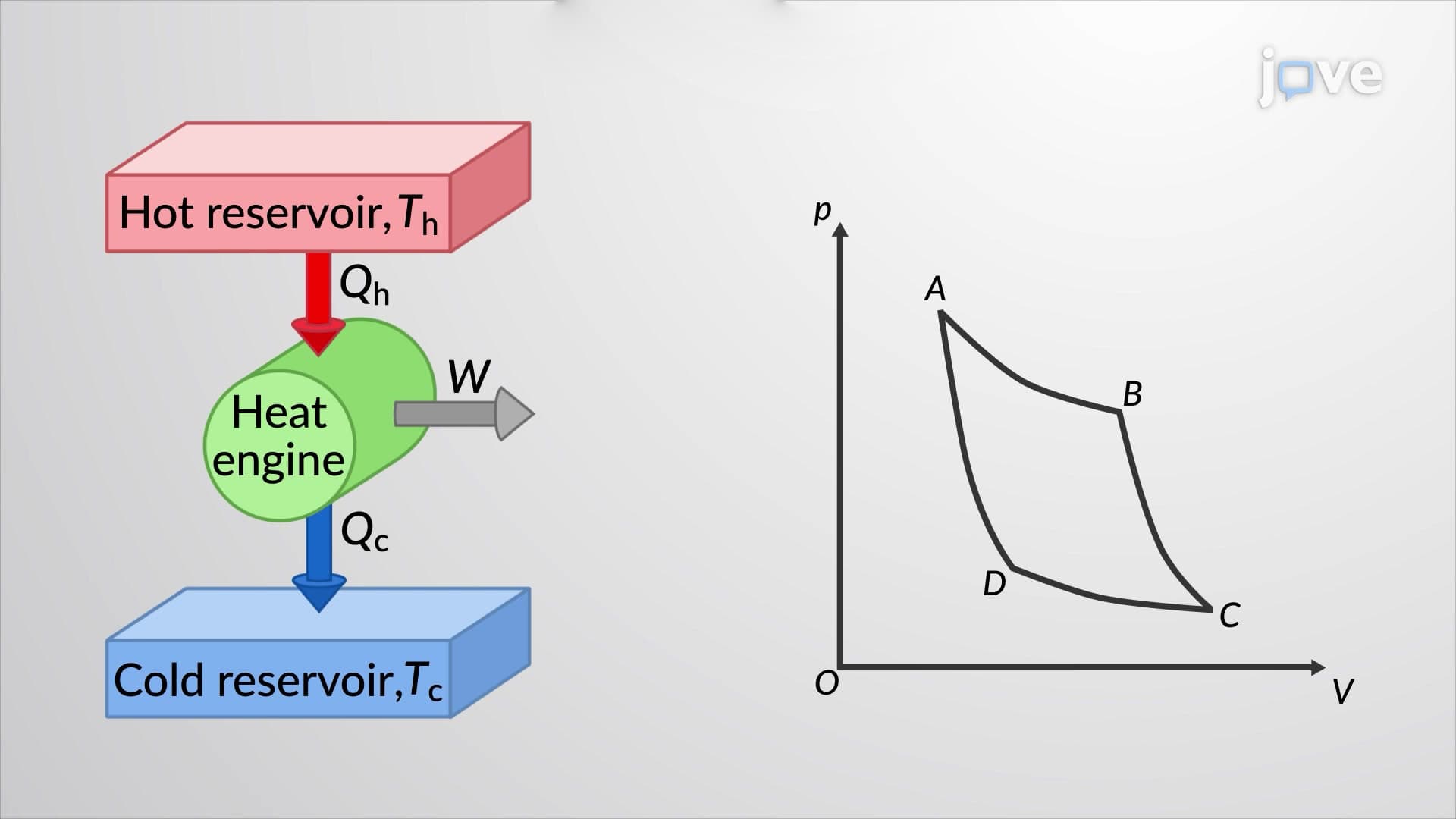
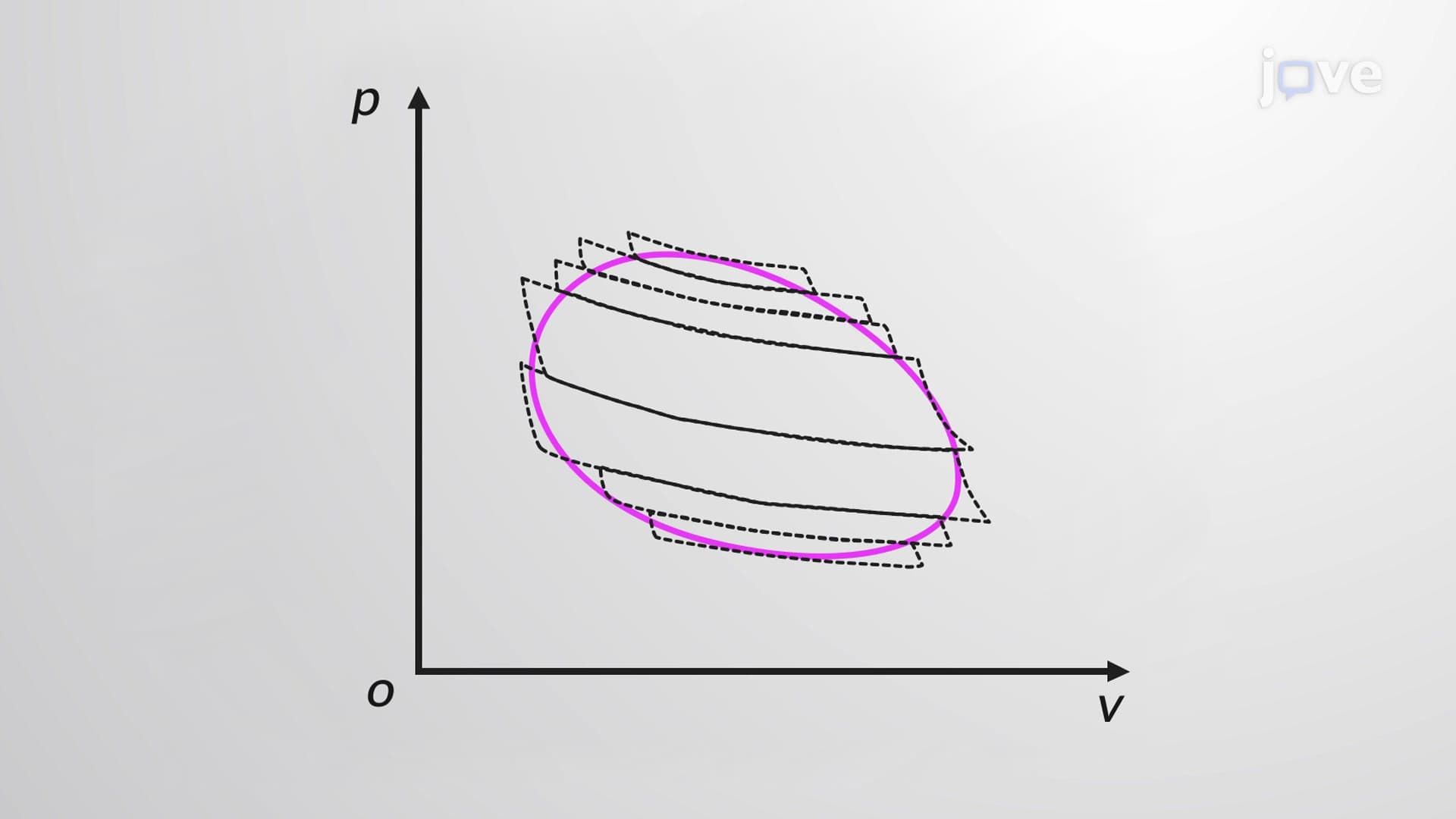
The Carnot cycle consists of four carefully orchestrated steps that maximize energy conversion while minimizing waste. During isothermal expansion, the working fluid (typically an ideal gas) absorbs heat from a high-temperature reservoir while maintaining constant temperature-imagine a piston slowly expanding while in contact with a hot surface. Next, adiabatic expansion occurs when the gas is thermally isolated and allowed to expand further, causing its temperature to drop naturally to match the cold reservoir temperature.
The cycle continues with isothermal compression, where the gas releases heat to the cold reservoir while being compressed at constant low temperature. Finally, adiabatic compression completes the cycle as the isolated gas is compressed back to its original high-temperature state. These four processes create a closed loop that theoretically converts the maximum possible amount of heat into useful work.
Understanding the Carnot cycle proves essential for engineering students and professionals working in America's energy sector. Coal-fired power plants in states like Wyoming and West Virginia, natural gas facilities in Texas, and even geothermal plants in California all operate under Carnot efficiency limitations. A typical coal plant achieves only about 35-40% efficiency, far below the theoretical Carnot maximum due to irreversible processes like friction, heat conduction, and turbulence.
Modern automotive engines provide another excellent example. The latest Ford EcoBoost engines or Chevrolet's small-displacement turbocharged motors achieve roughly 25-30% thermal efficiency under optimal conditions. While impressive for real-world applications, these efficiencies remain constrained by Carnot principles and the temperature differences between combustion chambers and exhaust systems.
Students preparing for AP Physics C: Thermodynamics, college-level physics courses, or engineering programs must thoroughly understand Carnot cycle calculations. The efficiency formula η = 1 - (T_cold/T_hot) appears frequently on exams, requiring students to work with absolute temperatures in Kelvin. Practice problems often involve calculating maximum theoretical efficiencies for various temperature combinations or determining the impact of improving hot reservoir temperatures versus lowering cold reservoir temperatures.
Related Micro-courses