Loading subject page…

- Anatomy and Physiology
- The Axial Skeleton
- The Auditory Ossicles
Micro-course: The Axial Skeleton
57,801 views
Learn key concepts and earn your certificate.



The Auditory Ossicles

00:00
01:11
Video Summary: What Is the Auditory Ossicles
Ever wonder how a whisper can travel from your eardrum to your brain in milliseconds? The auditory ossicles anatomy reveals three microscopic bones that amplify sound vibrations by up to 22 times their original intensity. When a fire alarm rings at 120 decibels in a US school building, these tiny structures work together to protect your hearing while ensuring you receive the warning. What is the auditory ossicles system becomes clearer when you understand these bones form the smallest mechanical lever system in the human body. Watch the full video on JoVE Coach to master this concept with expert-led visuals and step-by-step explanations.
- Understand what is the auditory ossicles and identify the three bones: malleus, incus, and stapes
- Recognize the structural connections between ear ossicles structure function and sound transmission
- Analyze how the ossicle chain hearing mechanism amplifies vibrations from the tympanic membrane
- Identify the role of synovial joints in connecting malleus incus stapes ear bones
- Evaluate the protective function of tensor tympani and stapedius muscles during loud sound exposure
- Apply knowledge of middle ear bones anatomy to explain conductive hearing loss mechanisms
- Compare the size relationships between the three ossicles and their functional significance
- Explore how ossicle vibration sound transmission enables neural impulse generation in the inner ear
Understanding What is The Auditory Ossicles: The Middle Ear's Mechanical Advantage
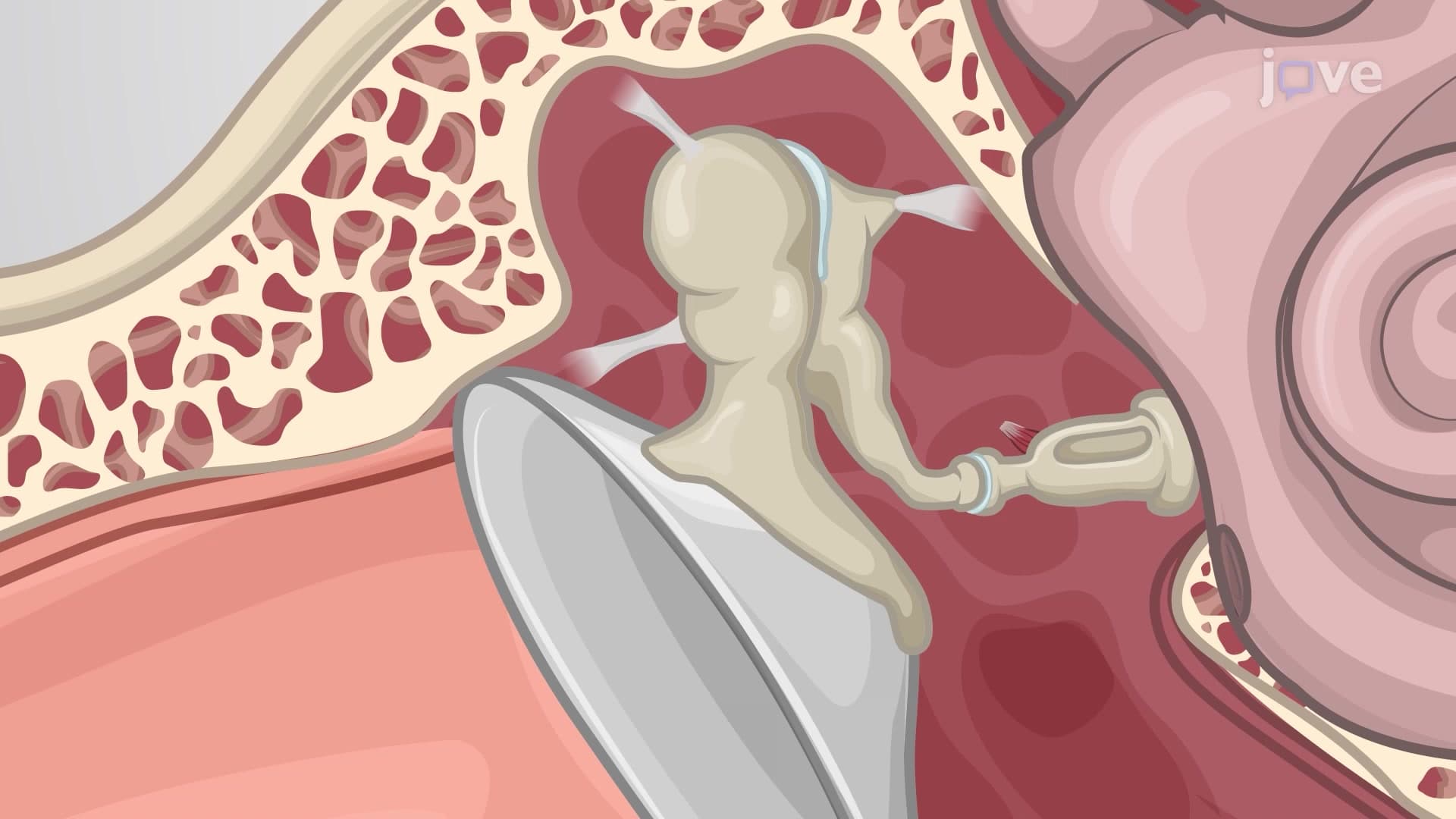
What is the auditory ossicles system represents one of nature's most efficient mechanical amplifiers. These three interconnected bones-malleus, incus, and stapes-form a sophisticated lever system that increases sound pressure by approximately 1.3 times through mechanical advantage, while the area difference between the tympanic membrane and oval window provides an additional 17-fold amplification.
Ear Ossicles Structure Function: Individual Bone Characteristics
The malleus incus stapes ear chain demonstrates remarkable engineering precision. The malleus, resembling a hammer, measures about 8-9 millimeters and weighs roughly 23 milligrams. Its manubrium attaches firmly to the tympanic membrane, while its head articulates with the incus through the smallest synovial joint in the human body. The incus, shaped like an anvil, serves as the intermediate link, with its long process connecting to the stapes via the lenticular process. The stapes, weighing only 2-4 milligrams, is the lightest bone in the human body and fits precisely into the oval window.
Middle Ear Bones Anatomy: Clinical Significance in Healthcare
Understanding middle ear bones anatomy proves essential for healthcare professionals. Otosclerosis, affecting approximately 3 million Americans, occurs when abnormal bone growth fixes the stapes in the oval window, causing conductive hearing loss. This condition particularly impacts young adults and can be surgically corrected through stapedectomy, where the stapes is replaced with a prosthetic device. Medical students studying for the USMLE frequently encounter questions about ossicular chain dysfunction and its audiological consequences.
Ossicle Vibration Sound Protection Mechanisms
The ossicle chain hearing system includes built-in protection against acoustic trauma. When sound levels exceed 80-90 decibels-common in US industrial settings-the stapedius and tensor tympani muscles contract reflexively within 40-160 milliseconds. This acoustic reflex reduces sound transmission by 15-20 decibels, protecting the delicate inner ear structures. However, this reflex cannot protect against sudden loud noises like gunshots or explosions, explaining why hearing protection is mandatory in US military and construction environments.
Frequently Asked Questions
The auditory ossicles are three tiny bones (malleus, incus, stapes) in the middle ear that amplify and transmit sound vibrations from the eardrum to the inner ear. They increase sound pressure by about 22 times, making quiet sounds audible while protecting against loud noises. Without these bones, you would experience significant hearing loss equivalent to wearing heavy-duty earplugs constantly.
MCAT questions often test ossicle function in hearing loss scenarios, requiring you to distinguish between conductive and sensorineural hearing problems. AP Biology exams typically focus on the mechanical physics of sound amplification and the ossicles' role in sensory transduction. Expect diagram-based questions asking you to trace sound waves from the tympanic membrane through the ossicular chain to the cochlea.
Human Anatomy and Physiology, Comparative Anatomy, and Neuroscience courses extensively cover ossicular anatomy and function. Medical school curricula include ossicle pathology in ENT (Ear, Nose, Throat) rotations. Many universities use cadaveric dissection to examine these structures, though their microscopic size makes them challenging to observe without magnification.
Traditional hearing aids amplify sound waves reaching the damaged ossicular chain, partially compensating for reduced mechanical transmission. Bone-anchored hearing aids bypass damaged ossicles entirely by transmitting vibrations directly through skull bones to the inner ear. In severe cases, surgical ossicular reconstruction using prosthetic devices restores the mechanical advantage these bones normally provide.
Basic high school physics concepts about levers, pressure, and wave transmission are sufficient to understand ossicular function. The key principles involve mechanical advantage (like using a crowbar) and pressure amplification (concentrating force over a smaller area). Most students find the lever analogy helpful-the ossicles work like a system of connected levers that multiply the force of sound waves.
Use the mnemonic "MIS" (Malleus, Incus, Stapes) or "Most Interesting Structures" to remember the sequence. Associate each bone with its shape: Malleus = Hammer, Incus = Anvil, Stapes = Stirrup. Create concept maps connecting each bone's anatomy to its specific function in the hearing process. Practice with unlabeled ear diagrams until you can identify each ossicle's location and articulations.
Audiologists regularly diagnose ossicular chain dysfunction through specialized hearing tests like tympanometry and stapedial reflex testing. ENT surgeons perform microsurgeries to repair or replace damaged ossicles, requiring detailed anatomical knowledge. Understanding normal ossicular function is essential for interpreting hearing test results and recommending appropriate treatments for the 48 million Americans with hearing loss.
Explore cochlear anatomy and hair cell function to understand how mechanical vibrations become neural signals. Study comparative anatomy to see how different mammals have evolved varied ossicular arrangements. Investigate acoustic physics principles like impedance matching and resonance that explain why the ossicular system is so efficient at sound transmission.
Related Micro-courses