Loading subject page…


215,805 views

Video Summary: What are Hydrogen Bonds
Ever wonder why water droplets bead up on a car windshield instead of spreading flat? The answer lies in hydrogen bonds explained through the unique attractions between water molecules. These special intermolecular forces occur when hydrogen atoms form electrostatic attractions with electronegative atoms like oxygen, nitrogen, or fluorine. In biological systems across the United States-from the DNA in forensic labs at the FBI to protein structures studied at Harvard Medical School-hydrogen bonds provide crucial structural stability. Watch the full video on JoVE Coach to master this concept with expert-led visuals and step-by-step explanations.
Hydrogen bonds explained begins with recognizing these as special intermolecular attractions that are stronger than typical van der Waals forces but weaker than covalent bonds. The hydrogen bond definition chemistry describes a three-part system: a hydrogen atom covalently bonded to an electronegative atom (the donor), an electronegative atom with lone electron pairs (the acceptor), and the electrostatic attraction between them.
The electronegativity scale, developed by American chemist Linus Pauling, helps us understand why only certain atoms participate effectively in hydrogen bonding. Fluorine (4.0), oxygen (3.5), and nitrogen (3.0) have sufficiently high electronegativity values compared to hydrogen (2.1) to create the necessary charge separation.
In intermolecular hydrogen bonding, the donor molecule contains a hydrogen atom covalently bonded to F, O, or N. This creates a significant dipole because these electronegative atoms pull electron density away from hydrogen, leaving it with a partial positive charge (δ+). The acceptor molecule must have an electronegative atom with at least one lone pair of electrons, which carries a partial negative charge (δ-).
Hydrogen bond strength typically ranges from 5-30 kJ/mol, making these interactions about 10-20 times stronger than van der Waals forces but roughly 10-20 times weaker than covalent bonds. This intermediate strength proves crucial for biological processes-strong enough to provide stability, yet weak enough to allow for dynamic changes.
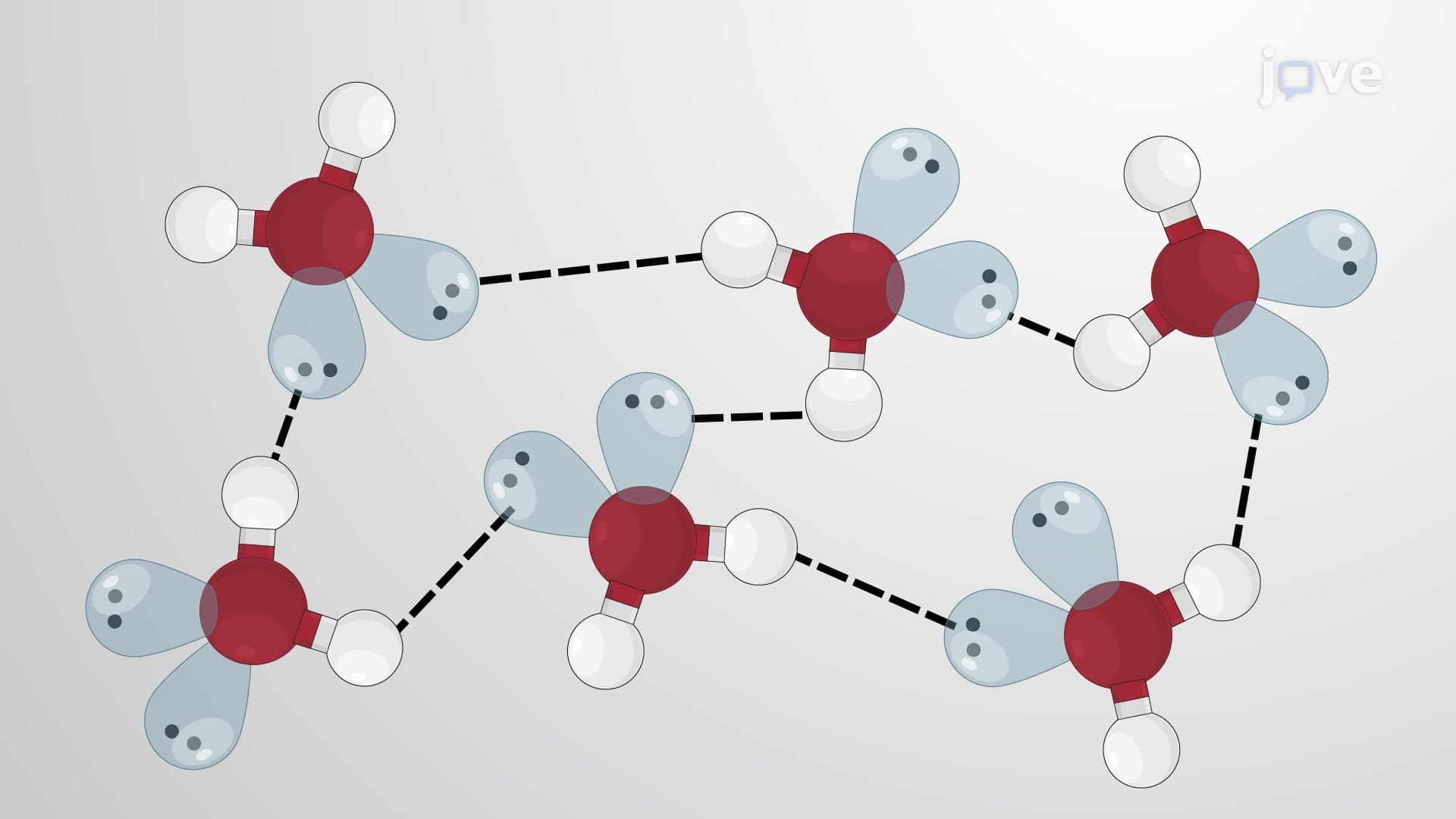
Water hydrogen bonding exemplifies these concepts perfectly. Each water molecule can form up to four hydrogen bonds: two as a donor (using its two hydrogen atoms) and two as an acceptor (using the two lone pairs on oxygen). This extensive hydrogen bonding network explains water's unusually high boiling point (100°C) compared to similar-sized molecules like methane (-162°C).
These hydrogen bonds create water's unique properties essential for life in the United States and globally: surface tension that allows water striders to walk on pond surfaces, the expansion of ice that prevents lakes from freezing solid, and water's role as the universal biological solvent.
Protein hydrogen bond formation drives the folding of polypeptide chains into functional three-dimensional structures. In secondary structures like alpha helices and beta sheets, hydrogen bonds form between the backbone atoms-specifically between the carbonyl oxygen of one amino acid and the amino hydrogen of another residue located several positions away.
Students preparing for the MCAT or AP Biology exams should understand that hydrogen bonds also stabilize the DNA double helix structure through complementary base pairing: adenine with thymine (2 hydrogen bonds) and guanine with cytosine (3 hydrogen bonds). Research institutions like the National Institutes of Health rely on understanding these interactions for drug design and genetic research.
Related Micro-courses