Loading video…


 26 Concepts
 111.9K views

Video Summary: What Is Integration of Synaptic Events
Ever wondered how your brain decides whether to send a signal when thousands of neurons are simultaneously whispering different messages? Synaptic integration biology explains this critical decision-making process occurring millions of times per second in your nervous system. The integration of synaptic events determines whether neurons at Johns Hopkins Medical School laboratories fire action potentials based on competing excitatory and inhibitory inputs. This fundamental mechanism controls everything from reflexes to complex thoughts through spatial and temporal summation processes. Watch the full video on JoVE Coach to master this concept with expert-led visuals and step-by-step explanations.
The integration of synaptic events represents one of neuroscience's most elegant computational processes. At any given moment, a typical neuron in your brain receives hundreds to thousands of synaptic inputs, each contributing either excitatory or inhibitory signals. The axon hillock acts as the neuron's "decision center," mathematically summing these competing inputs to determine whether an action potential fires.
Spatial summation occurs when multiple synapses activate simultaneously across different locations on the neuron's dendrites and cell body. Consider a motor neuron controlling muscle contraction-multiple sensory inputs from stretch receptors, balance organs, and motor cortex commands all converge spatially. Meanwhile, temporal summation involves rapid-fire stimulation at a single synapse, where successive EPSPs arrive before previous ones decay.
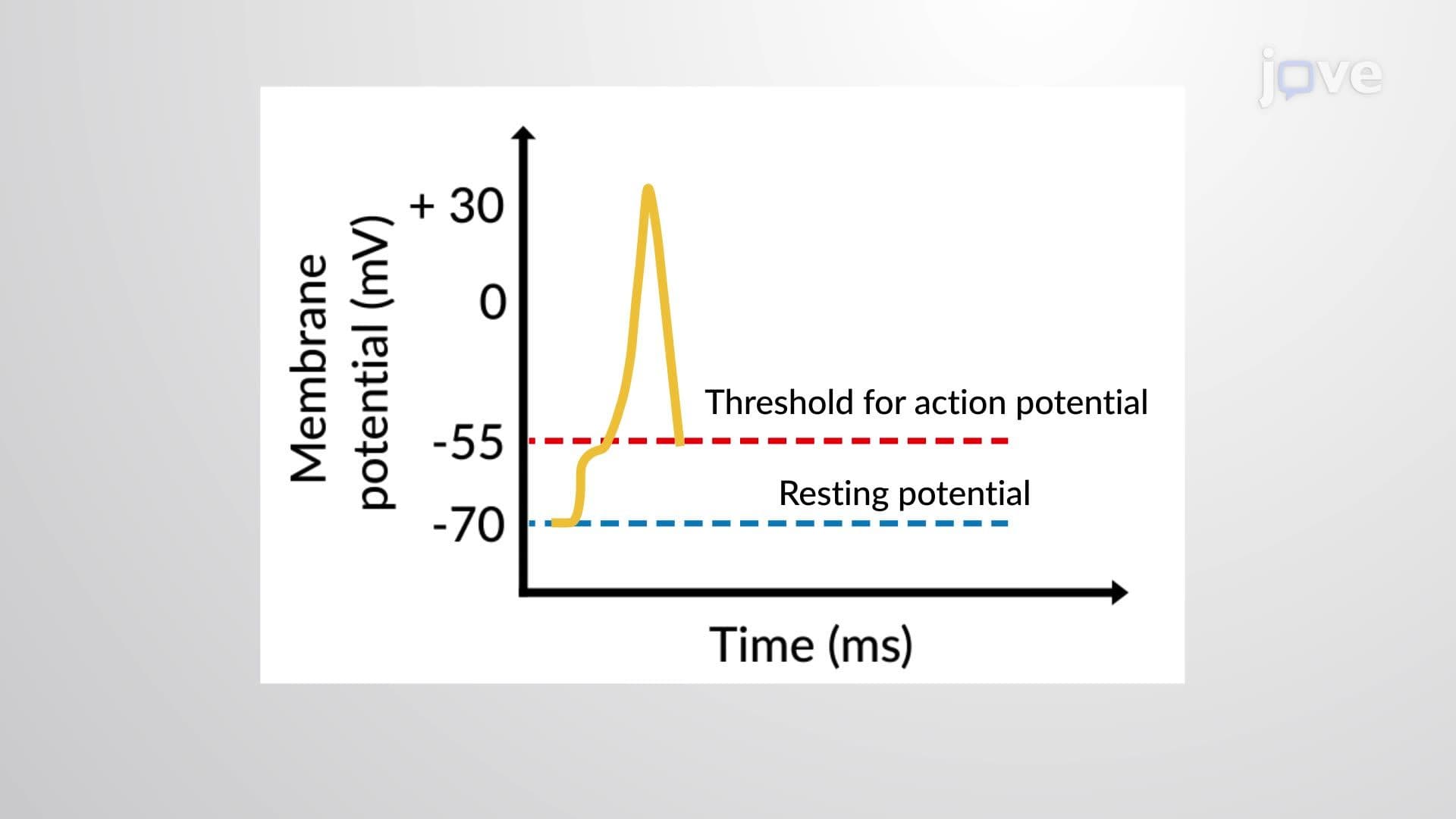
Students preparing for the MCAT or AP Biology exams should understand that individual EPSPs typically produce only 0.5 mV depolarization-far below the ~15 mV needed to reach threshold. This safety mechanism prevents random neuronal firing while ensuring legitimate signals get through via summation.
Synaptic integration explains how common substances affect brain function. Caffeine enhances EPSP summation by blocking adenosine receptors, making neurons more excitable-explaining why your morning coffee improves alertness. Conversely, benzodiazepines used in anxiety treatment enhance GABA-mediated inhibition, making threshold achievement more difficult.
At medical schools like Harvard or Stanford, students learn that understanding synaptic integration is crucial for comprehending neurological disorders. Epilepsy involves excessive excitatory summation overwhelming inhibitory controls, while depression may involve insufficient excitatory integration in mood-regulating circuits.
This process underlies every neurological function, from simple reflexes tested in clinical examinations to complex decision-making studied at research institutions like the National Institutes of Health. When you quickly pull your hand from a hot stove, spinal interneurons integrate pain signals with motor commands through precisely timed synaptic summation, demonstrating how this cellular mechanism scales to protect organisms in real-time survival situations.
Related Micro-courses