Loading…
Loading video…

6,337 views

How far does a sprinter actually travel when their speed changes every second? The distance problem is a foundational calculus concept that estimates total distance traveled when velocity isn't constant. Using velocity data collected at timed intervals — much like GPS tracking in a US track-and-field event — the distance problem introduces Riemann sums and leads directly to definite integrals. Watch the full video on JoVE Coach to master this concept with expert-led visuals and step-by-step explanations.
The distance problem asks a deceptively simple question: if you know how fast an object is moving at various moments in time, how do you calculate the total distance it has traveled? When velocity is constant, the answer is straightforward — distance equals velocity multiplied by time. But in real-world motion, velocity rarely stays the same. A car accelerating on a highway, a cyclist climbing a hill, or a runner pushing off the starting blocks all experience continuously changing speeds. The distance problem provides the mathematical framework to handle exactly these situations.
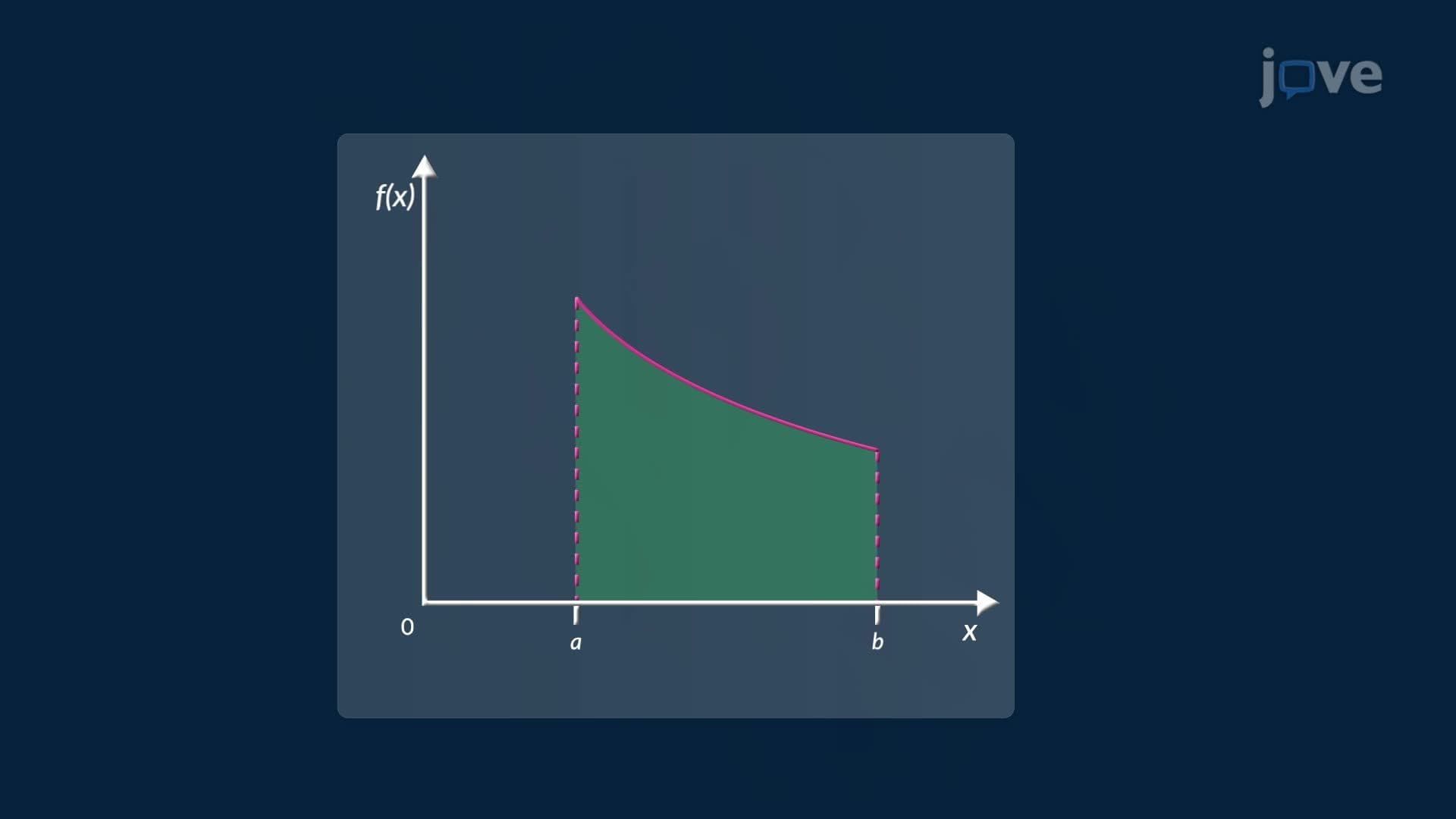
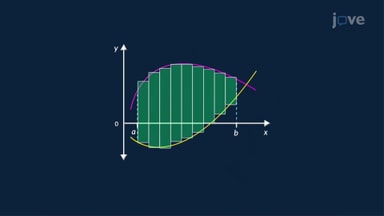
When velocity changes over time, the velocity-time graph becomes a curve rather than a flat line. The area under that curve represents the total distance traveled — but calculating it precisely requires a clever strategy. The distance problem introduces Riemann sums, a method of dividing the time interval into smaller sub-intervals and approximating the distance covered in each one using rectangle areas.
Two standard estimates are used. The lower sum uses the velocity at the left endpoint of each sub-interval — typically the slower speed at the start — giving a conservative underestimate. The upper sum uses the right endpoint velocity — typically the faster speed — producing an overestimate. The true distance lies between these two values. For example, if a runner's velocity is sampled every half-second over three seconds, the lower and upper sums might yield 10.55 meters and 13.65 meters respectively, bracketing the actual distance traveled.
The accuracy of any Riemann sum approximation depends directly on how many sub-intervals are used. With only a few wide rectangles, the approximation can be quite rough. As the number of intervals increases — and each rectangle becomes narrower — the upper and lower sums converge toward the same value. In the limit, with infinitely many infinitesimally thin rectangles, the sum becomes exact. This limiting process defines the definite integral of velocity over time, written as the integral of v(t) from t = a to t = b, and it equals the precise total distance traveled.
The distance problem is a critical topic in AP Calculus AB and BC, where students are tested on interpreting area under curves, evaluating Riemann sums, and applying the Fundamental Theorem of Calculus. College-level Calculus I courses at US universities — from community colleges to four-year institutions — use the distance problem as the primary motivation for introducing definite integrals. Students learn that antiderivatives are not just algebraic tools; they are the key to unlocking exact area calculations.
On the AP exam, free-response questions frequently present a table of velocity values and ask students to estimate distance using left, right, or midpoint Riemann sums. Understanding the distance problem deeply — not just procedurally — allows students to interpret results, justify approximations, and connect numerical methods to analytical solutions. Mastery here builds directly into broader integral topics including properties of integrals, indefinite integrals, and applications like work, area between curves, and accumulation functions.
Frequently Asked Questions
The distance problem is a calculus concept that determines how far an object has traveled when its velocity changes over time. Instead of a simple multiplication, it requires summing up many small displacement estimates across short time intervals. This process leads directly to the idea of the definite integral as the area under a velocity-time curve. It is one of the most intuitive entry points into integral calculus. ---
The lower sum uses the minimum velocity in each time interval — typically the left endpoint for increasing velocity — to produce an underestimate of total distance. The upper sum uses the maximum velocity — typically the right endpoint — to produce an overestimate. Together, they bracket the true distance. As the number of intervals increases, both sums converge to the same value: the exact definite integral. ---
The AP Calculus AB exam regularly includes free-response and multiple-choice questions involving Riemann sums based on velocity data tables. Students may be asked to compute a left-endpoint or right-endpoint approximation for total distance and then compare it to the exact integral. Understanding why the approximation over- or underestimates — based on whether the function is increasing or decreasing — is frequently tested. Practicing these problems builds both computational skill and conceptual reasoning. ---
Yes, the distance problem is foundational to both AP Calculus AB and BC. In BC, the concept extends further into topics like parametric equations and vector-valued functions, where distance is calculated along a curved path rather than a straight line. The core logic — using integrals to accumulate small changes — remains identical. Mastering the basics in AB makes the BC extensions significantly easier to navigate. ---
GPS navigation systems used in US vehicles continuously estimate distance traveled by sampling speed at frequent time intervals — essentially solving the distance problem in real time. NASA engineers use the same integral-based approach to calculate spacecraft trajectories, and sports scientists at US universities use motion-capture data to analyze athlete performance. Anywhere velocity data is collected over time, the distance problem framework applies. ---
A solid understanding of algebra and basic graphing is enough to get started with the distance problem. Familiarity with the concept of velocity and how to read a velocity-time graph is helpful but not required going in. The Riemann sum method — the core technique — is built up step by step, making it accessible to students in late high school or early college. Comfort with summation notation develops naturally as you work through examples. ---
Start by practicing Riemann sum calculations using velocity data tables, since this format appears frequently on AP Calculus free-response questions and college midterms. Sketch the velocity-time graph for each problem and shade the rectangles to build visual intuition. Then work backward from the definite integral to verify your approximations. Alternating between numerical estimation and exact integral evaluation is the most effective study strategy for long-term retention. ---
After the distance problem, the natural next steps are the Fundamental Theorem of Calculus, which formalizes the connection between derivatives and integrals, and antiderivatives, which allow you to compute exact integrals analytically. From there, exploring the properties of definite integrals — such as linearity and interval splitting — and the difference between definite and indefinite integrals will round out your understanding of integral calculus and prepare you for more advanced applications.
Area Between Curves: Integrating With Respect to x explores a complementary area of Calculus, while Distance Problem focuses on the specific concept covered in this video. Understanding both helps you build a stronger foundation in Calculus.
A basic understanding of Area Problem is helpful before diving into Distance Problem. If you are starting from scratch, the Integrals series builds knowledge progressively, so beginning from the first video requires no prior background in Calculus.
The ideas in Distance Problem show up in everyday Calculus contexts, often alongside concepts like Arc Length of a Curve. This video connects the theory to practical situations you may encounter in coursework or exams.
After Distance Problem, the natural next step is Definite Integral in the Integrals series. Following the playlist in order helps concepts build on each other without gaps.
The Distance Problem video runs for 1 minute, so you can cover the core concept in a single focused study session without needing a long block of time.
Related Micro-courses

Related Subjects