Loading video…


 12 Concepts
 3.6K views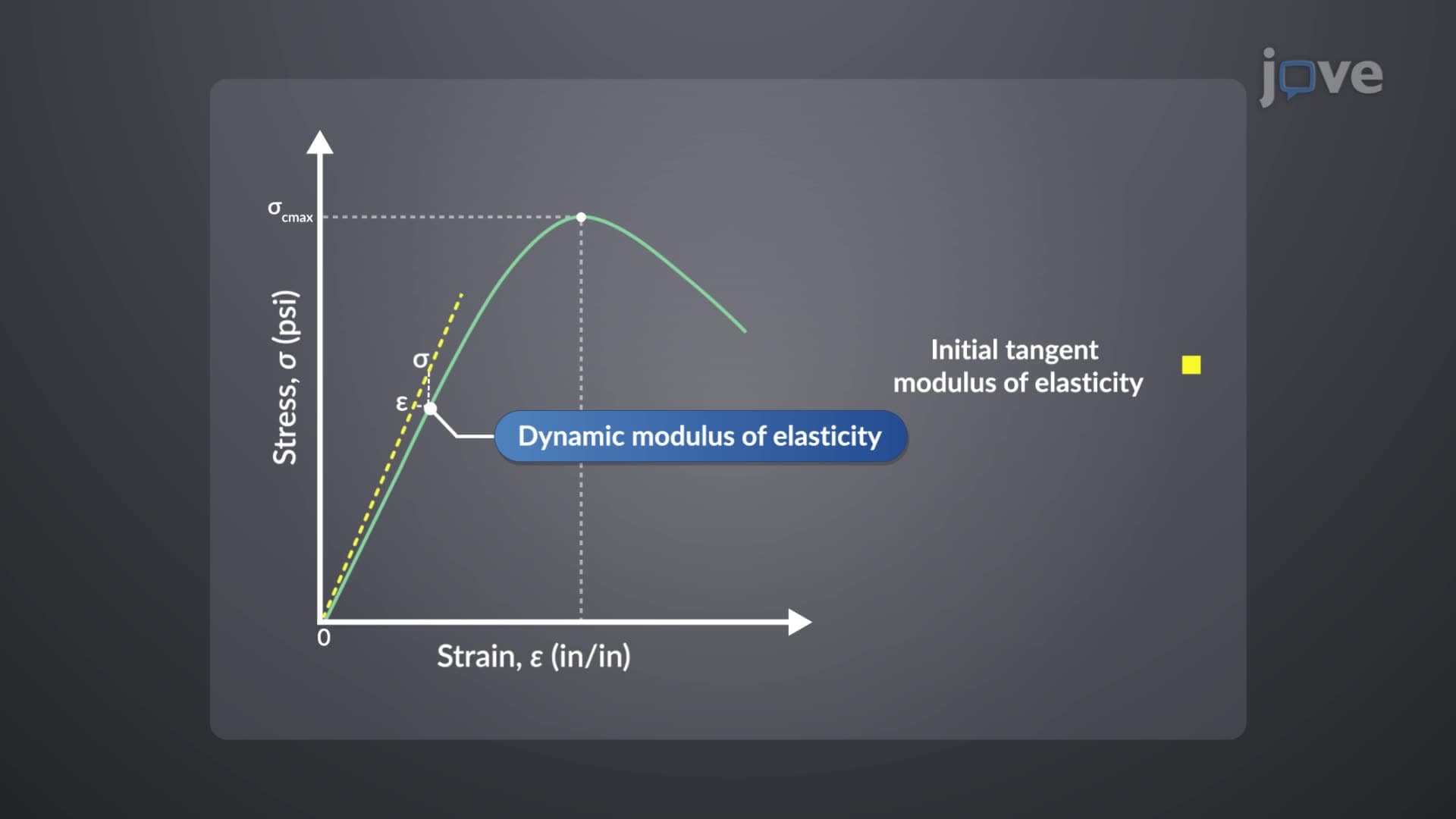

Video Summary: Dynamic Modulus of Elasticity of Concrete Explained
Why can San Francisco's Golden Gate Bridge withstand earthquakes while a sidewalk crack spreads under foot traffic? The answer lies in understanding the dynamic modulus of elasticity of concrete, a critical property that measures how concrete responds to rapidly changing forces versus static loads. This concept explains why engineers use different calculations for structures experiencing vibrations, impacts, or seismic activity compared to steady loads. Watch the full video on JoVE Coach to master this concept with expert-led visuals and step-by-step explanations.
The dynamic modulus of elasticity of concrete represents a fundamental material property that governs how concrete structures respond to rapidly applied loads, vibrations, and impact forces. Unlike static modulus, which measures resistance to slowly applied constant loads, dynamic modulus captures concrete's behavior under time-varying stresses typical in real-world applications like traffic loading on highway bridges, seismic events, and machinery vibrations in industrial buildings.
This distinction proves crucial for American infrastructure projects. Consider the Interstate Highway System, where bridge decks experience millions of vehicle load cycles annually. Engineers must account for dynamic effects when designing these structures, as the concrete's apparent stiffness increases under rapid loading conditions compared to laboratory static tests.
The primary testing approach employs sonic resonance techniques using standardized concrete beam specimens. The setup involves clamping a concrete beam at its center point while connecting electromagnetic exciters and vibration sensors to opposite ends. When the exciter generates variable frequency vibrations, the beam reaches resonance at its fundamental frequency, creating maximum deflection readings on detection equipment.
This non-destructive testing method offers significant advantages for quality control in construction projects across the United States. Major concrete producers like Cemex and LafargeHolcim routinely use sonic testing to verify material properties before shipping to construction sites, ensuring compliance with American Concrete Institute (ACI) standards.
The dynamic modulus calculation incorporates the fundamental resonance frequency, beam geometry, and concrete density through established engineering formulas. Higher frequency readings indicate stiffer concrete with greater dynamic modulus values, typically 20-40% higher than corresponding static measurements.
This property becomes particularly relevant for students preparing for Advanced Placement Physics or engineering coursework, where understanding wave propagation through solid materials connects to broader concepts in mechanics and materials science. Civil engineering programs at universities like MIT and Stanford emphasize these principles in structural dynamics courses, preparing students for professional practice in earthquake-prone regions.
Engineers also estimate dynamic modulus using initial tangent slope measurements from concrete stress-strain curves. This graphical method involves drawing a tangent line at the curve's origin and calculating its slope, providing approximate dynamic modulus values without specialized testing equipment.
Related Micro-courses