Loading subject page…


3,374 views

Video Summary: Properties of Fourier Series I Explained
Did you know that the same mathematical principles powering your FM radio also enable advanced medical imaging at hospitals like Mayo Clinic? Properties of Fourier Series II reveal how signals maintain their essential characteristics even when shifted, reversed, or combined-creating the foundation for everything from radio broadcasting to MRI technology. These advanced properties, including time-shifting preservation and symmetry relationships, demonstrate why Fourier analysis remains crucial in modern engineering applications. Watch the full video on JoVE Coach to master this concept with expert-led visuals and step-by-step explanations.
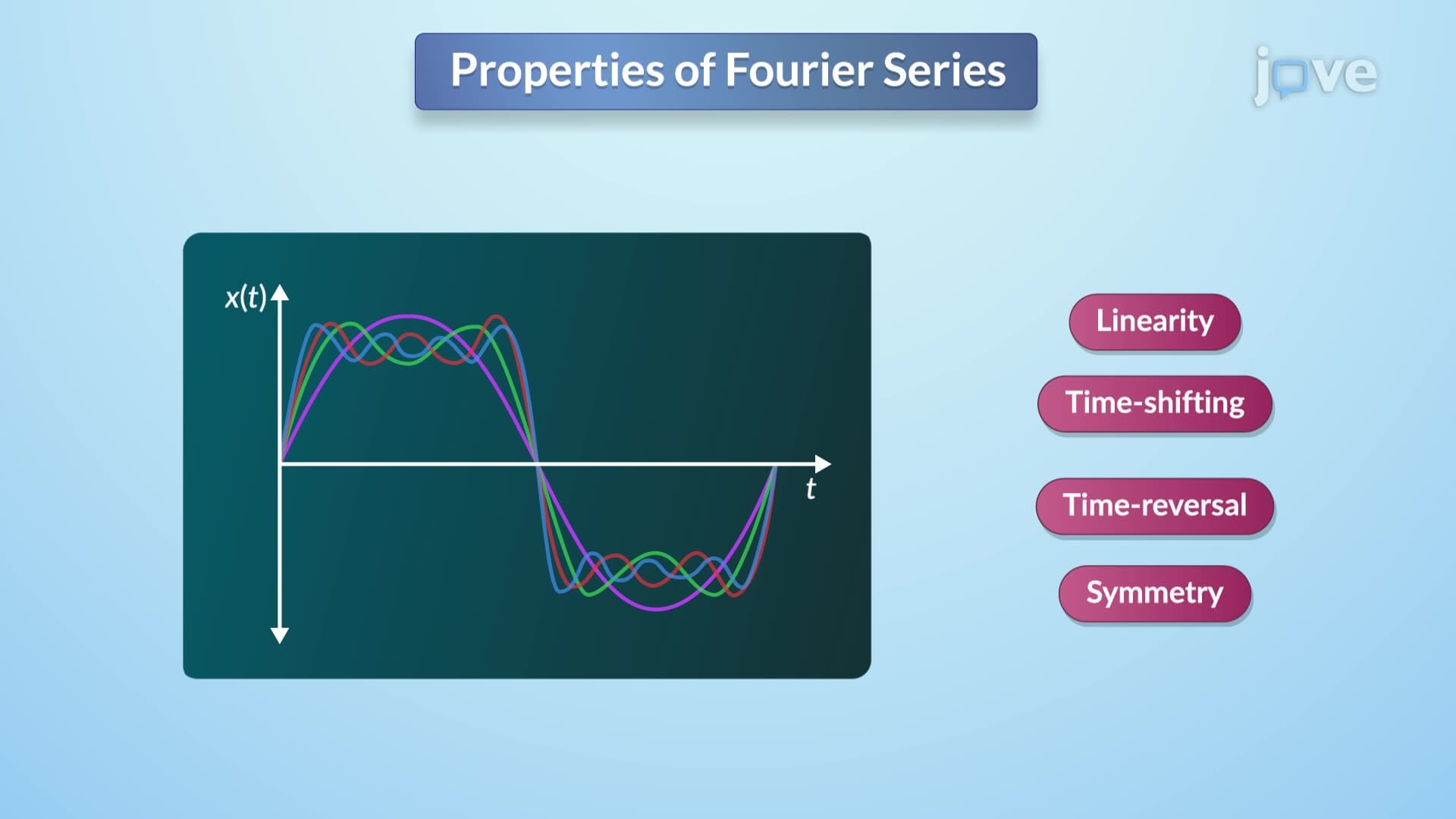
The Properties of Fourier Series II encompass advanced characteristics that make Fourier analysis indispensable in engineering and physics applications. These properties-linearity, time-shifting, time-reversal, and symmetry-form the mathematical backbone of modern signal processing systems used throughout American industries, from telecommunications to medical imaging.
The linearity property represents one of the most powerful aspects of Fourier analysis. When engineers at companies like Texas Instruments combine multiple periodic signals, the resulting Fourier coefficients follow a predictable linear relationship. If signal x(t) has coefficients a(k) and signal y(t) has coefficients b(k), then the combined signal [c₁x(t) + c₂y(t)] will have coefficients [c₁a(k) + c₂b(k)]. This principle enables complex signal processing applications, from mixing audio tracks in recording studios to combining data streams in cellular networks.
Time-shifting properties reveal a fascinating characteristic: when a periodic signal shifts in time, the magnitude of its Fourier coefficients remains unchanged. This property proves essential in FM radio systems across the United States, where signals must maintain quality despite timing variations during transmission. The phase information changes, but the fundamental frequency content-what determines signal clarity-stays constant. This principle appears frequently on AP Physics C exams and college-level signals and systems courses.
Even and odd symmetry properties create predictable patterns in Fourier coefficients. Even symmetric signals produce even symmetric coefficients, while odd symmetric signals yield odd symmetric coefficients. These relationships simplify calculations significantly and appear in various forms on standardized tests. For example, when analyzing power grid harmonics at utility companies like Pacific Gas & Electric, engineers leverage these symmetry properties to predict system behavior and optimize performance.
Understanding these advanced properties prepares students for success in electrical engineering programs at institutions like MIT, Stanford, and UC Berkeley, where Fourier analysis forms the foundation for advanced coursework in communications, control systems, and digital signal processing.
Related Micro-courses