Loading…
Loading video…

1,459 views
Ever wondered how electricity travels from towering transmission lines to the transformer outside your home? Secondary distribution serves as the critical final link, stepping down high voltage to the 120V-240V levels that power everyday appliances in American households. Unlike primary distribution systems that handle thousands of volts, secondary distribution operates at much lower, safer voltages—similar to how Pacific Gas & Electric delivers power to San Francisco neighborhoods. Watch the full video on JoVE Coach to master this concept with expert-led visuals and step-by-step explanations.
Primary distribution represents the intermediate stage of electrical power delivery, bridging the gap between high-voltage transmission networks and low-voltage secondary distribution systems. While secondary distribution delivers electricity directly to end users at household voltages (120V-240V), primary distribution operates at medium voltages typically ranging from 4kV to 35kV across American utility networks.
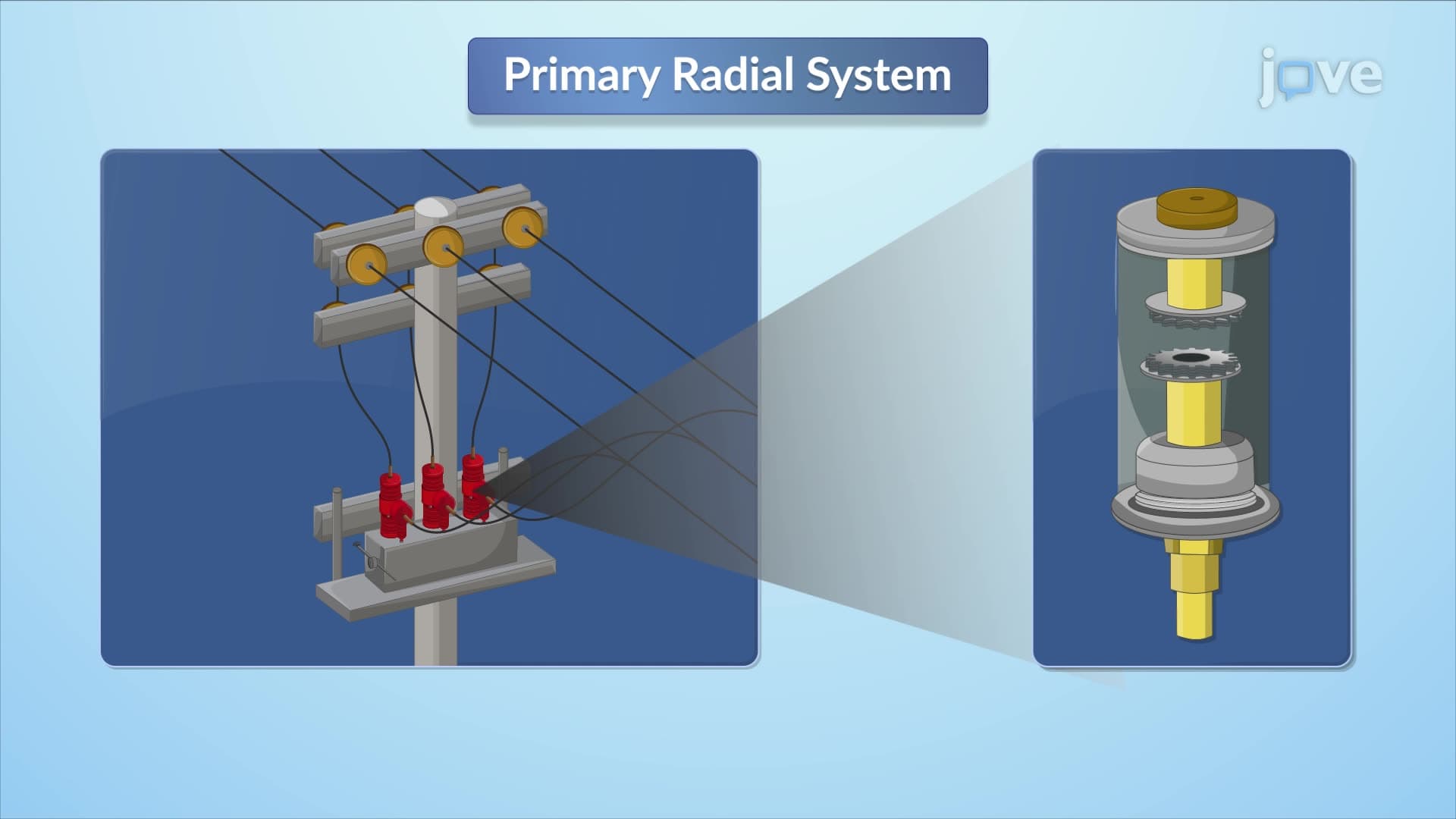
The primary radial system dominates rural and suburban areas across the United States, particularly in regions served by utilities like Georgia Power or Duke Energy. This configuration features individual three-phase feeder mains extending outward from distribution substations like branches of a tree. The system's simplicity makes it cost-effective for low-load density areas, though it offers limited redundancy. When lightning strikes or equipment failures occur, automatic reclosing devices provide first-line protection by momentarily opening circuits during faults, then attempting to restore service—a process familiar to anyone who's experienced brief power flickers during thunderstorms.
High-reliability applications, such as hospitals or data centers, often rely on primary loop systems that create circular pathways back to the distribution substation. This design ensures dual-feed capability, meaning power can flow from either direction if one section fails. Major metropolitan areas like New York City utilize sophisticated primary network systems featuring interconnected grids of feeders supplied from multiple substations. These networks incorporate unit substations strategically placed throughout high-density areas, replacing traditional distribution infrastructure with more flexible, localized solutions.
Modern primary distribution systems employ sophisticated protection schemes crucial for maintaining service reliability. Sectionalizing fuses provide automatic isolation of faulted sections, while shunt capacitor banks maintain voltage stability during varying load conditions—concepts frequently tested on electrical engineering PE exams and college power systems courses. Understanding these protection mechanisms helps explain why some neighborhoods experience shorter outages than others during severe weather events affecting utility companies like ConEd or Southern California Edison.
Frequently Asked Questions
Primary distribution operates at medium voltages (4kV-35kV) between transmission lines and end users, while secondary distribution delivers lower voltages (120V-240V) directly to homes and businesses. Primary distribution systems include radial, loop, and network configurations designed for different reliability and load requirements. This distinction is fundamental for understanding electrical power delivery systems.
Secondary distribution definition encompasses the final voltage transformation stage that converts primary distribution voltages to usable household levels. Secondary systems typically operate below 1000V and include the familiar residential service drops and commercial building feeders. The boundary between primary and secondary distribution occurs at distribution transformers.
Exam questions typically focus on system configuration selection based on load density and reliability requirements, fault protection device operation, and voltage regulation calculations. Students should understand when to apply radial versus loop versus network systems for different scenarios. Practice problems often involve fault current calculations and protection coordination studies.
AP Physics C: Electricity and Magnetism touches on electrical power concepts, though primary distribution is more commonly covered in college-level electrical engineering courses. High school students encounter related concepts in AP Environmental Science when studying electrical grid efficiency and renewable energy integration. Advanced placement credit can help students skip introductory college physics courses covering these topics.
Consolidated Edison uses network primary distribution throughout Manhattan's high-density areas, providing exceptional reliability for critical loads like hospitals and financial centers. Rural areas served by companies like Georgia Power rely primarily on radial systems due to lower load densities and cost considerations. Load forecasting and system planning determine optimal configurations for each service area.
The basic concepts are accessible to high school students with solid algebra and basic physics knowledge. Focus on understanding system purposes rather than complex calculations initially—think of primary distribution like highway systems feeding neighborhood streets. Visual diagrams and real-world examples make these concepts much more approachable for beginners.
Create system comparison charts highlighting radial, loop, and network advantages and applications. Practice identifying appropriate system types for different scenarios (rural farm, city hospital, suburban neighborhood). Use utility company websites to find real examples of distribution systems in your area for concrete context.
Advanced students should investigate smart grid technologies, distributed energy resources integration, and power quality analysis. Topics like voltage regulation, load forecasting, and protection coordination provide deeper understanding of modern electrical distribution systems. These concepts bridge into power systems analysis and renewable energy integration studies.
Related Micro-courses


Related Subjects
 Civil Engineering 30 micro-courses›Mechanical Engineering 28 micro-courses›