Loading subject page…


1,731 views

Video Summary: Special Cases in Common Stock Valuation Part Ii
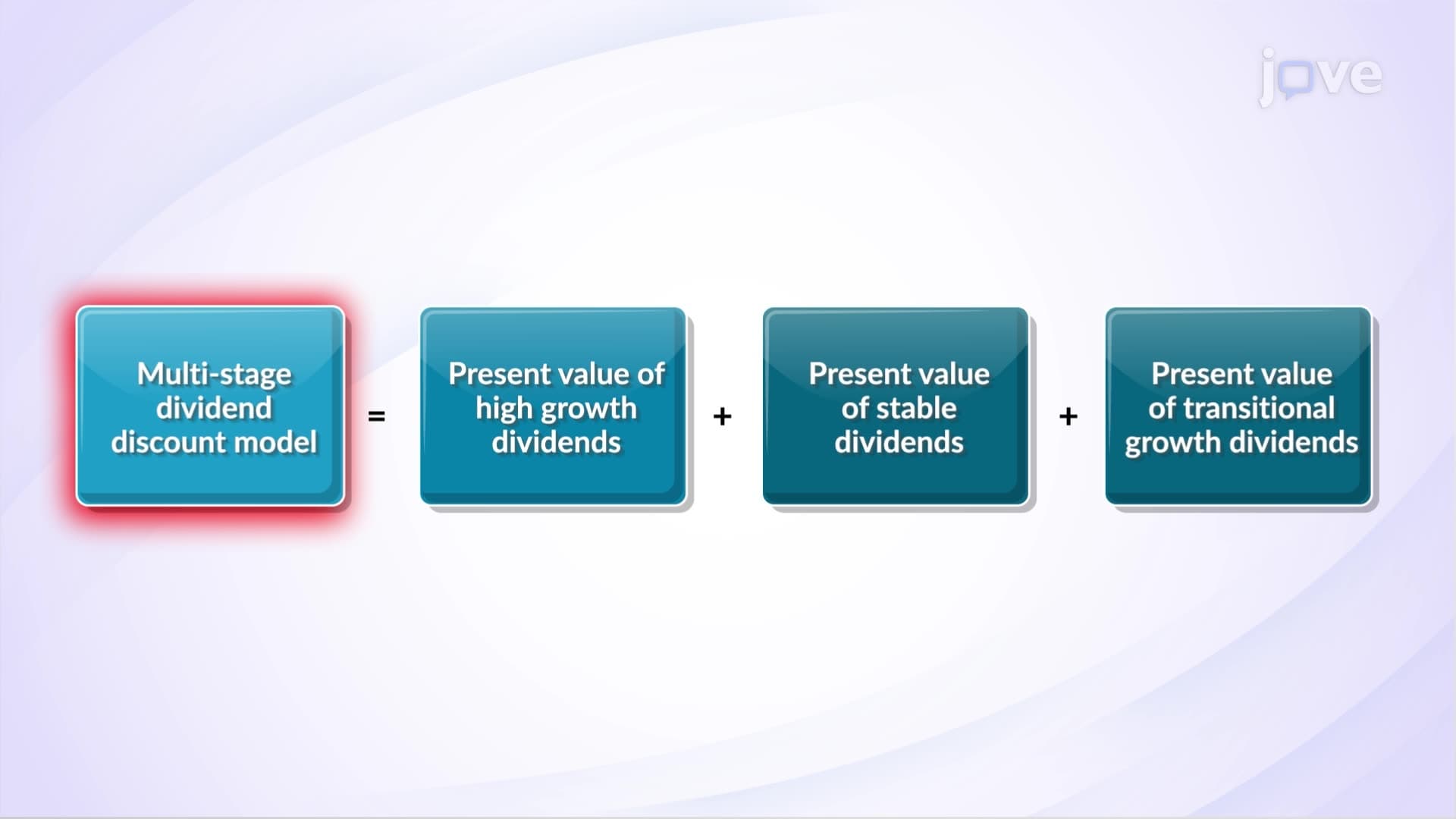
Special cases in common stock valuation become critical when evaluating high-growth companies like Tesla or Amazon that experience distinct phases of expansion and maturity. Traditional single-stage models fail to capture the complex dividend patterns these firms exhibit as they transition from rapid growth to stable operations. The Multi-Stage Dividend Discount Model addresses these valuation challenges by segmenting growth into high-growth, transitional, and stable phases, providing investment professionals with more accurate intrinsic value calculations. Watch the full video on JoVE Coach to master this concept with expert-led visuals and step-by-step explanations.
Investment professionals frequently encounter companies that don't fit traditional valuation models. Consider Netflix's evolution from a DVD rental service to a streaming giant, then to a mature content producer-each phase required different growth assumptions and valuation approaches. Special cases in common stock valuation address these complex scenarios where companies experience distinct growth phases that significantly impact their dividend-paying capacity and stock value.
The Multi-Stage Dividend Discount Model provides a sophisticated approach for valuing companies with variable growth patterns. This methodology recognizes that high-growth companies like Apple or Microsoft typically progress through three distinct phases: an initial high-growth period driven by market expansion and innovation, a transitional phase where growth moderates due to increased competition or market saturation, and finally a stable maturity phase with predictable dividend patterns.
Professional analysts use this framework when evaluating technology companies, biotech firms, or emerging market leaders that demonstrate clear lifecycle patterns. The model's strength lies in its ability to capture the economic reality that no company can maintain extraordinary growth indefinitely-market forces, competition, and resource constraints eventually normalize growth rates.
When applying multi-stage valuation models, investment committees must carefully calibrate growth assumptions based on industry analysis, competitive dynamics, and macroeconomic factors. For instance, evaluating a company like Zoom during its rapid expansion phase requires different growth projections than assessing a mature utility company like Consolidated Edison.
The transitional phase proves most challenging to model, as it requires predicting when and how quickly growth will decelerate. Professional analysts examine factors such as market penetration rates, competitive threats, regulatory changes, and management's capital allocation strategies to determine appropriate transition timing and magnitude.
Portfolio managers leverage multi-stage models when constructing growth-oriented investment strategies or evaluating merger and acquisition opportunities. The methodology proves particularly valuable when presenting investment cases to institutional clients or board members, as it provides a more nuanced and defensible valuation framework than simplified single-stage approaches. This comprehensive analysis helps investment professionals identify undervalued opportunities while managing downside risk through more accurate intrinsic value calculations.
Related Micro-courses