Loading subject page…

- Introduction to Psychology
- Thinking, Language and Intelligence
- Creative Thinking
Micro-course: Thinking, Language And Intelligence
54,049 views
Learn key concepts and earn your certificate.













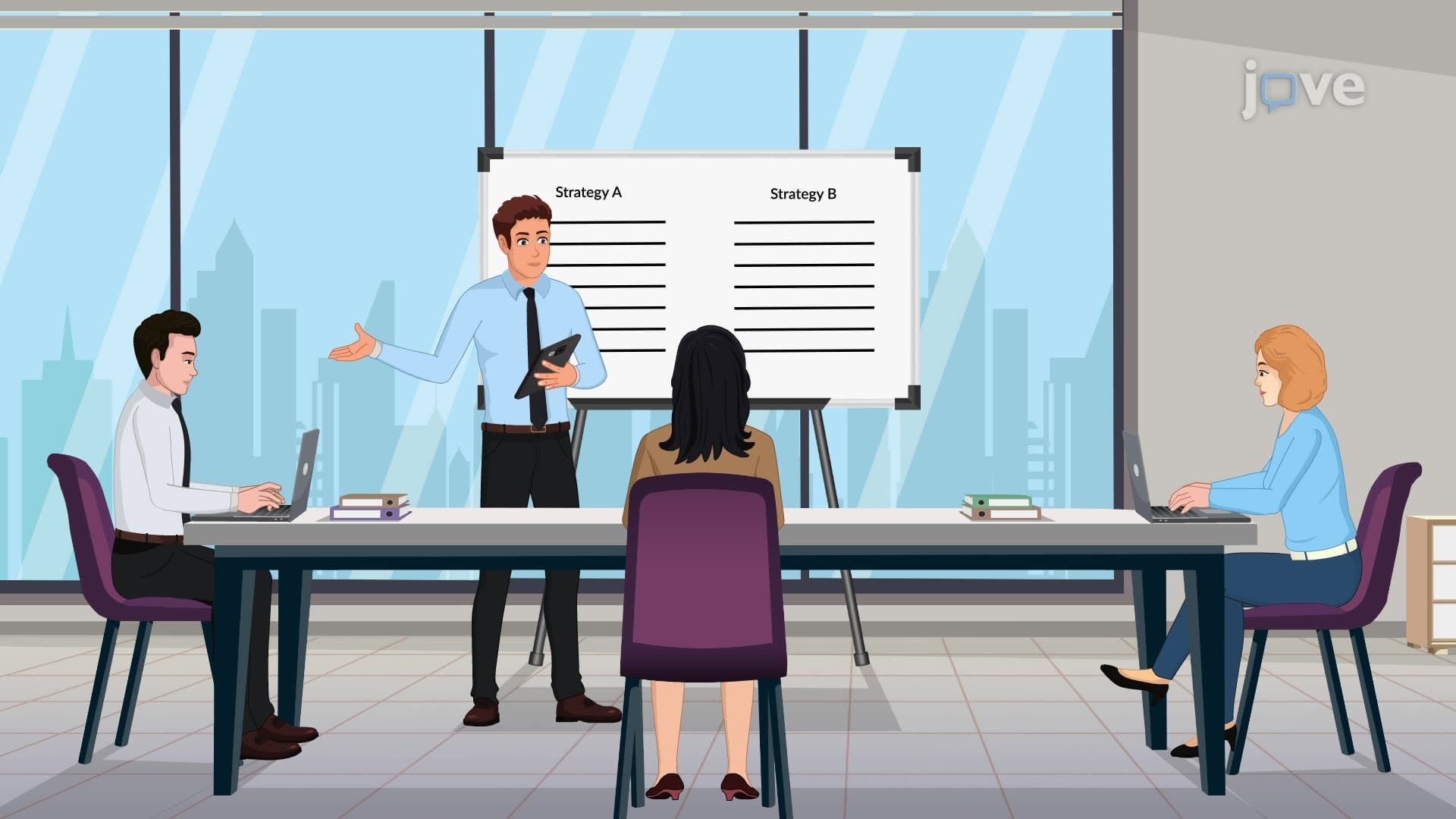






Creative Thinking

00:00
01:25
Video Summary: What Is Creative Thinking
Did you know that intelligence isn't just about memorizing facts-it's also about generating innovative solutions? Creative thinking represents a crucial component of intelligence that combines generating multiple ideas with selecting the best one. Consider how Apple revolutionized smartphones not by making bigger batteries, but by creating more energy-efficient processors. What is creative thinking involves both divergent thinking (brainstorming many solutions) and convergent thinking (choosing the optimal approach). Watch the full video on JoVE Coach to master this concept with expert-led visuals and step-by-step explanations.
- Understand what is creative thinking and how it relates to overall intelligence and problem-solving abilities
- Identify the two primary components of creative thinking: divergent and convergent thinking processes
- Analyze how divergent thinking generates multiple creative solutions during brainstorming and ideation phases
- Compare convergent thinking's role in evaluating and selecting the single best solution from available options
- Evaluate real-world examples of creative thinking in technology, business, and everyday problem-solving scenarios
- Apply both divergent and convergent thinking strategies to tackle complex academic and personal challenges
- Recognize the cyclical relationship between generating ideas and refining them into practical solutions
- Explore how creative thinking skills enhance academic performance and career readiness across disciplines
Understanding Creative Thinking as a Component of Intelligence
Creative thinking represents a fundamental aspect of intelligence that goes beyond traditional analytical reasoning. The intelligence definition encompasses multiple cognitive abilities, including the capacity to generate novel solutions and adapt thinking patterns to new challenges. When exploring what is intelligence in detail, creative thinking emerges as a critical component that distinguishes highly intelligent individuals from those who simply excel at memorization or routine problem-solving.
This intelligence overview reveals that creative thinking operates through two complementary cognitive processes that work together to produce innovative outcomes. Understanding these mechanisms provides valuable intelligence basics for students preparing for advanced coursework and standardized assessments.
Divergent Thinking: Expanding Possibilities
Divergent thinking forms the generative phase of creative problem-solving, where the mind explores multiple pathways simultaneously. This process exemplifies key intelligence concepts by demonstrating cognitive flexibility and original idea generation. During divergent thinking, individuals suspend judgment and allow unconventional connections to emerge.
For example, when NASA engineers faced the challenge of removing carbon dioxide from Apollo 13's damaged spacecraft, they used divergent thinking to brainstorm solutions using only materials available on board. This real-world application demonstrates how divergent thinking can literally save lives when conventional approaches fail.
Students encounter divergent thinking requirements on AP Psychology exams, SAT essay sections, and college admissions essays that ask for creative problem-solving approaches. The process involves fluency (generating many ideas), flexibility (switching between different types of ideas), originality (producing unique solutions), and elaboration (developing ideas in detail).
Convergent Thinking: Refining Solutions
Convergent thinking represents the evaluative phase where multiple possibilities narrow down to optimal solutions. This intelligence study guide component involves analytical skills, critical evaluation, and practical judgment. Unlike divergent thinking's expansive nature, convergent thinking applies logical criteria to select the most effective approach.
Consider how medical professionals in US hospitals use convergent thinking during diagnosis. After considering multiple potential conditions (divergent thinking), they systematically eliminate possibilities using test results, symptoms, and medical history to reach accurate diagnoses. This process appears frequently on MCAT questions that require students to analyze complex clinical scenarios.
Integration and Practical Applications
Understanding intelligence requires recognizing how divergent and convergent thinking work together cyclically. Creative thinkers don't simply choose between these approaches-they alternate between expansion and evaluation phases throughout problem-solving processes.
This integration appears across academic disciplines and standardized assessments. AP English students use divergent thinking to brainstorm essay themes, then apply convergent thinking to select the strongest arguments. Similarly, college engineering students generate multiple design concepts before converging on feasible solutions that meet specific constraints.
The intelligence concept extends beyond academic settings into career preparation. Employers increasingly value creative thinking skills, recognizing that tomorrow's challenges require both innovative idea generation and practical implementation abilities.
Frequently Asked Questions
Creative thinking is a cognitive process that generates innovative solutions through both idea expansion and evaluation phases. Unlike routine thinking that follows established patterns, creative thinking deliberately seeks novel approaches and unconventional connections. It combines divergent thinking (generating multiple possibilities) with convergent thinking (selecting optimal solutions) to solve problems innovatively.
Intelligence encompasses creative thinking as a core component alongside analytical and practical abilities. Creative intelligence involves cognitive flexibility, originality, fluency in idea generation, and the ability to elaborate on concepts. It represents the capacity to think beyond conventional boundaries while maintaining practical effectiveness in problem-solving situations.
AP Psychology exams frequently include questions about divergent and convergent thinking processes, often through multiple-choice scenarios or free-response questions. Students must identify examples of each thinking type, explain their roles in problem-solving, and analyze how they contribute to creativity. Questions may reference famous creativity researchers like J.P. Guilford or present real-world creative thinking applications.
MCAT questions often test creative thinking through scenarios requiring innovative problem-solving approaches in scientific contexts. Critical Analysis and Reasoning sections may present passages about creative processes, while Psychological, Social, and Biological Foundations sections include questions about cognitive flexibility, divergent thinking, and creative problem-solving in medical or research settings.
American companies like Google, Apple, and Tesla rely heavily on creative thinking for product development and problem-solving. Marketing teams use divergent thinking during campaign brainstorming, then apply convergent thinking to select the most effective strategies. Engineers at companies like SpaceX use creative thinking to develop innovative solutions for space exploration challenges, combining multiple idea generation with rigorous evaluation processes.
Creative thinking concepts require no advanced mathematical or scientific prerequisites-they're accessible to all high school students. The principles apply across all academic disciplines, from arts and literature to STEM fields. Understanding creative thinking actually enhances performance in various subjects by providing flexible problem-solving approaches.
Practice identifying divergent and convergent thinking examples in different contexts, create concept maps connecting creative thinking to intelligence theories, and work through sample scenarios requiring both types of thinking. Focus on understanding the cyclical relationship between idea generation and evaluation rather than memorizing definitions alone.
Explore related intelligence concepts like analytical thinking, practical intelligence, and emotional intelligence to build comprehensive understanding. Study famous creativity researchers like Howard Gardner's multiple intelligence theory or Robert Sternberg's triarchic theory of intelligence, which provide broader contexts for creative thinking applications.
Related Micro-courses