Loading subject page…


16,515 views


Video Summary: Free Body Diagrams Problem Solving Guide
Ever wonder why a sled speeds up on some hills but slows down on others? Free body diagrams problem solving reveals the hidden forces at play in everyday motion. Take a 10 kg block sliding down a 30-degree ramp with friction-engineers use this exact scenario when designing ski slopes at Colorado's Vail Resort. This Free Body Diagrams Problem Solving Guide demonstrates how to identify forces, resolve components using trigonometry, and apply Newton's laws to calculate acceleration. Watch the full video on JoVE Coach to master this concept with expert-led visuals and step-by-step explanations.
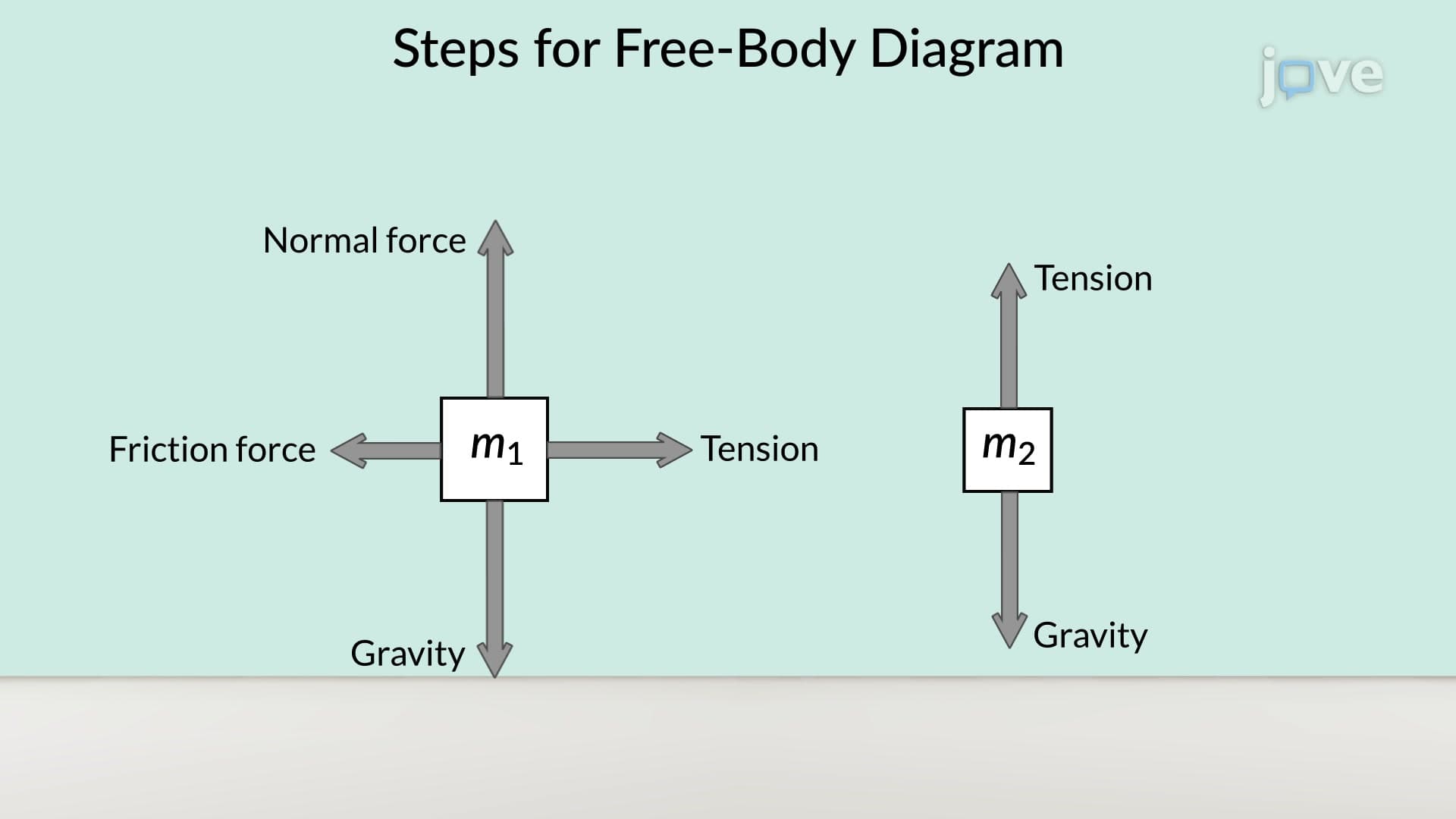
Free body diagrams problem solving forms the cornerstone of mechanics in high school physics and college engineering courses. This systematic approach transforms complex motion scenarios into manageable mathematical problems by isolating and analyzing individual forces.
The foundation of effective problem solving begins with identifying three critical forces: gravitational weight (mg), normal force (N), and friction force (f). For inclined planes, weight resolution becomes crucial. The weight component parallel to the slope equals mg sin θ, while the perpendicular component equals mg cos θ. This trigonometric breakdown appears frequently on AP Physics exams and college midterms, making mastery essential for academic success.
Understanding normal force relationships proves vital for engineering applications. On inclined surfaces, the normal force equals the perpendicular weight component: N = mg cos θ. Friction force follows the relationship f = μN, where μ represents the coefficient of friction. This concept applies directly to real-world scenarios like calculating braking distances on San Francisco's steep streets or designing conveyor belt systems in manufacturing plants.
The net force calculation requires careful attention to force directions. For objects sliding down inclined planes, the net force equals the parallel weight component minus friction: F(net) = mg sin θ - μmg cos θ. Applying Newton's second law (F = ma) yields acceleration: a = g(sin θ - μ cos θ). This formula appears in countless physics problems and serves as a foundation for more advanced dynamics concepts in college-level courses.
Engineering students at institutions like MIT and Stanford regularly encounter variations of this problem when analyzing structural loads, vehicle dynamics, and mechanical system design. The problem-solving methodology transfers directly to professional applications in aerospace, civil, and mechanical engineering fields.
Related Micro-courses