Loading subject page…


16,515 views

Video Summary: Steps for Free Body Diagram Guide
Ever wonder how NASA engineers calculate the forces on a rocket during launch? The steps for free body diagram provide the foundation for solving complex physics problems by systematically identifying and analyzing forces. This essential physics technique helps students understand everything from elevator mechanics in skyscrapers to the tension in suspension bridge cables like San Francisco's Golden Gate Bridge. Watch the full video on JoVE Coach to master this concept with expert-led visuals and step-by-step explanations.
The steps for free body diagram form the cornerstone of mechanical problem-solving in physics. These systematic steps transform complex real-world scenarios into manageable mathematical representations. Whether you're analyzing the forces on an elevator in the Empire State Building or studying the mechanics of a construction crane, free body diagrams provide the visual framework needed to solve force problems accurately.
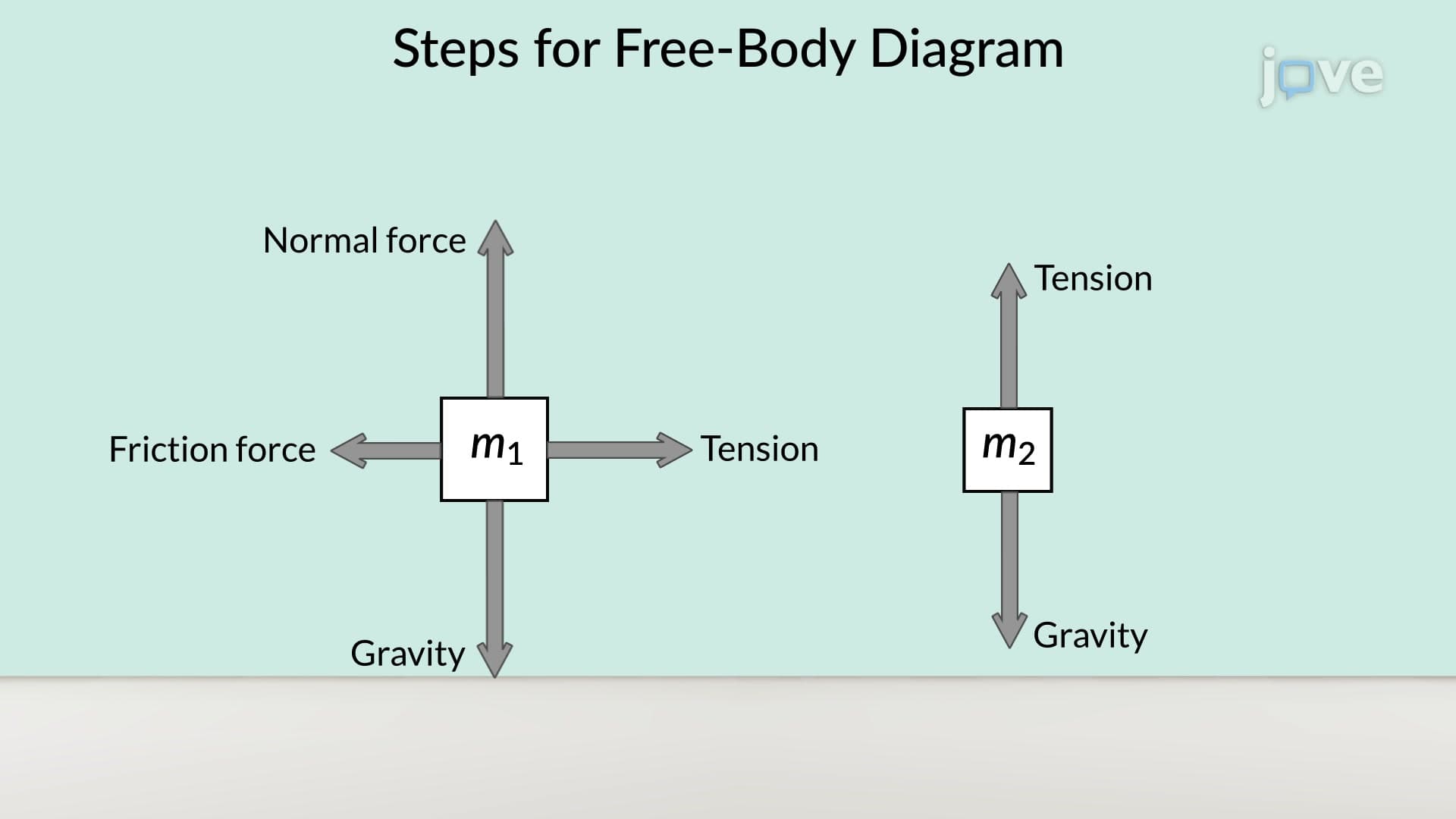
The first crucial step involves isolating each object in the system and identifying all external forces. In the classic pulley problem, this means separating the two blocks and examining each independently. For the block on the table, we identify four distinct forces: gravitational weight (mg) acting downward, normal force (N) from the table acting upward, tension force (T) from the string pulling horizontally, and kinetic friction (f) opposing the motion. The hanging block experiences only two forces: its weight pulling downward and tension pulling upward. This systematic identification prevents common errors that plague students on AP Physics exams and college midterms.
Proper vector representation distinguishes successful physics students from those who struggle. Each force must be drawn as an arrow with appropriate direction and relative magnitude. The weight vectors always point toward Earth's center, normal forces perpendicular to contact surfaces, and tension forces along the string direction. This visual clarity becomes essential when solving problems on standardized tests like the SAT Subject Test in Physics or MCAT physics sections.
Once forces are properly identified and drawn, Newton's second law (F = ma) applies to each object separately. For the table block: T - f = m₁a, where friction opposes motion. For the hanging block: m₂g - T = m₂a, where weight exceeds tension for downward acceleration. These equations connect algebraically since both blocks share the same acceleration magnitude due to the inextensible string constraint. Solving simultaneously yields the system acceleration: a = (m₂g - μm₁g)/(m₁ + m₂), where μ represents the friction coefficient.
Related Micro-courses