Loading video…


 6 Concepts
 16.5K views

Video Summary: What are Categories of Equilibrium
Ever wondered why a suspension bridge doesn't collapse under thousands of cars, or how a construction crane balances massive steel beams? The answer lies in understanding categories of equilibrium, the fundamental ways forces can act on objects to maintain balance. From the Golden Gate Bridge's cable tensions to a simple tug-of-war game, engineers classify equilibrium into three distinct force systems: collinear, coplanar concurrent, and coplanar non-concurrent forces. Watch the full video on JoVE Coach to master this concept with expert-led visuals and step-by-step explanations.
Categories of equilibrium represent the systematic classification of how forces interact to maintain balance in physical systems. This fundamental concept bridges theoretical physics with practical engineering applications, from designing skyscrapers to analyzing biomechanical forces in the human body.
Collinear equilibrium occurs when all forces act along the same straight line. The classic example is a tug-of-war between two equally matched teams, the rope experiences equal and opposite forces that cancel out, resulting in zero net force. In engineering, this principle applies to tension cables in suspension bridges like the Verrazano-Narrows Bridge in New York, where cable tensions must balance perfectly to support the roadway.
For collinear equilibrium, the mathematical condition is straightforward: ΣF = 0, meaning the sum of all forces equals zero. Students preparing for AP Physics or college-level statics courses must master this concept as it forms the foundation for more complex equilibrium analysis.
When multiple forces act on an object but all meet at a single point within the same plane, we have coplanar concurrent equilibrium. Think of the forces acting on a traffic light suspended at an intersection, the weight of the light, tension in the support cables, and wind forces all converge at the mounting point.
For equilibrium in concurrent systems, both horizontal and vertical force components must balance independently: ΣFx = 0 and ΣFy = 0. This principle is extensively tested on MCAT physics sections and forms a core component of engineering statics courses at institutions like MIT and Stanford. Students learn to resolve forces into components using trigonometry, then apply equilibrium conditions to solve for unknown forces.
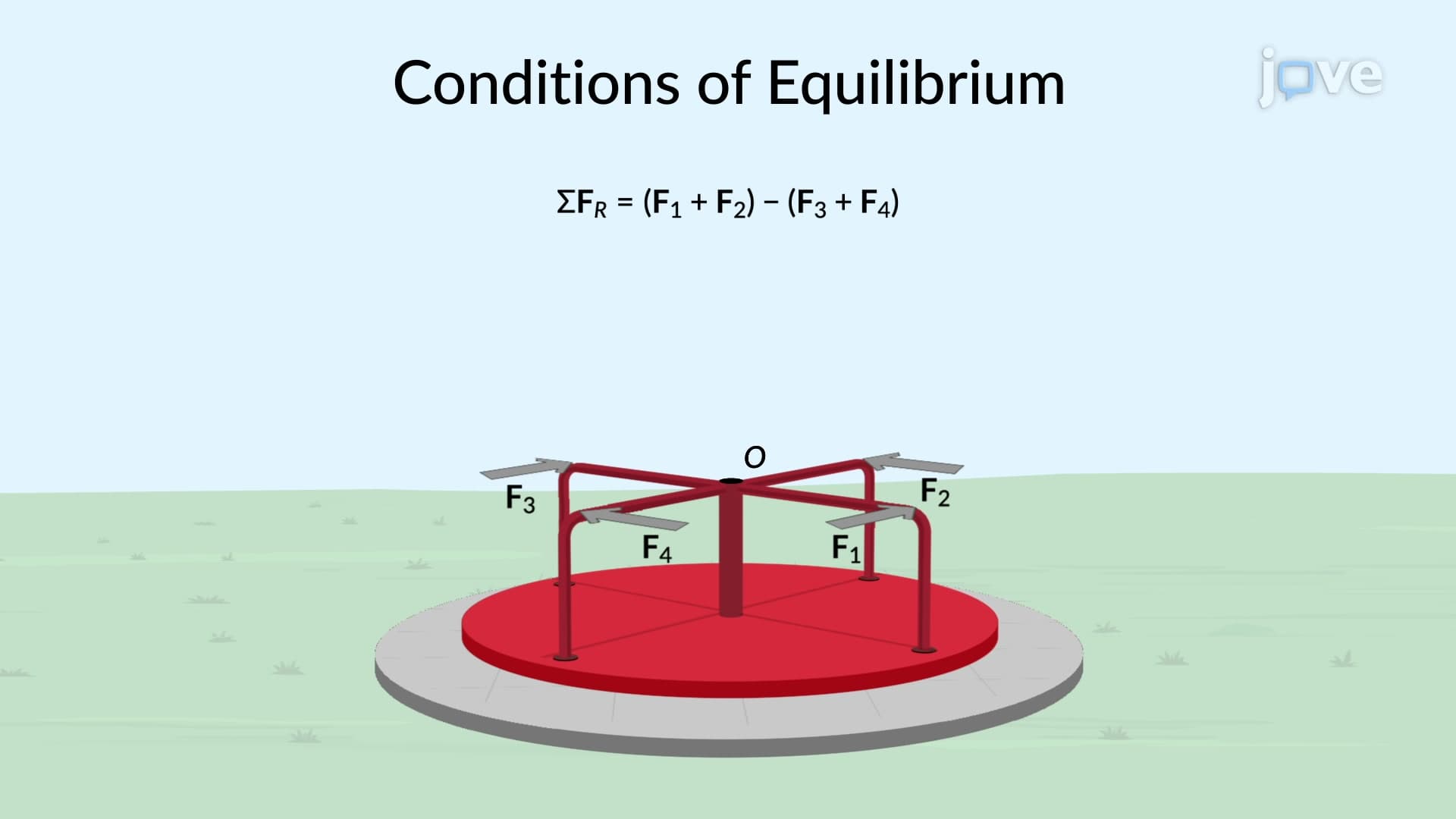
The most complex category involves parallel forces that don't meet at a common point. Consider a construction crane: the weight of the load creates a downward force, while the counterweight provides an opposing moment. These forces are parallel but separated by distance, requiring moment equilibrium analysis.
Non-concurrent equilibrium requires both force balance (ΣF = 0) and moment balance (ΣM = 0) about any chosen point. This concept appears frequently in college-level mechanics courses and professional engineering exams, where students must analyze structures like building frames and machine components.
Related Micro-courses