Loading video…


 6 Concepts
 16.5K views

Video Summary: What Is Free Body Diagram
Ever wonder how NASA engineers calculate the forces on a rocket during launch? A free body diagram is the essential physics tool that transforms complex force problems into simple visual representations. Picture analyzing a football player catching a pass - engineers use free body diagrams to map every force acting on both the player and ball, from gravity to air resistance. This fundamental concept bridges the gap between real-world physics and mathematical problem-solving in mechanics. Watch the full video on JoVE Coach to master this concept with expert-led visuals and step-by-step explanations.
A free body diagram represents the cornerstone of physics problem-solving, serving as a bridge between observable phenomena and mathematical analysis. This powerful visualization technique isolates a single object or system, showing every force acting upon it as vectors with specific directions and magnitudes. Students encounter this concept extensively in AP Physics courses, SAT Subject Tests, and introductory college mechanics.
The beauty of free body diagrams lies in their simplicity - they transform complicated real-world scenarios into manageable visual representations. Whether analyzing a suspension bridge in San Francisco or studying the forces on a basketball during a free throw, these diagrams provide the foundation for understanding mechanical systems.
Creating effective free body diagrams requires understanding several key elements. The object of interest becomes represented as either a simple dot or basic outline, completely isolated from its surroundings. Force vectors appear as arrows, with arrow direction indicating force direction and arrow length proportional to force magnitude.
Consider a textbook resting on a classroom desk. The free body diagram shows two primary forces: gravitational force (weight) pulling downward and normal force from the desk pushing upward. This equilibrium condition explains why the book remains stationary - a concept fundamental to statics problems on the MCAT and engineering entrance exams.
Free body diagram applications extend far beyond classroom exercises. Structural engineers analyzing earthquake resistance in California buildings rely on these diagrams to calculate forces on support beams. Aerospace engineers at SpaceX use similar principles when designing rocket trajectories, mapping forces during different flight phases.
In biomechanics, physical therapists apply free body diagram concepts when analyzing human movement. A runner's stride involves complex force interactions - ground reaction forces, air resistance, and muscle tensions - all mappable through systematic force analysis.
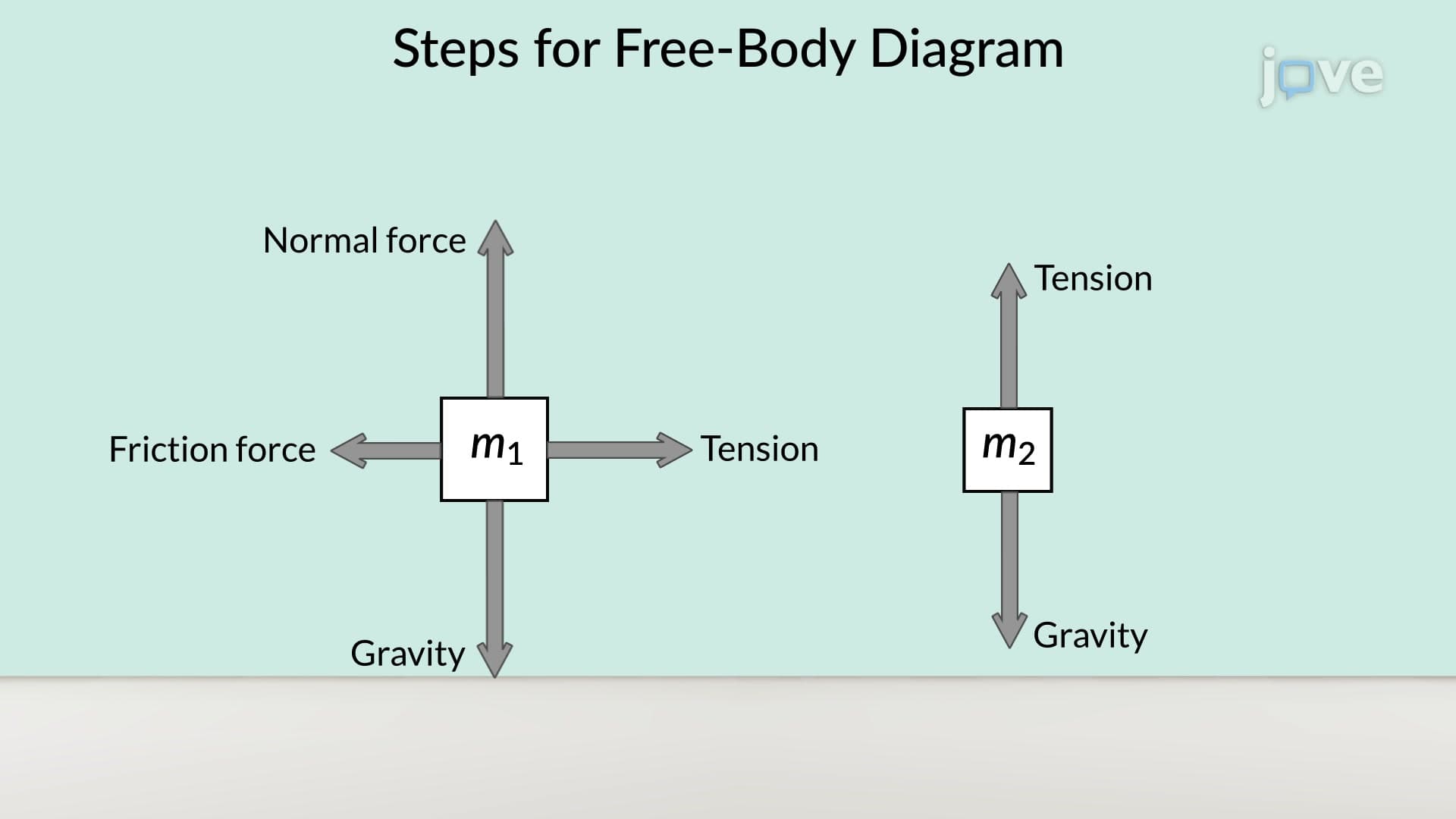
Mastering free body diagram construction provides significant advantages on standardized tests and college coursework. The systematic approach involves four key steps: identifying the system of interest, isolating the object, identifying all forces, and representing forces as vectors.
Advanced applications include multi-body systems where objects interact through contact forces. A truck pulling a trailer involves separate free body diagrams for each vehicle, connected through tension forces in the coupling mechanism. These scenarios frequently appear on AP Physics exams and college mechanics midterms, making diagram mastery essential for academic success.
Related Micro-courses