Loading video…


 40 Concepts
 156.8K views

Video Summary: Ketones with Nonenolizable Aromatic Aldehydes Explained
Ever wonder why certain organic reactions produce only one major product instead of a messy mixture? Ketones with nonenolizable aromatic aldehydes follow predictable patterns that pharmaceutical companies like Pfizer exploit when synthesizing drug precursors. When acetone meets benzaldehyde under basic conditions, the absence of alpha hydrogens on the aromatic aldehyde forces a single reaction pathway, creating trans-cinnamic acid derivatives used in flavor compounds. This selectivity makes Ketones With Nonenolizable Aromatic Aldehydes Explained a crucial concept for understanding synthetic organic chemistry. Watch the full video on JoVE Coach to master this concept with expert-led visuals and step-by-step explanations.
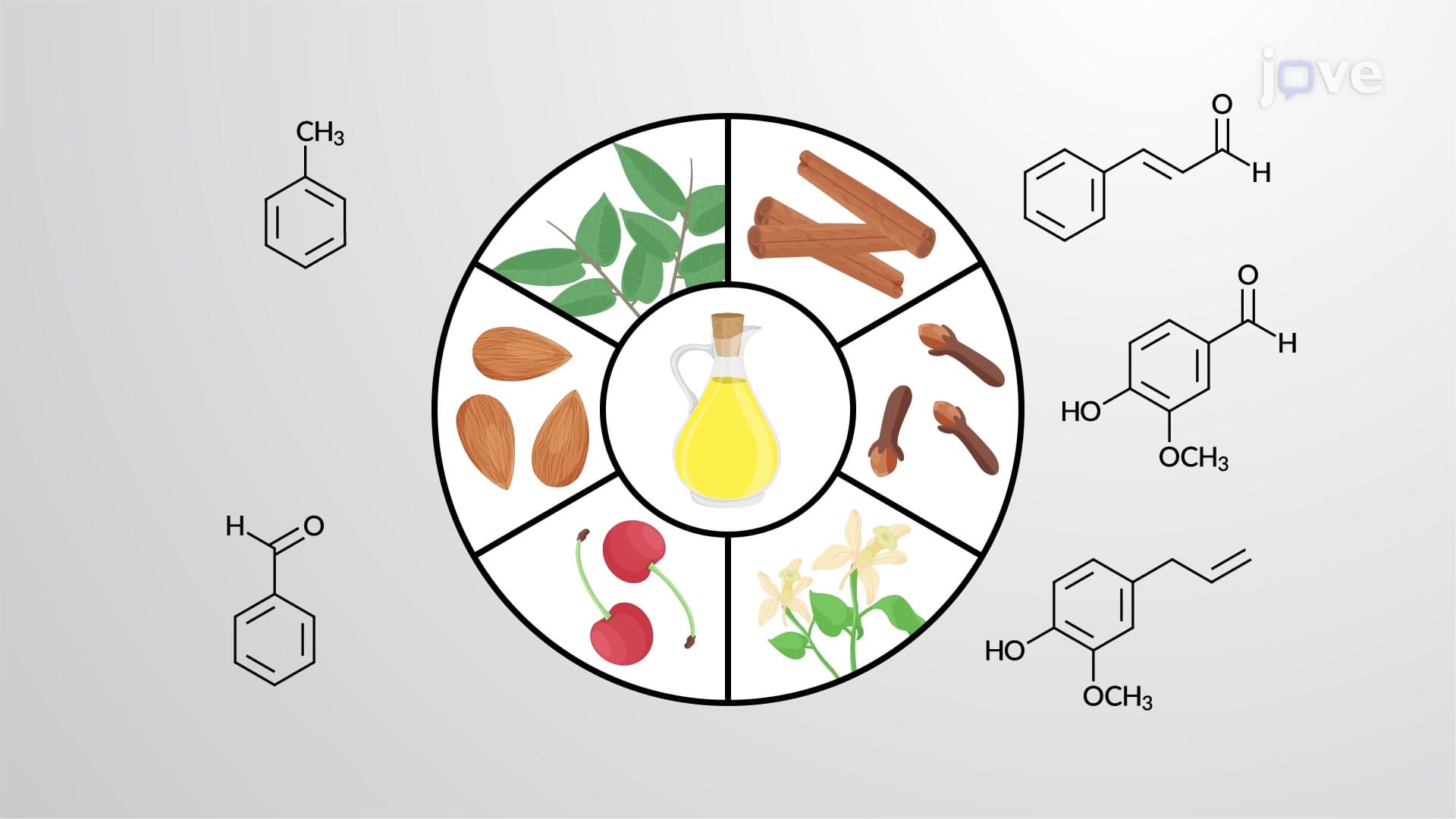
The reaction between ketones and nonenolizable aromatic aldehydes represents a masterclass in selective organic synthesis. Unlike typical aldol condensations that can produce multiple products, this system forces a single reaction pathway due to structural constraints. Nonenolizable aldehydes-primarily aromatic compounds like benzaldehyde, 4-methoxybenzaldehyde, and 2-furaldehyde-lack alpha hydrogens, preventing them from forming enolate anions. This limitation becomes an advantage in synthetic chemistry, as seen in the industrial production of cinnamaldehyde derivatives used in perfumes and flavorings.
The Claisen-Schmidt condensation proceeds through a well-defined mechanism. Under basic conditions, the ketone forms an enolate anion by losing an alpha hydrogen. This nucleophilic enolate attacks the electrophilic carbonyl carbon of the aromatic aldehyde, creating a β-hydroxyketone intermediate. Unlike traditional aldol products that might remain hydrated, the extended conjugation possible with the aromatic ring drives immediate dehydration, yielding an α,β-unsaturated carbonyl compound. Students preparing for the MCAT often encounter this reaction type, as it demonstrates key principles of nucleophilic addition and elimination mechanisms.
The trans stereoisomer predominates in these reactions due to reduced steric interactions. When the large aromatic substituent and the carbonyl-containing portion adopt a trans relationship, they minimize unfavorable steric clashes that would destabilize the cis isomer. This stereoselectivity proves crucial in pharmaceutical synthesis-companies like Merck rely on such predictable outcomes when manufacturing drug intermediates. College organic chemistry courses, including those preparing students for the American Chemical Society (ACS) standardized exam, emphasize this stereochemical control as a fundamental concept.
Beyond textbook examples, this reaction type appears throughout medicinal chemistry. The synthesis of chalcones-compounds with anti-inflammatory and anticancer properties-frequently employs Claisen-Schmidt condensations between acetophenone derivatives and substituted benzaldehydes. Students at universities like MIT and Stanford encounter these reactions in advanced organic chemistry laboratory courses, where they synthesize bioactive compounds using similar methodology. Understanding these reactions also proves essential for AP Chemistry students tackling synthesis problems and college undergraduates preparing for graduate school entrance exams.
Related Micro-courses