Loading subject page…


72,830 views

Video Summary: Work Done During Volume Changes in Thermodynamic Systems
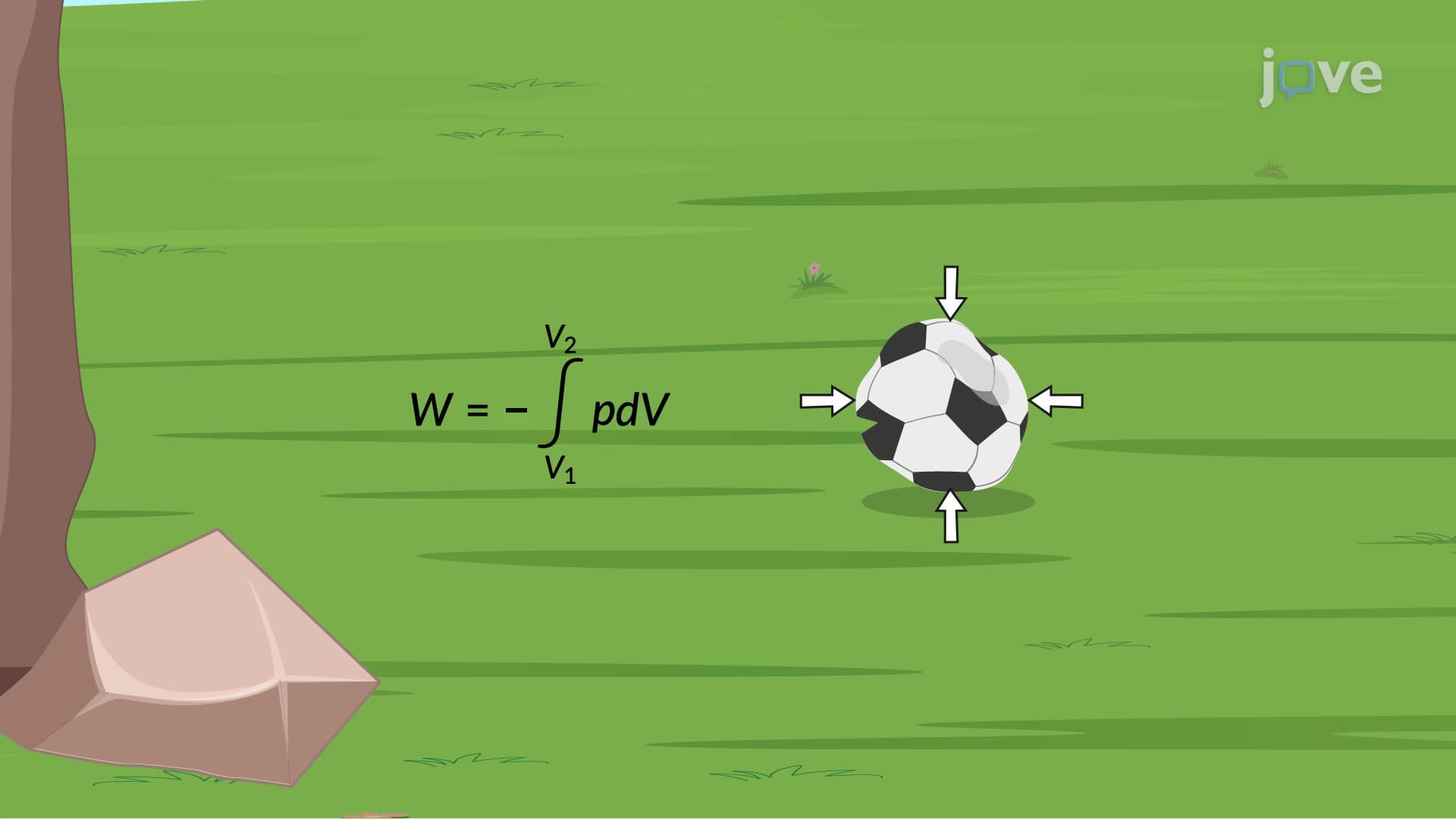
Ever wonder why a deflating basketball becomes harder to squeeze as air escapes? Work done during volume changes in thermodynamic systems governs this everyday phenomenon, where atmospheric pressure performs work on the collapsing ball. From NASA's spacecraft fuel tanks expanding in zero gravity to automotive engine pistons compressing gas mixtures, understanding Work Done During Volume Changes in Thermodynamic Systems reveals the fundamental relationship between pressure, volume, and energy transfer. Watch the full video on JoVE Coach to master this concept with expert-led visuals and step-by-step explanations.
The concept of work done during volume changes in thermodynamic systems forms a cornerstone of thermodynamics, bridging the gap between mechanical work and thermal energy. When a gas expands or contracts, it performs work against external pressure or has work performed upon it by surrounding forces. This fundamental relationship governs everything from the operation of car engines to the behavior of weather systems across the United States.
The mathematical expression W = -∫P dV represents the work calculation for volume changes, where the negative sign follows the thermodynamic convention. When a system expands (positive ΔV), it performs positive work on its surroundings, like steam pushing a piston in a locomotive engine. Conversely, when compressed (negative ΔV), work is performed on the system, as occurs in diesel engine compression strokes.
For constant pressure processes (isobaric), the integration simplifies to W = -P(V₂ - V₁), making calculations straightforward for applications like weather balloon expansion as it rises through decreasing atmospheric pressure. Students encounter this relationship frequently in AP Chemistry and Physics courses, where understanding the sign convention proves crucial for exam success.
American industries rely heavily on volume-change work principles. In power generation, steam turbines at facilities like the Hoover Dam utilize expanding steam to generate electricity through controlled volume changes. The aerospace industry applies these concepts in rocket propulsion systems, where combustion gases expand rapidly through nozzles, performing work to achieve thrust.
Automotive engineering showcases practical applications through internal combustion engines, where the four-stroke cycle demonstrates compression work (intake and compression strokes) and expansion work (power stroke). Students preparing for the MCAT encounter similar concepts when studying respiratory physiology, where diaphragm movement creates pressure differentials enabling lung ventilation.
Mastery of work done during volume changes in thermodynamic systems appears across multiple academic assessments. AP Physics and Chemistry exams frequently test pressure-volume diagram interpretation and work calculations. College-level physical chemistry courses expand these concepts to include statistical mechanics and molecular-level explanations.
Success strategies include practicing P-V diagram sketching, memorizing key process types (isothermal, adiabatic, isobaric, isochoric), and understanding when to apply different work formulas. Students should focus on sign convention mastery, as incorrect signs frequently cause exam errors in thermodynamics problems.
Related Micro-courses