Loading video…


 19 Concepts
 72.8K views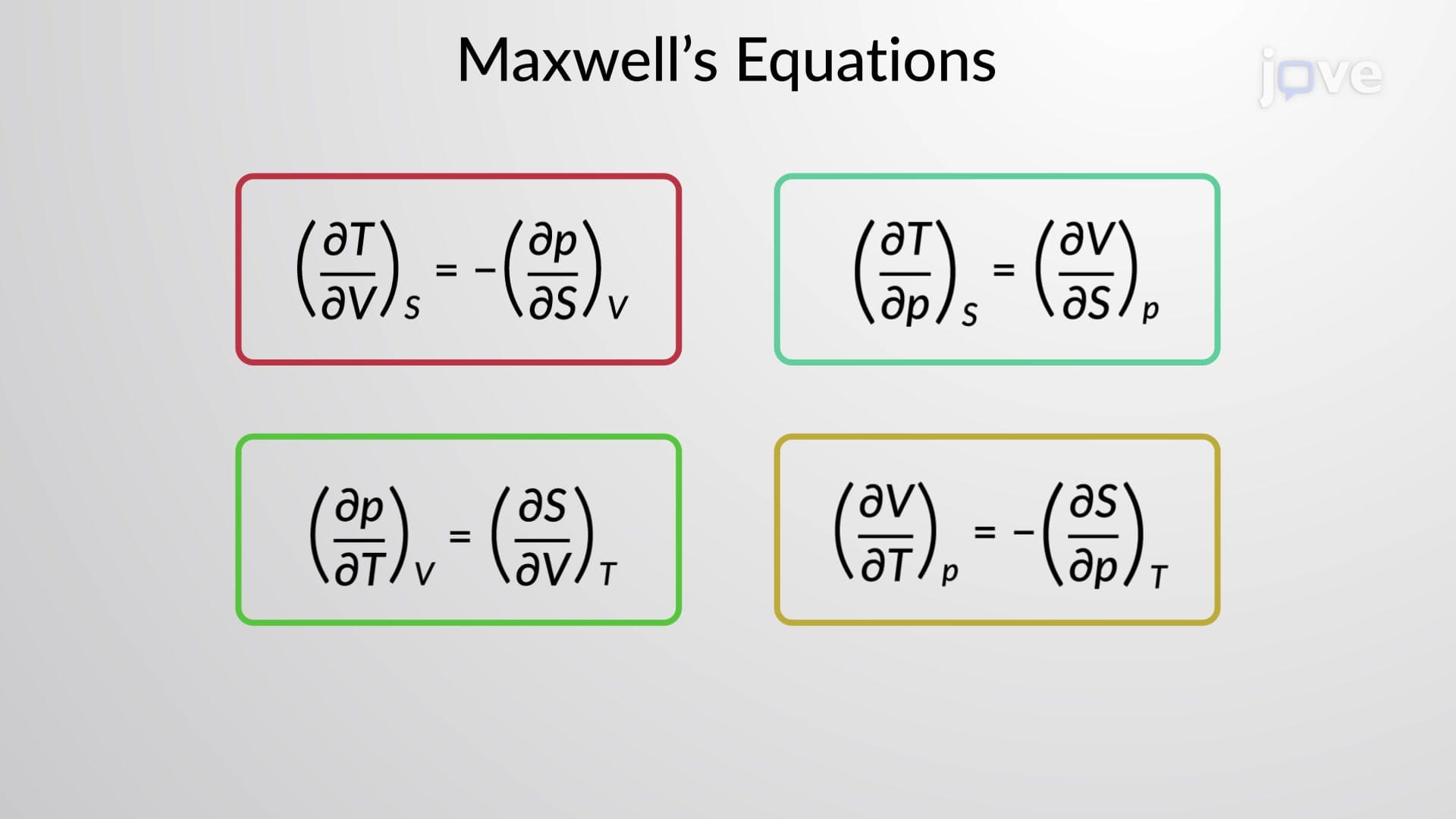

Video Summary: What Is Maxwells Thermodynamic Relations
Ever wondered how engineers at NASA's Jet Propulsion Laboratory calculate the precise thermodynamic properties needed for spacecraft propulsion systems? Maxwell's thermodynamic relations provide the mathematical foundation that connects easily measurable quantities like temperature and pressure to complex properties that are difficult to measure directly. These four fundamental equations, derived from thermodynamic potentials, allow scientists and engineers to solve intricate problems in everything from rocket engine design to power plant efficiency optimization. Watch the full video on JoVE Coach to master this concept with expert-led visuals and step-by-step explanations.
Maxwell's thermodynamic relations represent one of the most elegant achievements in classical thermodynamics, providing four fundamental equations that connect seemingly unrelated thermodynamic properties. These relations emerge from the mathematical requirement that thermodynamic state functions must have exact differentials, meaning their values depend only on the current state of the system, not the path taken to reach that state.
The first Maxwell relation stems from internal energy U as a function of entropy S and volume V. Since internal energy is a state function, its mixed partial derivatives must be equal: (∂T/∂V) at constant S equals -(∂P/∂S) at constant V. This relationship proves invaluable when studying gas expansion processes in automotive engines, where direct entropy measurements are impractical.
The second relation derives from enthalpy H(S,P), yielding: (∂T/∂P) at constant S equals (∂V/∂S) at constant P. Power plant engineers at facilities like the Palo Verde Nuclear Generating Station use this relation to optimize steam turbine performance, converting difficult entropy calculations into manageable pressure and temperature measurements.
The third relation comes from Helmholtz free energy F(V,T): (∂P/∂T) at constant V equals (∂S/∂V) at constant T. This equation proves crucial in understanding battery chemistry and electrochemical processes used in Tesla's lithium-ion battery manufacturing.
The fourth relation originates from Gibbs free energy G(P,T): -(∂V/∂T) at constant P equals (∂S/∂P) at constant T. Chemical engineers at pharmaceutical companies like Pfizer rely on this relation to predict how drug solubility changes with temperature and pressure during manufacturing processes.
These relations frequently appear on AP Physics 2 exams and college thermodynamics courses at institutions like MIT and Stanford. Students often encounter problems requiring the calculation of entropy changes using easily measurable quantities like temperature and pressure variations. The beauty of Maxwell's relations lies in their ability to transform abstract thermodynamic calculations into practical engineering solutions, making them essential tools for future engineers and scientists working in energy, aerospace, and chemical industries.
Related Micro-courses