Loading video…


 13 Concepts
 49.7K views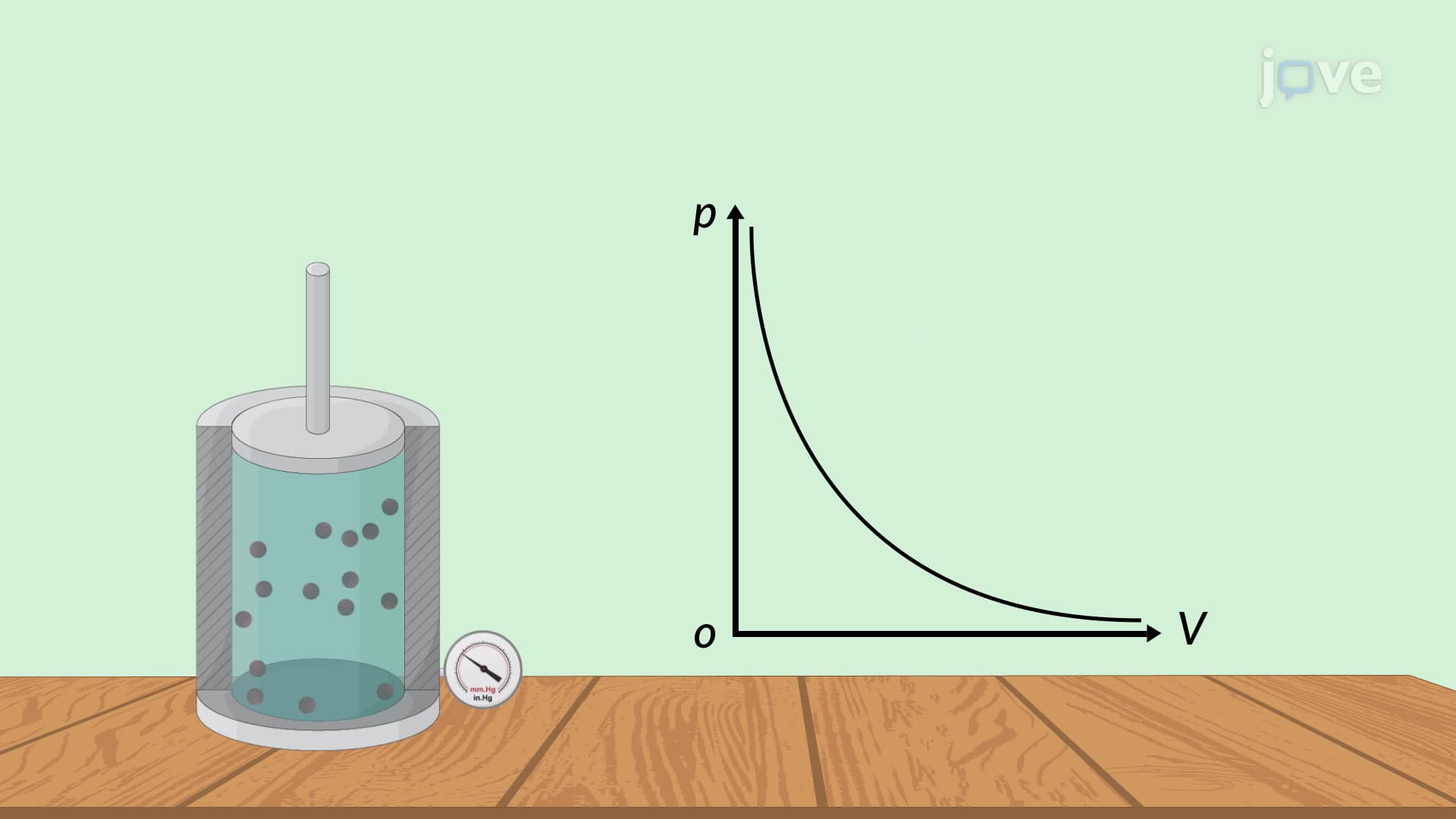

Video Summary: What Is Ideal Gas Equation
Ever wondered why a helium balloon deflates faster in winter or how NASA calculates fuel requirements for rocket launches? The ideal gas equation connects pressure, volume, temperature, and amount of gas in one powerful formula that explains these everyday phenomena. From predicting weather patterns across the United States to designing car engines in Detroit, this fundamental equation governs gas behavior in countless applications. Watch the full video on JoVE Coach to master this concept with expert-led visuals and step-by-step explanations.
The ideal gas equation, expressed as PV = nRT, represents one of chemistry's most versatile tools for predicting gas behavior. This equation elegantly combines four centuries of scientific discovery into a single relationship that connects pressure (P), volume (V), number of moles (n), and temperature (T) through the universal gas constant (R). Unlike many scientific principles that apply only under specific conditions, the ideal gas equation finds applications everywhere from the combustion chambers of Ford engines in Michigan to the pressurized cabins of commercial aircraft.
Each component of the ideal gas equation stems from historically significant gas laws that students encounter throughout their chemistry education. Boyle's Law demonstrates the inverse relationship between pressure and volume-compress a gas in a syringe, and pressure increases proportionally. Charles's Law shows direct proportionality between volume and temperature, explaining why hot air balloons rise during summer festivals across America. Gay-Lussac's Law connects pressure and temperature, crucial for understanding pressure cooker safety and automotive tire pressure changes. Avogadro's Law links volume to the amount of substance, fundamental to stoichiometric calculations in AP Chemistry coursework.
The ideal gas equation proves remarkably accurate for most gases under normal conditions, making it invaluable for engineering applications. Chemical engineers at companies like DuPont use these calculations to design reactor vessels, while meteorologists rely on gas law principles to predict storm systems moving across the continental United States. However, the equation works best at high temperatures and low pressures-conditions where gas molecules behave most "ideally" by having minimal intermolecular forces and occupying negligible volume compared to their container.
Students preparing for standardized tests like the AP Chemistry exam, SAT Subject Tests, or college chemistry courses must become comfortable manipulating the ideal gas equation. The universal gas constant R = 8.314 J/(mol·K) remains constant regardless of gas type-whether calculating oxygen consumption in cellular respiration for pre-med students or determining hydrogen production in electrolysis experiments. Practice problems typically involve solving for one variable when given the other three, requiring strong algebraic skills and unit conversion proficiency. Success comes from understanding not just the mathematical manipulation but also the physical meaning behind each calculation.
Related Micro-courses