Loading video…


 13 Concepts
 49.7K views

Video Summary: Maxwell Boltzmann Distribution Problem Solving Explained
Why do some oxygen molecules in your lungs move at 200 m/s while others zip around at 400 m/s? Maxwell Boltzmann distribution problem solving reveals the mathematical framework behind molecular speed variations in gases. Consider how anesthesiologists at Johns Hopkins must understand these principles when calculating gas diffusion rates during surgery. This Maxwell Boltzmann Distribution Problem Solving Explained tutorial demonstrates how to calculate speed ratios, root-mean-square velocities, and most probable speeds for real gas systems. Watch the full video on JoVE Coach to master this concept with expert-led visuals and step-by-step explanations.
The Maxwell Boltzmann distribution represents one of statistical mechanics' most powerful tools for understanding molecular behavior in gases. This mathematical framework, developed by James Clerk Maxwell and Ludwig Boltzmann, describes how molecular speeds are distributed in an ideal gas at thermal equilibrium. For students preparing for AP Chemistry, MCAT, or college-level physical chemistry courses, mastering these problem-solving techniques proves essential for success.
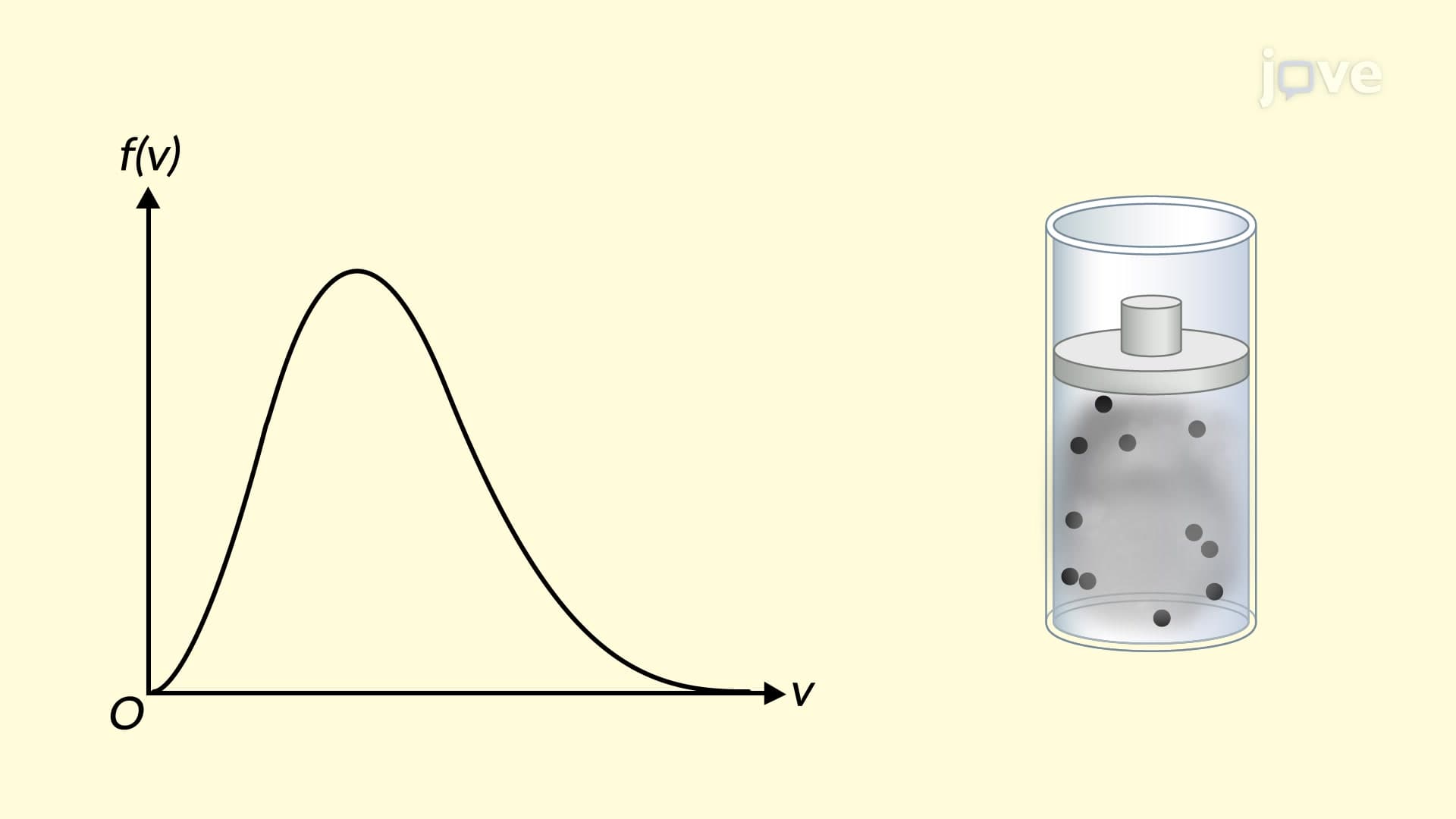
When solving maxwell boltzmann distribution problems, the probability density function f(v) = 4π(M/2πRT)^(3/2) × v² × exp(-Mv²/2RT) governs molecular speed distributions. Here, M represents molar mass, R is the gas constant (8.314 J/mol·K), T denotes absolute temperature, and v represents molecular speed. Students often encounter this in college chemistry courses at institutions like MIT or UC Berkeley, where understanding the exponential decay factor proves crucial for calculating speed ratios.
For the oxygen example presented, calculating the ratio of molecules at 400 m/s versus 200 m/s requires substituting these velocities into the distribution function. The speed-squared term in the numerator initially favors higher speeds, but the exponential decay factor ultimately dominates, creating the characteristic asymmetric distribution curve that peaks at intermediate speeds.
The root-mean-square speed equation v(rms) = √(3RT/M) represents the square root of the average of squared molecular speeds. For oxygen at room temperature (298 K), this yields approximately 482 m/s. Meanwhile, the most probable speed v(mp) = √(2RT/M) corresponds to the distribution's peak, calculating to roughly 394 m/s for oxygen molecules.
These calculations appear frequently on standardized exams like the MCAT, where students must quickly determine molecular speeds for different gases. Understanding that v(rms) > v(average) > v(mp) helps students check their calculations and understand the physical meaning behind each speed measure.
Chemical engineers at companies like ExxonMobil and Dow Chemical apply these principles when designing gas separation equipment and optimizing reaction conditions. Understanding how molecular speed distributions change with temperature allows engineers to predict diffusion rates, optimize catalytic processes, and design efficient distillation columns for petroleum refining operations across Texas and Louisiana.
Related Micro-courses