Loading subject page…


170,405 views

Video Summary: Sternbergs Triangular Theory of Love Explained
Ever wondered why your feelings for your high school sweetheart felt different from your love for family or best friends? Sternberg's Triangular Theory of Love explains how the same emotion can manifest in seven distinct ways through three core components. Consider how celebrity couples like Brad Pitt and Angelina Jolie experienced passionate infatuation that later evolved into deeper companionate love. Watch the full video on JoVE Coach to master this concept with expert-led visuals and step-by-step explanations.
Robert Sternberg's groundbreaking psychological framework revolutionized how researchers and clinicians understand human love relationships. Developed in the 1980s, this theory posits that love consists of three fundamental components that combine in different proportions to create seven distinct types of love experiences. Unlike earlier models that treated love as a single emotion, Sternberg's approach recognizes the complexity and variability of human romantic and interpersonal connections.
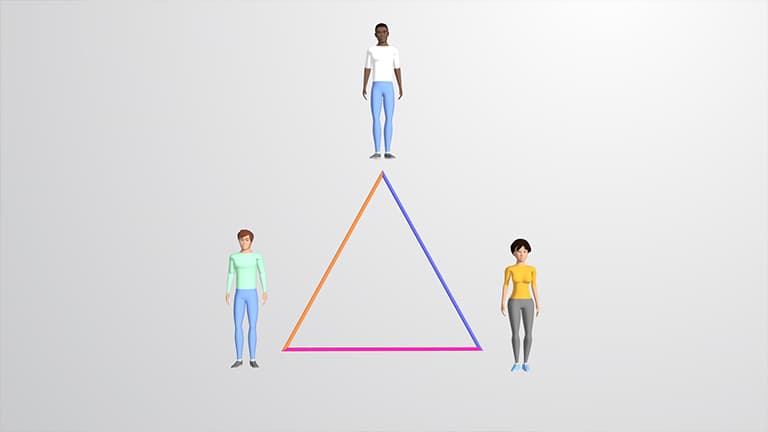
The theory's triangular structure places each component at a vertex: intimacy at the top, passion at the bottom-left, and commitment at the bottom-right. This geometric representation helps visualize how different combinations create unique relationship profiles, making it particularly valuable for students studying social psychology in AP courses or undergraduate programs.
Intimacy represents the emotional closeness and connectedness between partners. This component develops through self-disclosure, mutual understanding, and shared emotional experiences. In practical terms, intimacy manifests when couples share personal fears with each other, discuss future dreams, or provide emotional support during challenging times. Research from UCLA's Relationship Institute shows that couples with high intimacy scores report greater relationship satisfaction over decades.
Passion encompasses the physical and romantic attraction driving the relationship. This component includes sexual desire, physical attraction, and the excitement of romantic pursuit. Think of the intense feelings experienced by new couples at universities across America-the butterflies, constant texting, and magnetic attraction that characterizes early dating relationships.
Commitment involves the cognitive decision to maintain the relationship long-term. Unlike the emotional nature of intimacy or the physiological aspects of passion, commitment represents a conscious choice to work through difficulties and build a future together. This component explains why arranged marriages in some American immigrant communities can develop into deeply loving relationships over time.
Combining these components creates seven distinct love types. Consummate love represents the ideal, incorporating all three components equally-though Sternberg acknowledges this balance rarely remains constant. Romantic love (intimacy + passion) characterizes many college relationships where couples feel deeply connected and attracted but avoid long-term planning. Companionate love (intimacy + commitment) describes many long-term marriages where passion has diminished but emotional connection and dedication remain strong.
Fatuous love (passion + commitment) might occur in whirlwind Vegas weddings where couples commit quickly based on intense attraction without developing emotional intimacy. Empty love (commitment only) represents relationships maintained purely through obligation, while infatuated love (passion only) describes celebrity crushes or brief intense attractions without deeper connection.
Understanding these distinctions proves essential for students taking the MCAT's psychology section or AP Psychology exams, where Sternberg's theory frequently appears in relationship psychology questions. The framework also provides practical insights for understanding personal relationships and makes abstract psychological concepts tangible through everyday examples.
Related Micro-courses