Loading video…


 13 Concepts
 13.6K views

Video Summary: What Is Position and Displacement
Did you know that NASA's Mars rovers can travel thousands of meters across the Red Planet yet have a displacement of just a few hundred meters from their landing site? Position and displacement are fundamental physics concepts that explain this seeming paradox. Position defines where an object is located in space relative to a reference point, while displacement measures the straight-line change between starting and ending positions. Watch the full video on JoVE Coach to master this concept with expert-led visuals and step-by-step explanations.
Position and displacement form the cornerstone of kinematics, the study of motion without considering forces. These concepts appear throughout high school physics courses, AP Physics exams, and college-level mechanics, making them essential for academic success and real-world applications.
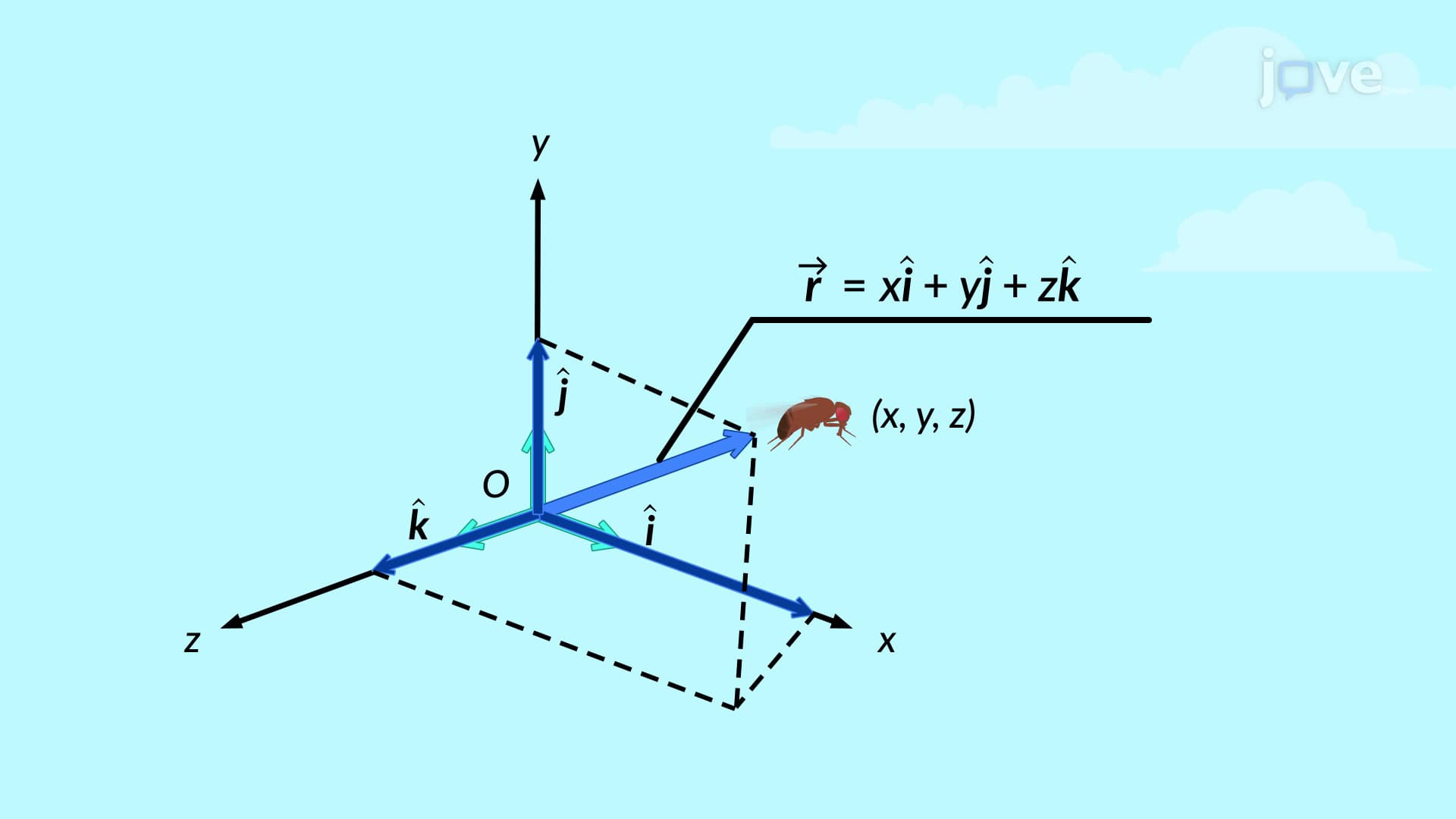
Position describes exactly where an object exists within a coordinate system. Think of position as your GPS coordinates, it's a specific address in space. In physics problems, we typically use Cartesian coordinates (x, y, z) with an origin point as our reference. For example, if you're studying projectile motion in AP Physics, the position of a basketball might be (5 meters, 3 meters) relative to the hoop.
Position can be one-dimensional (along a line), two-dimensional (on a plane), or three-dimensional (in space). US engineering programs emphasize coordinate systems because they're crucial for everything from designing roller coasters at Disney World to programming robotic assembly lines in Detroit auto plants.
Displacement measures the change in position, specifically, the straight-line distance and direction from start to finish. Unlike distance, which adds up all the twists and turns of a path, displacement only cares about the initial and final positions. The mathematical relationship is elegantly simple: Displacement = Final Position - Initial Position, or Δr = rf - ri.
Consider a football player running a complex play pattern. They might sprint 40 yards total distance, but if they end up 10 yards closer to the goal line, their displacement is just 10 yards forward. This distinction frequently appears on SAT Subject Tests and college physics exams.
Engineers at companies like Boeing use displacement calculations for aircraft navigation systems. Medical professionals rely on displacement concepts in MRI imaging and surgical robotics. For students, understanding position and displacement is crucial for success on the MCAT physics section, where these concepts appear in biomechanics problems.
In classroom settings, these concepts bridge to more advanced topics like velocity (displacement over time) and acceleration. Mastering position and displacement basics early creates a strong foundation for AP Physics success and college-level coursework in engineering and pre-med tracks.
Related Micro-courses