Loading subject page…

- Anatomy and Physiology
- Absorption of Nutrients
- Energy Balance
Micro-course: Absorption of Nutrients
34,747 views
Learn key concepts and earn your certificate.







Energy Balance

00:00
01:19
Video Summary: What Is Energy Balance
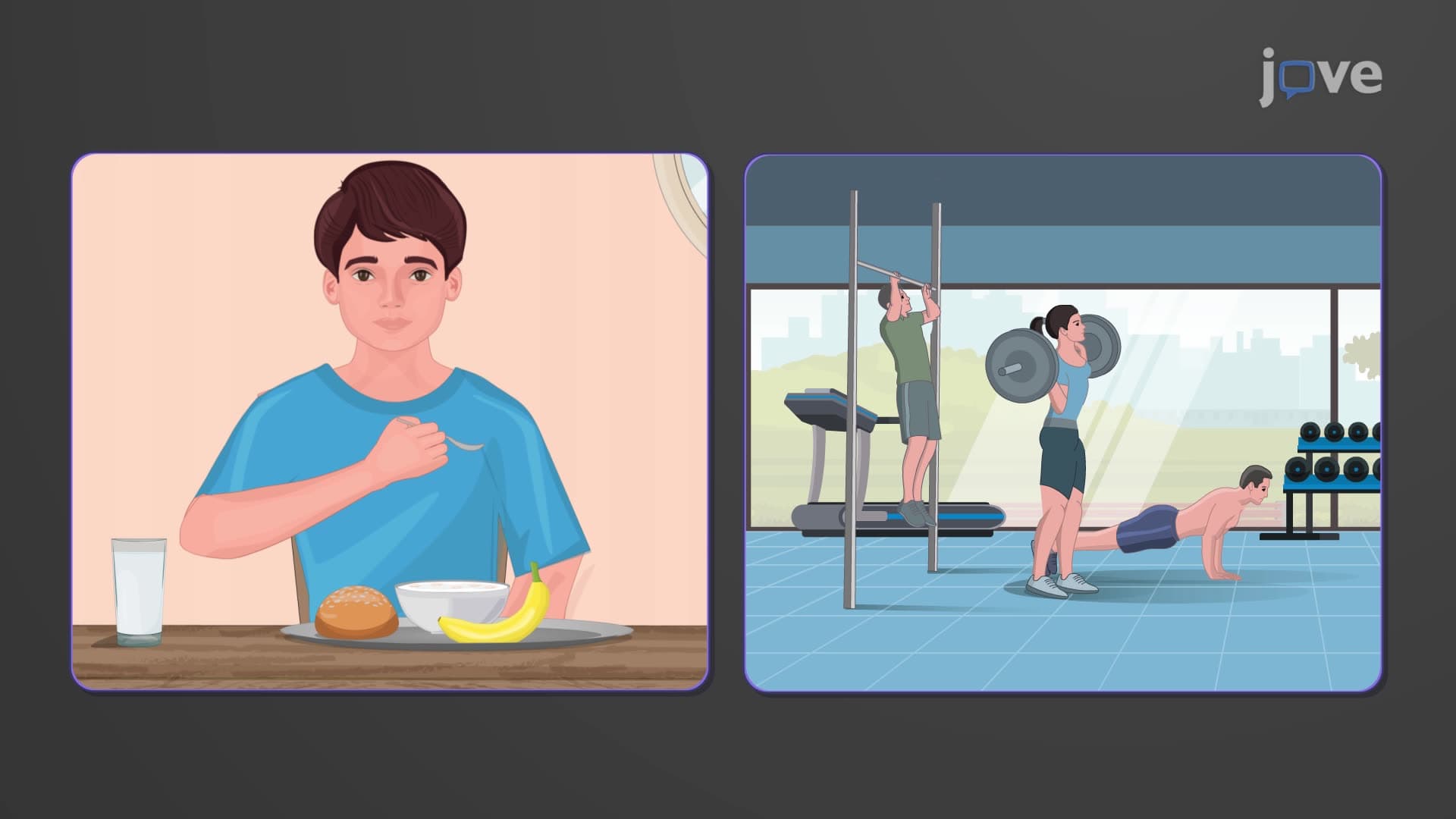
Did you know that a single Oreo cookie contains enough energy to power your brain for about 10 minutes? Understanding energy balance biology nutrition principles explains how your body manages this fuel. When a college student burns 2,200 calories daily through metabolism and activities but consumes 2,500 calories from dining hall meals, their body stores the extra 300 calories as fat. What is energy balance represents the fundamental equation governing weight management and metabolic health. Watch the full video on JoVE Coach to master this concept with expert-led visuals and step-by-step explanations.
- Understand what is energy balance and how it determines body weight changes through the relationship between caloric intake and energy expenditure
- Identify the caloric values of macronutrients: carbohydrates and proteins (4 kcal/g) versus fats (9 kcal/g)
- Analyze positive and negative energy balance scenarios and predict their physiological outcomes
- Compare how different food compositions affect energy density and weight management
- Evaluate energy expenditure components including basal metabolic rate (BMR) and physical activity
- Apply energy balance principles to real-world nutrition scenarios and dietary planning
- Recognize how calorimetry measures food energy content in laboratory settings
- Explore energy homeostasis mechanisms that regulate body weight over time
Understanding What is Energy Balance in Human Physiology
Energy balance represents one of the most fundamental concepts in human nutrition and physiology. This principle governs how our bodies manage the energy we consume versus the energy we expend, ultimately determining whether we maintain, gain, or lose weight. The concept is particularly crucial for students preparing for AP Biology, college nutrition courses, or pre-health programs like those required for medical school admission.
Measuring Food Energy and Macronutrient Contributions
Food energy measurement relies on calorimetry, where scientists burn food samples in controlled environments to determine their kilocalorie content. One kilocalorie equals the energy needed to raise one kilogram of water by one degree Celsius. This standardized measurement allows nutritionists and healthcare professionals to quantify dietary energy precisely.
The three macronutrients contribute different energy amounts per gram. Carbohydrates and proteins each provide approximately 4 kcal/g, while fats deliver about 9 kcal/g-more than twice the energy density. This explains why a tablespoon of olive oil (fat) contains roughly 120 calories, while a tablespoon of sugar (carbohydrate) contains only 48 calories. Understanding these values proves essential for MCAT biochemistry sections and clinical nutrition assessments.
Positive vs. Negative Energy Balance Outcomes
Positive energy balance occurs when caloric intake exceeds energy expenditure. For example, if a college athlete consumes 3,500 calories daily but only burns 3,200 calories through metabolism and training, the excess 300 calories get stored as adipose tissue. Over time, this surplus leads to weight gain at approximately one pound per 3,500 excess calories.
Negative energy balance develops when energy expenditure surpasses intake. A nursing student working 12-hour shifts might burn 2,400 calories daily while consuming only 2,000 calories, creating a 400-calorie deficit. The body compensates by metabolizing stored fat and potentially muscle tissue to meet energy demands.
Energy Expenditure Components and BMR
Total energy expenditure comprises several components, with basal metabolic rate (BMR) representing 60-70% of daily energy use in sedentary individuals. BMR includes essential functions like cellular respiration, protein synthesis, and maintaining body temperature. Physical activity, thermic effect of food, and adaptive thermogenesis account for remaining energy expenditure. These concepts frequently appear on USMLE Step 1 examinations and college physiology midterms.
Frequently Asked Questions
Energy balance is the relationship between calories consumed and calories burned by your body. It's crucial because it determines whether you maintain, gain, or lose weight over time. Understanding this concept helps you make informed decisions about diet and exercise for optimal health outcomes.
When your body energy balance is positive (eating more than you burn), you gain weight as excess calories are stored as fat. When it's negative (burning more than you eat), you lose weight as your body uses stored energy. Maintaining neutral energy balance keeps your weight stable.
These exams commonly test macronutrient caloric values, calorimetry principles, and metabolic calculations. You'll encounter questions about BMR, energy expenditure components, and how energy imbalances affect physiological processes. Practice calculating daily energy needs and interpreting nutrition labels for exam success.
Estimate your BMR using standard formulas, add activity calories, then compare to your daily intake. For a 150-pound college student, BMR might be 1,500 calories, plus 600 activity calories, totaling 2,100 daily needs. This calculation method appears frequently on nutrition and physiology assessments.
Fats contain more carbon-hydrogen bonds per molecule, which release more energy when broken during metabolism. Each gram of fat yields 9 kcal compared to 4 kcal from carbohydrates or proteins. This biochemical difference explains why high-fat foods are more calorie-dense.
Absolutely! Many university dining halls now post calorie information, allowing students to practice energy balance calculations daily. For example, balancing a 800-calorie lunch with planned evening exercise helps maintain healthy weight during stressful academic periods.
No advanced math is required-just basic arithmetic for calculating calories and percentages. Most energy balance problems involve simple addition, subtraction, and multiplication. Focus on understanding the underlying biological principles rather than complex mathematical manipulations.
Explore metabolic pathways like glycolysis and beta-oxidation, hormonal regulation of appetite and metabolism, and clinical applications in treating obesity and eating disorders. These advanced topics build naturally on energy balance foundations.
Expect scenario-based problems requiring you to calculate energy deficits or surpluses, interpret food labels, and predict weight changes over time. Practice with real examples using common foods and realistic activity levels to prepare effectively for these assessments.
Related Micro-courses

25 Concepts

20 Concepts

37 Concepts