Loading subject page…


1,409 views

Video Summary: What Is Boundary Layer Characteristics
Ever wondered why a Boeing 747 needs such massive engines to overcome drag forces during takeoff? The answer lies in boundary layer characteristics, the invisible fluid behavior that creates resistance around every moving object. When air flows over an aircraft wing or a NASCAR vehicle at Daytona International Speedway, friction between the fluid and surface creates a thin region where velocity changes dramatically. Understanding boundary layer characteristics is crucial for engineers designing everything from Formula 1 cars to wind turbines. Watch the full video on JoVE Coach to master this concept with expert-led visuals and step-by-step explanations.
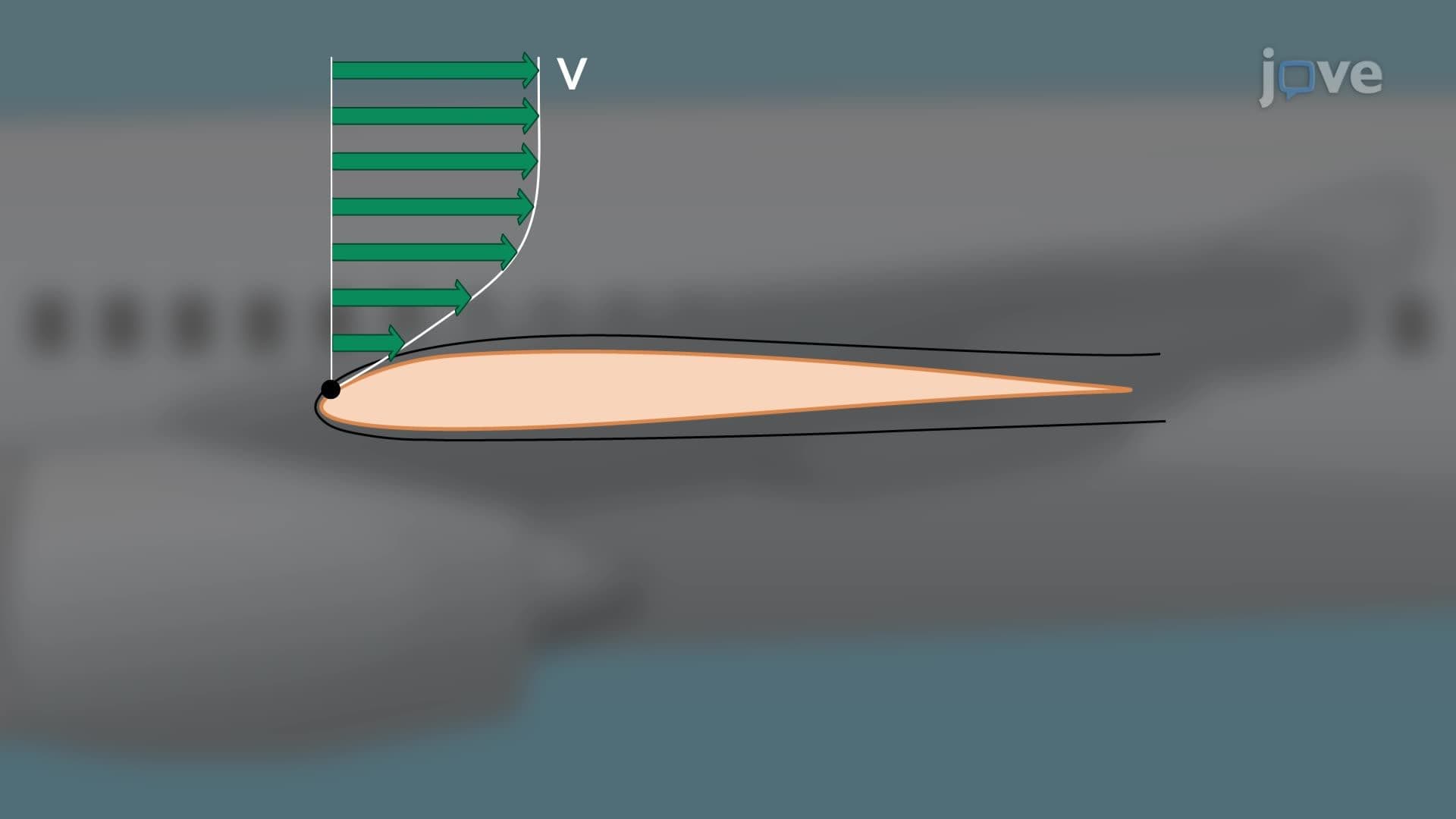
Boundary layer characteristics describe the behavior of fluid flow in the thin region adjacent to a solid surface, where viscous effects dominate and create significant velocity gradients. When fluid encounters any solid boundary, whether it's air flowing over a Tesla Model S or water moving past a submarine hull, friction forces cause the fluid particles closest to the surface to slow down dramatically. This creates a distinct zone where velocity transitions from zero at the wall (due to the no-slip condition) to the undisturbed free-stream velocity further away from the surface.
The boundary layer concept, first introduced by German engineer Ludwig Prandtl in 1904, revolutionized fluid mechanics by separating viscous effects near walls from inviscid flow in the outer region. This separation allows engineers to analyze complex flow problems more effectively, making it possible to design efficient aircraft, optimize pipeline systems, and reduce drag on vehicles.
The boundary layer begins as a thin, laminar region near the leading edge of any surface. In laminar flow, fluid particles move in smooth, parallel layers with minimal mixing between adjacent streamlines. This organized flow pattern creates relatively low skin friction but limited momentum transfer. However, as the boundary layer travels downstream and thickens, it becomes increasingly unstable.
The transition from laminar to turbulent flow occurs at a critical Reynolds number, typically around 500,000 for flat plates under standard conditions. This transition point varies based on surface roughness, pressure gradients, and external disturbances. Once turbulent, the boundary layer exhibits chaotic, three-dimensional motion with enhanced mixing between fluid layers. While turbulent boundary layers create higher skin friction, they also provide better resistance to flow separation, a crucial factor in maintaining attached flow over aircraft wings and turbine blades.
The Blasius equation provides an exact solution for laminar boundary layer velocity profiles over flat plates, showing that boundary layer thickness grows proportionally to the square root of distance from the leading edge. For turbulent boundary layers, engineers often use the momentum integral equation, which relates boundary layer growth to wall shear stress without requiring detailed velocity profile calculations.
These mathematical tools prove essential for students preparing for AP Physics exams, college fluid mechanics courses, and professional engineering licensing exams. Understanding boundary layer characteristics enables engineers at companies like Boeing, General Motors, and SpaceX to optimize designs for minimum drag, maximum efficiency, and improved performance in applications ranging from commercial aircraft to renewable energy systems.
Related Micro-courses