Loading subject page…


6,130 views

Video Summary: Region of Convergence of Laplace Tarnsform Explained
Did you know that understanding the properties of Laplace transform i can determine whether an electrical circuit will remain stable or oscillate uncontrollably? The Region of Convergence of Laplace Transform Explained reveals how complex mathematical regions dictate system behavior in engineering applications. From analyzing RC circuits in high school physics to designing control systems for NASA's spacecraft navigation, this fundamental concept bridges pure mathematics with real-world problem-solving. Watch the full video on JoVE Coach to master this concept with expert-led visuals and step-by-step explanations.
The Region of Convergence (ROC) represents one of the most crucial yet often overlooked aspects of Laplace transform theory. Unlike simple algebraic transformations, the Laplace transform's validity depends entirely on where we evaluate it in the complex plane. This mathematical region determines whether our transform equations actually converge to finite, meaningful values or diverge into mathematical chaos.
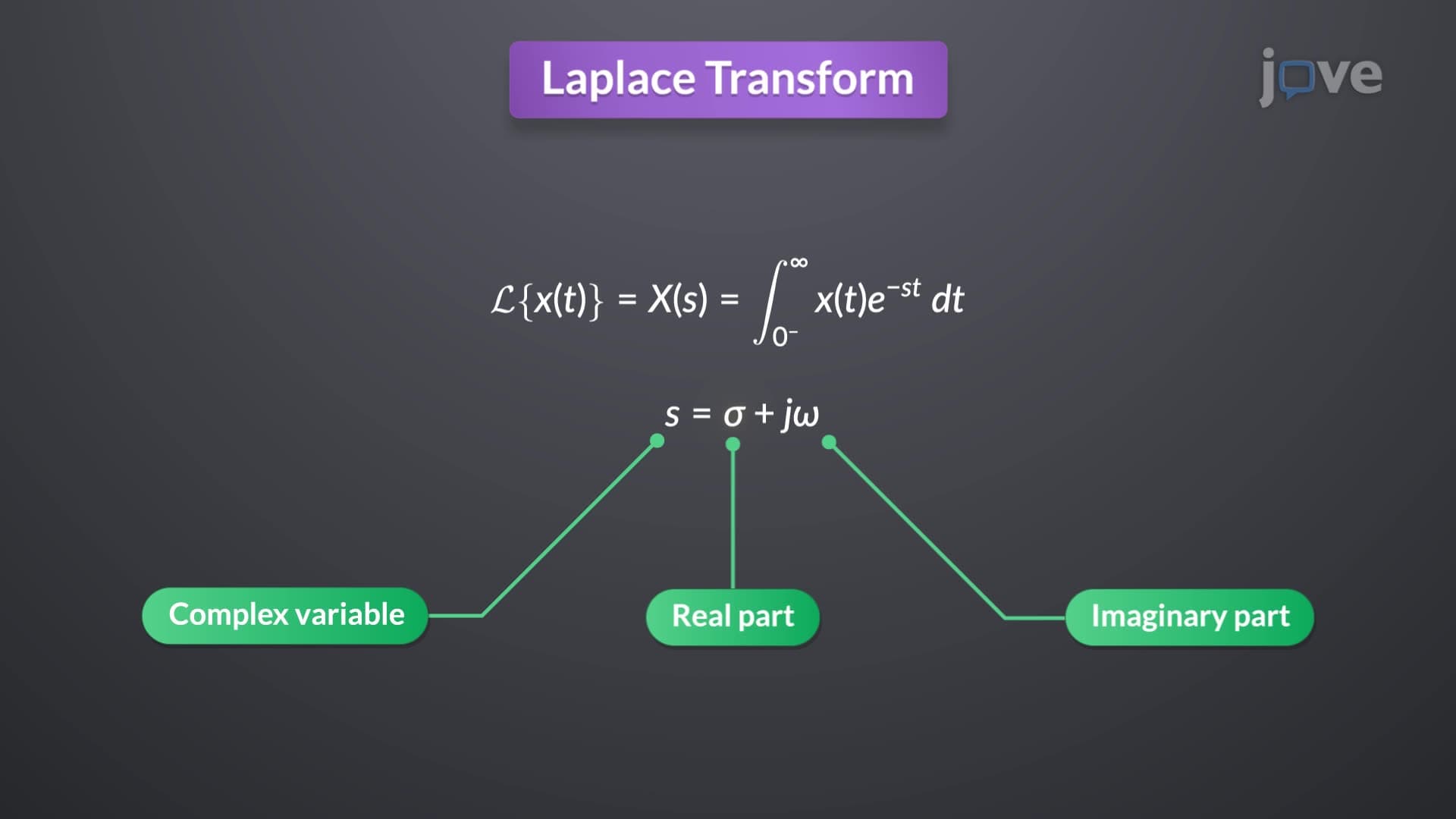
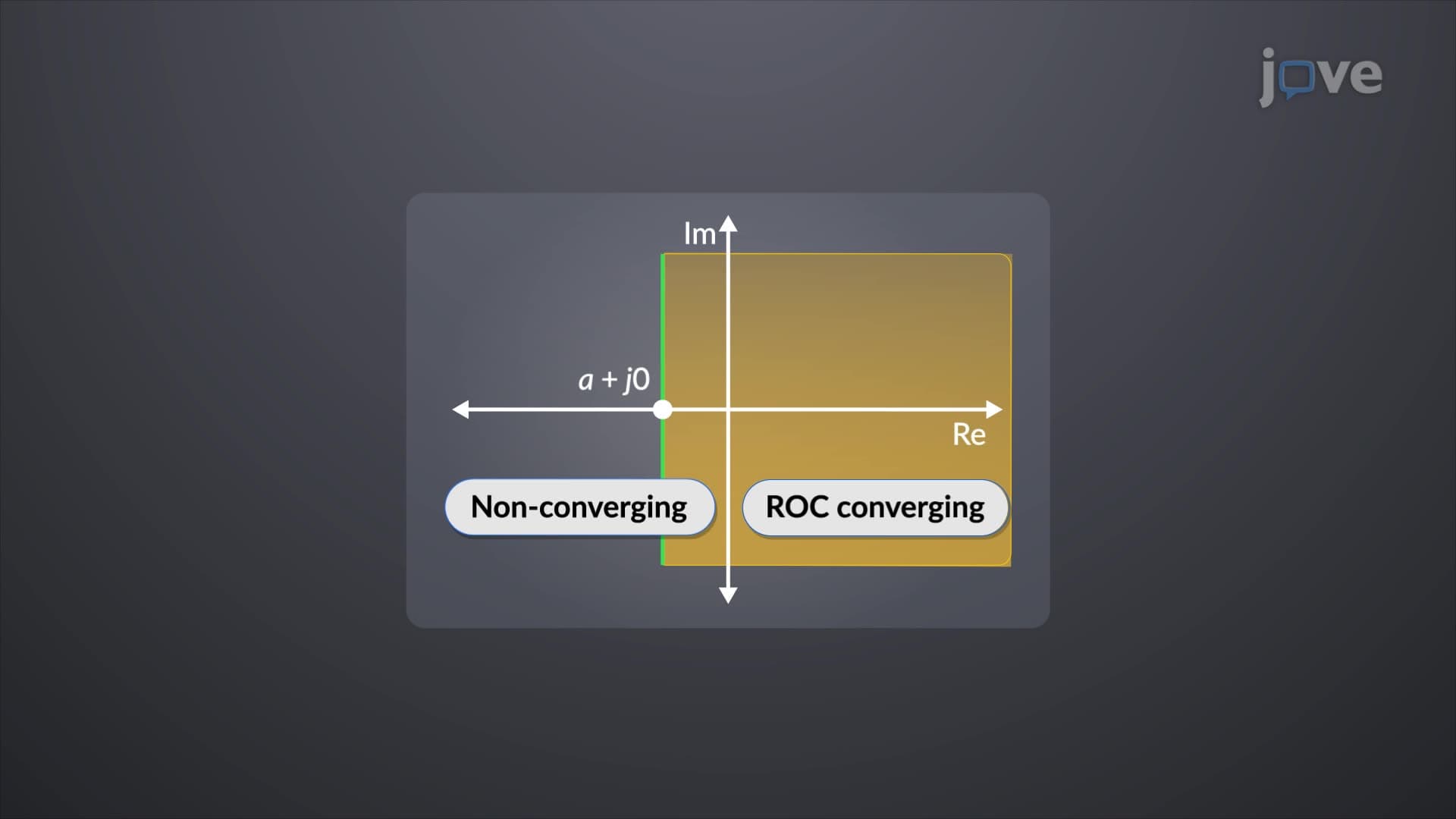
When we substitute the complex variable s = σ + jω into our Laplace transform integral, we create a two-dimensional domain where convergence depends on both the real part (σ) and imaginary part (ω). For a typical causal exponential signal e^(-at)u(t), the ROC becomes the right half-plane where σ > -a. This constraint isn't arbitrary-it ensures our integral from zero to infinity actually converges to a finite value.
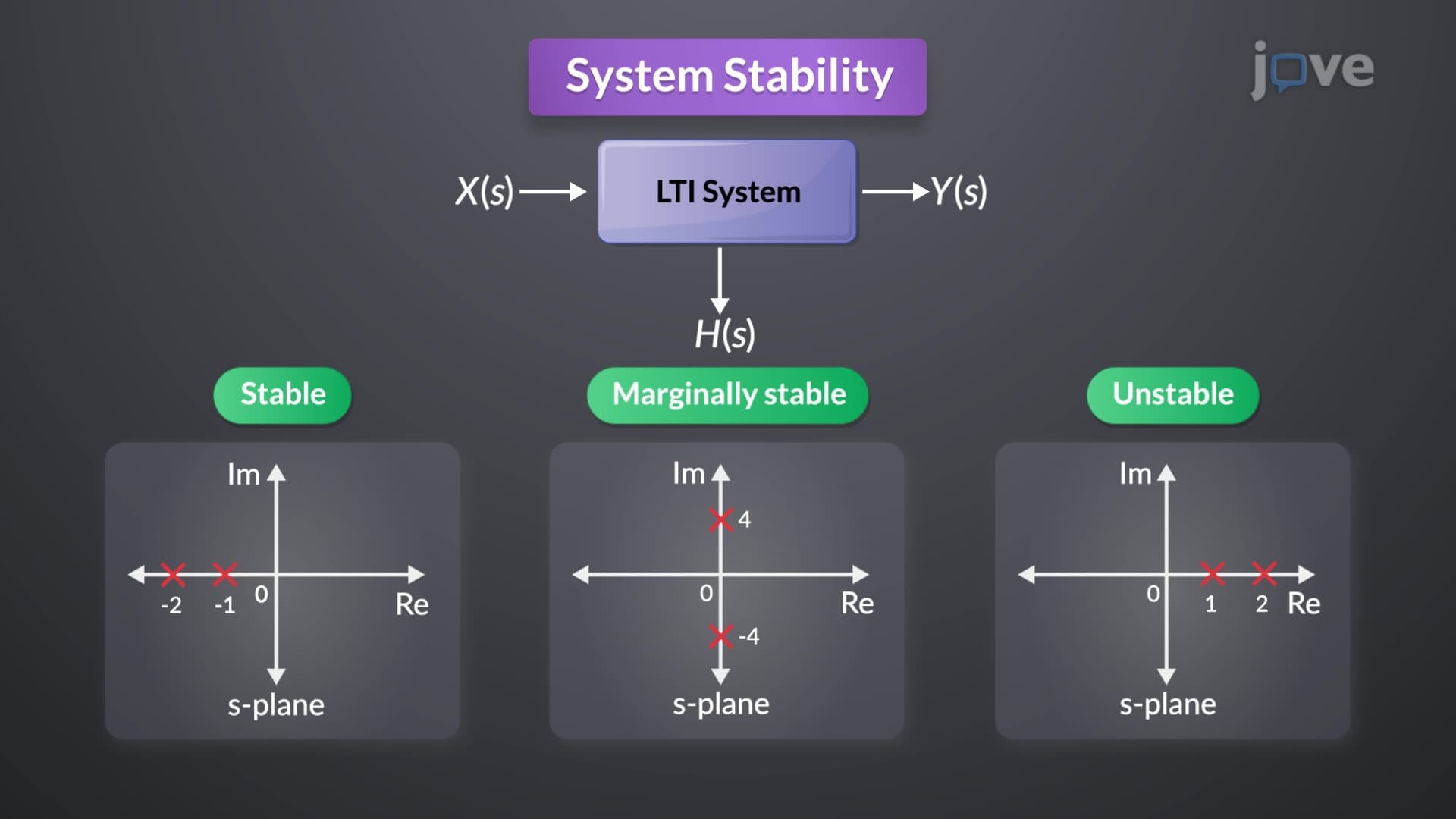
Consider analyzing the step response of an RC circuit in AP Physics C or introductory electrical engineering courses. The circuit's transfer function must have its ROC include the imaginary axis (where s = jω) for the system to remain stable. If the ROC excludes this region, the circuit becomes unstable, potentially leading to oscillations or component failure.
Different signal types produce dramatically different convergence regions. Right-sided (causal) signals create ROCs extending rightward from some vertical line in the s-plane. Left-sided (anti-causal) signals generate leftward-extending regions. Two-sided signals, common in communication systems, produce strip-shaped ROCs bounded by two vertical lines.
Finite-duration signals present a special case frequently encountered in SAT Subject Test Mathematics Level 2 and college calculus courses. These signals typically converge across the entire complex plane except possibly at s = 0 or s = ∞, making their analysis more straightforward but their physical interpretation more nuanced.
Understanding ROC properties becomes essential when analyzing feedback control systems, digital filters, or communication networks. Engineers at companies like Boeing or General Electric routinely apply these principles when designing aircraft control systems or power grid stabilizers. The ROC determines whether their systems will maintain stable operation under varying conditions.
In academic settings, MCAT physics sections and engineering midterms frequently test ROC concepts through stability analysis problems. Students must identify whether given transfer functions represent stable systems by examining their pole locations relative to the ROC boundaries.
Related Micro-courses