Loading subject page…

- Finance
- Dividend and Payout Policy
- Factors Supporting High Dividend Payout
Micro-course: Dividend and Payout Policy
1,159 views
Learn key concepts and earn your certificate.





Factors Supporting High Dividend Payout

00:00
01:30
Video Summary: Factors Supporting High Dividend Payout Explained
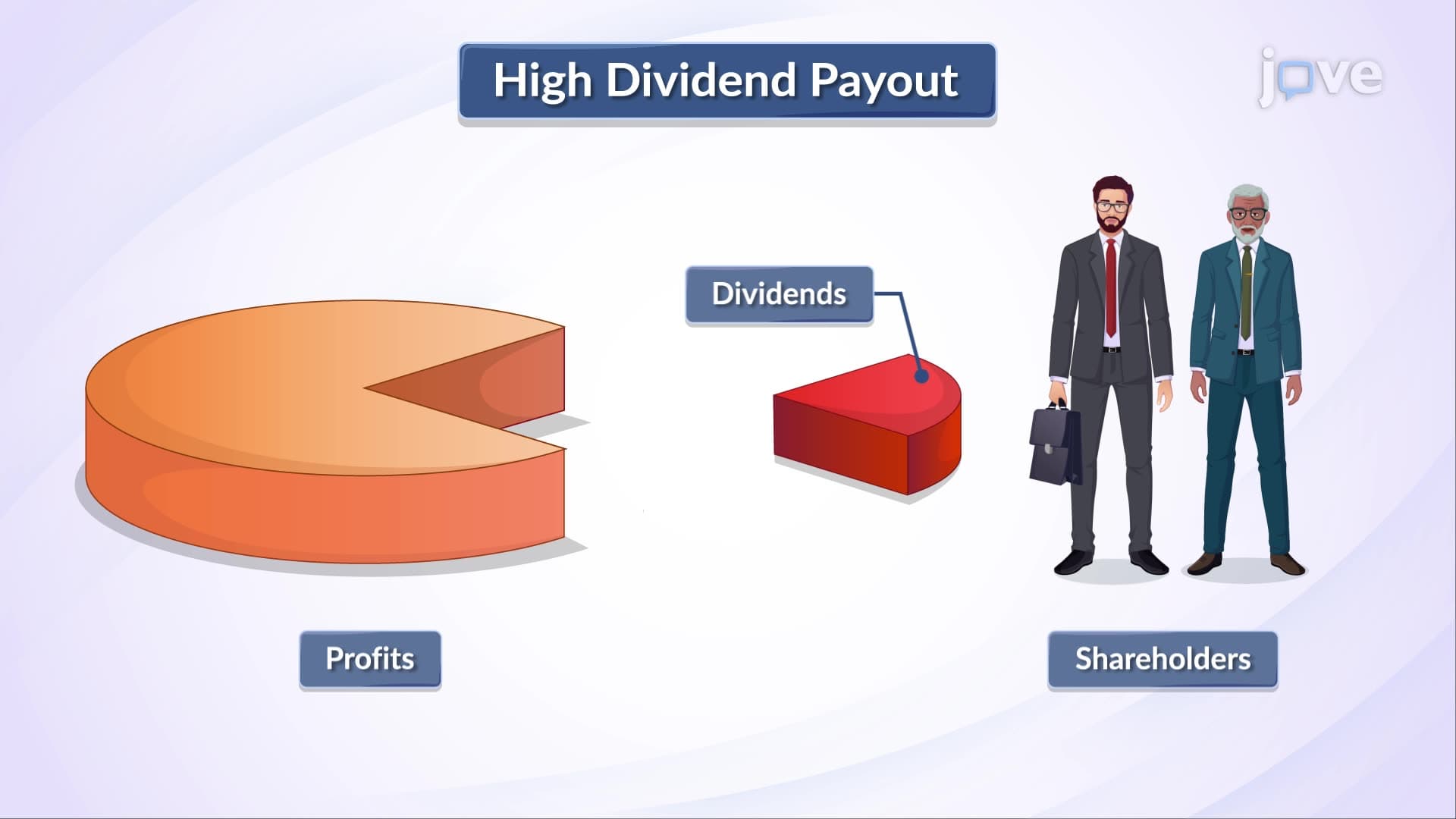
When Amazon surprises the market by initiating its first dividend while Apple increases its quarterly payout, investors ask: what factors supporting high dividend payouts drive these corporate decisions? Understanding factors supporting high dividend payout strategies helps professionals evaluate investment opportunities and corporate financial health. Companies like Procter & Gamble exemplify this approach, consistently rewarding shareholders while signaling market stability. Watch the full video on JoVE Coach to master this concept with expert-led visuals and step-by-step explanations.
- Apply dividend payout analysis to evaluate corporate financial stability and management confidence in future cash flows
- Identify mature companies with limited growth opportunities that prioritize shareholder returns over reinvestment strategies
- Assess industry characteristics that support sustainable high dividend policies, particularly in utilities and consumer staples sectors
- Leverage dividend yield metrics to distinguish between income-focused and growth-oriented investment opportunities
- Evaluate cash reserve management strategies and how excess liquidity influences dividend policy decisions
- Analyze competitive positioning signals that high dividend payouts send to institutional and retail investors
- Compare dividend sustainability across different business models and economic cycles for portfolio construction
- Implement dividend screening criteria to identify companies with reliable cash flow generation capabilities
Understanding the Strategic Foundation of High Dividend Payouts
Consider Berkshire Hathaway's recent decision to initiate dividends after decades of reinvestment focus-a move that signals Warren Buffett's acknowledgment of limited high-return investment opportunities. This exemplifies how factors supporting high dividend payout strategies reflect broader corporate lifecycle dynamics and capital allocation priorities.
Financial Maturity and Capital Allocation Efficiency
Mature companies operating in established markets face a fundamental capital allocation challenge: continue reinvesting in potentially lower-return projects or return capital to shareholders. Microsoft's transformation from a growth-focused tech company to a dividend aristocrat illustrates this evolution. The software giant now returns significant capital through dividends because its core markets have matured, and maintaining excessive cash reserves provides diminishing returns compared to shareholder distributions.
The decision matrix involves analyzing reinvestment opportunities against dividend yields. When internal projects consistently generate returns below 15-20%, management often shifts toward dividend policies to optimize shareholder value. This strategic pivot requires careful consideration of future growth prospects, competitive positioning, and cash flow predictability.
Industry Characteristics and Regulatory Environment
Utility companies like Duke Energy and NextEra Energy represent ideal high-dividend candidates due to regulated revenue streams and predictable cash flows. These businesses operate in capital-intensive industries with natural monopoly characteristics, generating steady returns that support consistent dividend payments. The regulatory framework provides revenue visibility, enabling management to commit to regular shareholder distributions without compromising operational requirements.
Consumer staples companies such as Coca-Cola and Johnson & Johnson leverage brand strength and defensive market positions to maintain dividend policies through economic cycles. Their non-cyclical revenue streams and pricing power create the financial stability necessary for sustainable high-dividend strategies.
Signaling Theory and Investor Attraction
High dividend payouts function as powerful market signals, communicating management confidence in future earnings and cash flow generation. When Apple doubled its dividend in recent years, the decision reflected management's assessment of business stability and excess capital generation capacity. This signaling mechanism attracts income-focused institutional investors, including pension funds and insurance companies requiring steady cash flows to meet obligations.
The investor clientele effect creates a self-reinforcing cycle: consistent high dividends attract income-focused investors, providing stock price stability that supports continued dividend policies. This dynamic particularly benefits companies seeking to reduce earnings volatility and maintain stable shareholder bases.
Frequently Asked Questions
Financial stability, predictable cash flows, limited growth opportunities, and excess capital generation drive high dividend policies. Companies prioritize shareholder returns when internal reinvestment options offer lower returns than distributing capital to investors.
Analyze free cash flow coverage ratios, debt-to-equity levels, and earnings consistency over multiple economic cycles. Companies with defensive business models and strong balance sheets maintain dividend payments better during downturns. Focus on dividend coverage ratios above 1.5x and consistent cash flow generation.
High-dividend stocks suit portfolios requiring steady income streams, particularly for pension funds or insurance companies with predictable payout obligations. They provide defensive characteristics during market volatility while offering inflation protection through dividend growth. Consider allocation timing based on interest rate environments and economic cycles.
High-dividend companies often become acquisition targets because consistent payouts demonstrate stable cash flows and mature market positions. However, dividend obligations can limit strategic flexibility and debt capacity for growth investments. Acquiring companies may reduce dividends post-merger to fund integration costs and growth initiatives.
P&G leverages diversified consumer staples products with consistent demand regardless of economic conditions. The company's global brand portfolio, pricing power, and operational efficiency generate predictable cash flows that support dividend payments. Their 66-year consecutive dividend increase record demonstrates this sustainability model.
Basic financial statement analysis and cash flow understanding suffice for evaluating dividend sustainability. Focus on learning key metrics like payout ratios, free cash flow, and debt coverage ratios. Most professionals can master dividend analysis through practice with publicly available financial data.
Dividend analysis skills directly apply to portfolio management, equity research, and investment advisory roles. Understanding dividend policies helps you identify stable income-generating investments, evaluate corporate capital allocation efficiency, and provide valuable insights for client investment recommendations and institutional portfolio construction.
Study dividend discount models for equity valuation, explore REIT dividend analysis for real estate investments, and learn about special dividend policies during capital restructuring events. Understanding tax implications of dividend policies across different investor types also provides valuable analytical depth.
Related Micro-courses

9 Concepts

11 Concepts

11 Concepts