Loading subject page…

- Finance
- Dividend and Payout Policy
- Factors Supporting Low Dividend Payout
Micro-course: Dividend and Payout Policy
1,159 views
Learn key concepts and earn your certificate.





Factors Supporting Low Dividend Payout

00:00
01:29
Video Summary: Factors Supporting Low Dividend Payout Explained
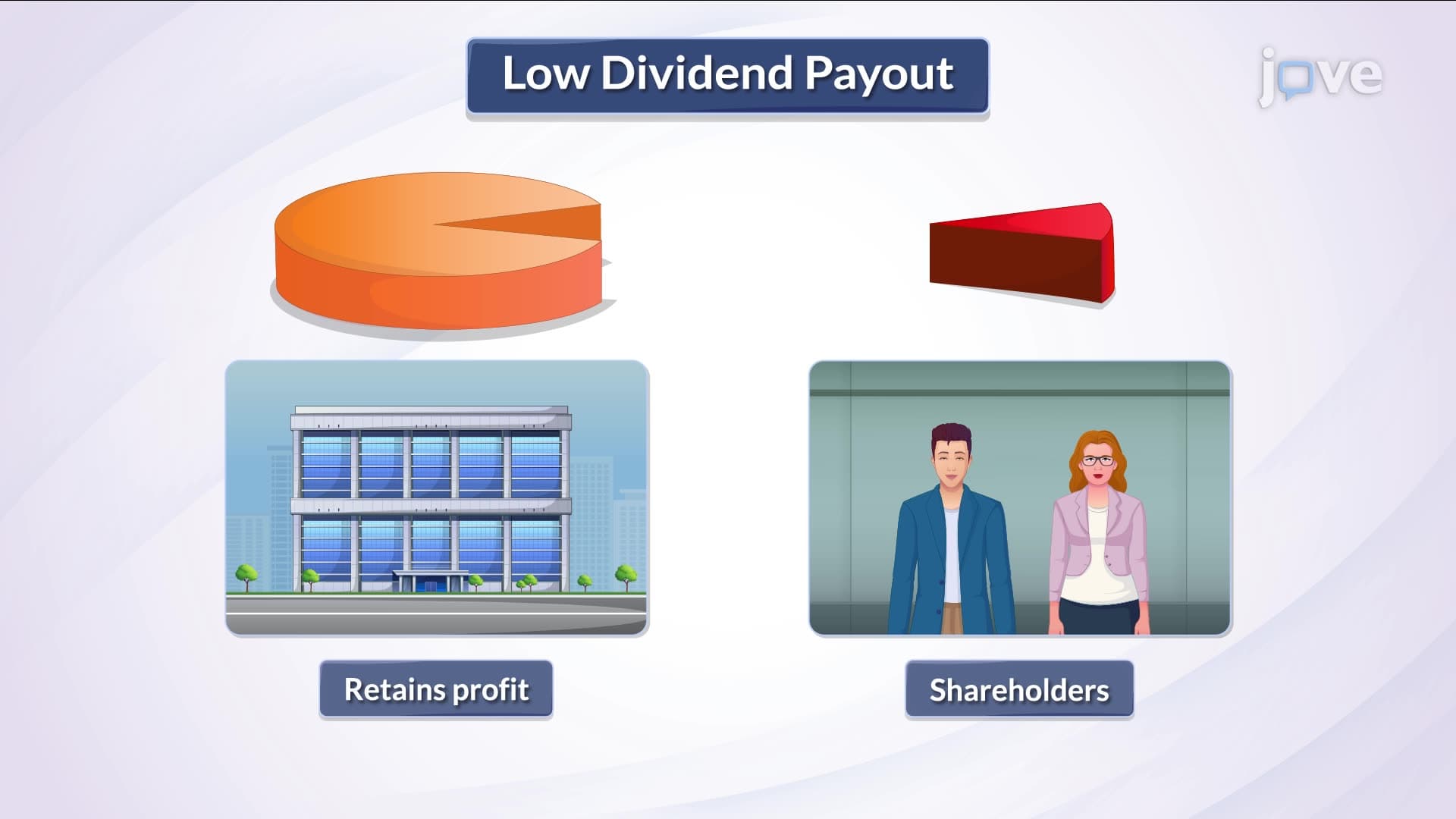
Corporate finance leaders face critical capital allocation decisions that directly impact shareholder value and competitive positioning. Factors supporting low dividend payouts represent strategic choices that prioritize reinvestment over immediate shareholder returns. Apple exemplifies this approach, historically retaining earnings to fund breakthrough innovations like the iPhone ecosystem rather than maximizing dividend distributions. This strategy enables companies to strengthen market position while maintaining financial flexibility during economic uncertainty. Watch the full video on JoVE Coach to master this concept with expert-led visuals and step-by-step explanations.
- Apply capital allocation frameworks to evaluate when low dividend policies create superior long-term shareholder value compared to high-payout strategies
- Analyze growth company financial statements to identify reinvestment opportunities that justify retaining earnings over dividend distributions
- Assess debt-to-equity ratios and coverage metrics to determine when debt reduction should take priority over dividend payments in corporate strategy
- Evaluate tax implications of dividend policies for both corporate entities and institutional investors in different market environments
- Implement cash flow forecasting models that balance growth investment needs with shareholder return expectations
- Identify industry-specific factors that influence optimal dividend payout ratios across technology, manufacturing, and service sectors
- Leverage low dividend strategies as competitive advantages during market downturns or periods of rapid industry transformation
- Compare peer company dividend policies to benchmark your organization's capital allocation effectiveness and investor communication strategy
Understanding Factors Supporting Low Dividend Payout Strategies
When Netflix decided to maintain minimal dividend payments during its streaming transformation, the company demonstrated how factors supporting low dividend payout explained principles drive strategic value creation. This decision enabled Netflix to invest over $15 billion annually in original content, fundamentally reshaping the entertainment industry while competitors struggled with legacy business models.
Growth Investment Imperatives Drive Capital Retention
High-growth companies face a fundamental capital allocation choice: distribute profits to shareholders or reinvest in market expansion. Amazon's two-decade approach of minimal dividends while investing heavily in infrastructure, AWS development, and market penetration illustrates how retained earnings can generate exponential returns. Technology leaders, pharmaceutical innovators, and emerging market disruptors typically prioritize reinvestment over dividends because their return on invested capital significantly exceeds what shareholders could achieve through alternative investments.
Financial Stability and Debt Management Considerations
Companies carrying substantial debt loads must balance shareholder expectations with financial prudence. General Electric's dramatic dividend reduction from $0.24 to $0.01 per share during 2017-2018 demonstrated how debt obligations can necessitate low payout policies. This strategic pivot allowed GE to allocate $20+ billion toward debt reduction rather than dividend payments, ultimately strengthening the balance sheet and preserving long-term viability. CFOs must evaluate interest coverage ratios, debt maturity schedules, and refinancing risks when determining sustainable payout levels.
Tax Optimization and Regulatory Environment Impact
Corporate tax strategy significantly influences dividend policy decisions. Companies operating in high-tax jurisdictions may find that retaining earnings provides superior after-tax returns for shareholders compared to dividend distributions that face double taxation. Additionally, regulatory requirements in heavily regulated industries like banking often mandate specific capital retention levels, limiting dividend flexibility regardless of profitability.
Competitive Positioning Through Strategic Reinvestment
Low dividend policies enable rapid response to competitive threats and market opportunities. Tesla's approach of reinvesting virtually all profits into manufacturing capacity, charging infrastructure, and autonomous driving technology allowed the company to maintain technological leadership while traditional automakers struggled to transition to electric vehicles. This strategic choice created sustainable competitive advantages that high dividend payments would have prevented.
Frequently Asked Questions
Low dividend payout factors are strategic considerations that justify retaining most company profits rather than distributing them to shareholders. These include growth investment opportunities, debt reduction priorities, tax optimization strategies, and competitive positioning needs. Companies like Alphabet and Microsoft historically used this approach to fund innovation and market expansion.
Assess your industry's capital intensity, growth prospects, and competitive dynamics alongside your debt levels and cash flow stability. Compare your return on invested capital to shareholder dividend yield expectations. High-growth sectors typically benefit more from retention strategies than mature, stable industries with limited expansion opportunities.
Consider dividend reductions when facing significant growth opportunities requiring capital investment, elevated debt levels threatening financial stability, or industry disruption demanding rapid strategic pivots. Present clear ROI projections showing how retained earnings will generate superior long-term shareholder value compared to current dividend yields.
Focus on return on invested capital (ROIC) exceeding cost of capital, debt-to-equity ratios above industry benchmarks, revenue growth rates outpacing competitors, and market share expansion opportunities. Demonstrate how reinvestment creates sustainable competitive advantages that dividend payments cannot deliver.
Berkshire Hathaway never paid regular dividends, instead reinvesting profits through acquisitions and business expansion under Warren Buffett's leadership. This approach generated compound annual returns exceeding 20% over decades, far surpassing what dividend-focused strategies could have achieved for shareholders.
Basic financial statement literacy and cash flow understanding enable effective participation in dividend policy discussions. Focus on learning key ratios like payout ratios, debt coverage metrics, and return on invested capital calculations. Most strategic decisions rely more on business judgment than complex financial modeling.
Understanding capital allocation strategies positions you for senior finance roles, board advisory positions, and strategic planning responsibilities. This knowledge proves valuable in M&A evaluations, investor relations, and executive decision-making processes across industries.
Study capital structure optimization, cost of capital calculations, and shareholder value creation frameworks. Understanding share buyback strategies, debt refinancing decisions, and merger considerations will provide comprehensive capital allocation expertise essential for senior leadership roles.
Related Micro-courses

9 Concepts

11 Concepts

11 Concepts