Loading subject page…


4,805 views

Video Summary: Equation of Motion for a Tutorial
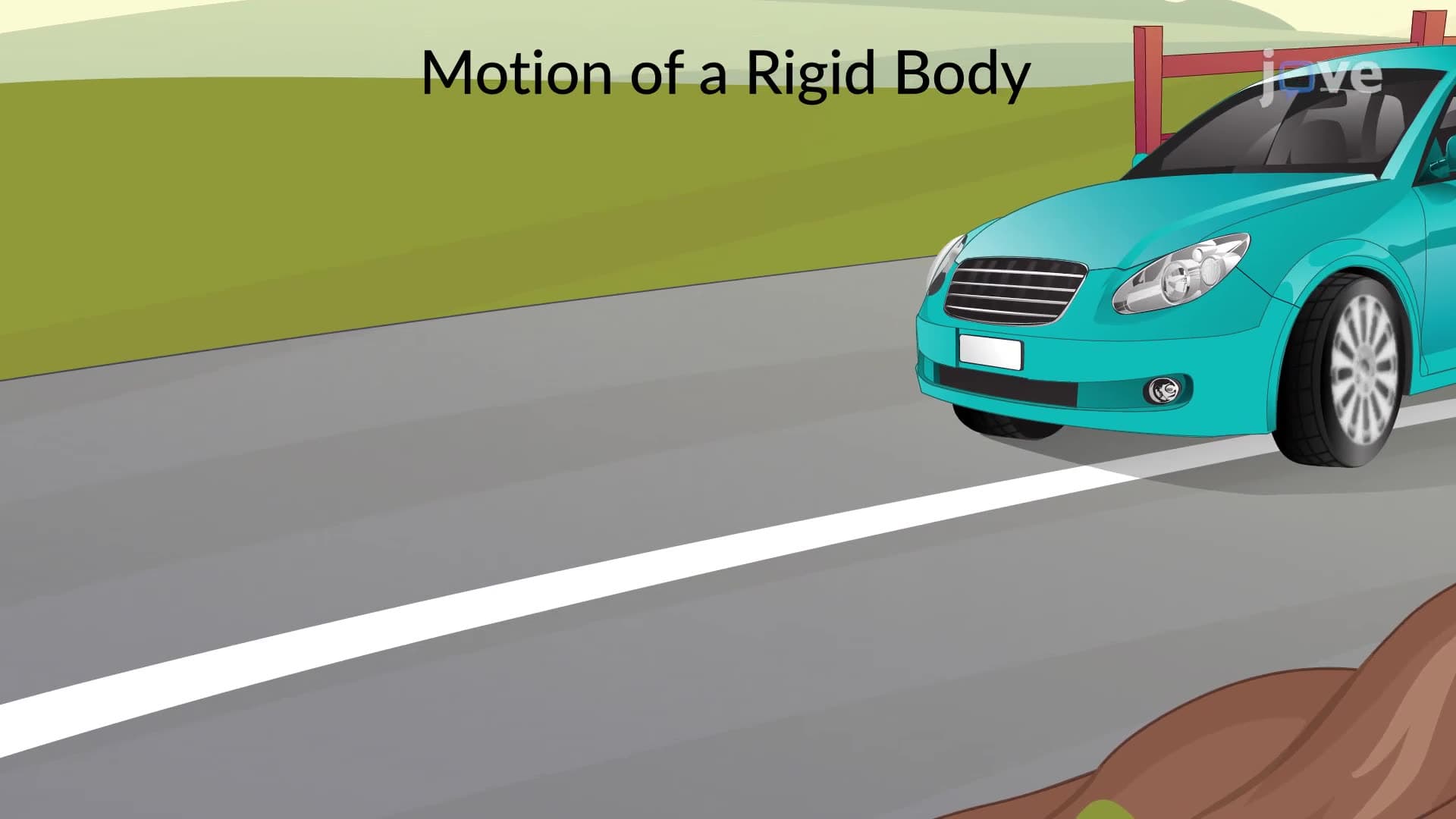
Ever wondered how NASA engineers calculate the exact trajectory needed to land a rover on Mars? The equation of motion for a rigid body combines both translational and rotational dynamics, describing how objects move through space under applied forces. For example, when a football spirals through the air after a quarterback's throw, engineers use these equations to predict its path by analyzing forces at the center of mass and moments causing rotation. Watch the full video on JoVE Coach to master this concept with expert-led visuals and step-by-step explanations.
The equation of motion for a rigid body represents one of the most fundamental concepts in classical mechanics, bridging the gap between simple particle motion and complex real-world dynamics. Unlike point particles that only translate, rigid bodies can simultaneously translate and rotate, requiring a more sophisticated mathematical framework to describe their motion completely.
The translational component follows Newton's Second Law applied to the body's center of mass (G). This gives us F = ma for the entire system, where F represents the sum of all external forces acting on the body. In practical applications like automotive crash testing, engineers at the National Highway Traffic Safety Administration (NHTSA) use this principle to analyze how vehicles deform and move during collisions. The center of mass motion remains predictable even when the vehicle experiences complex rotational effects.
When forces act at points other than the center of mass, they create moments that cause rotation. The rotational equation states that the sum of moments about point G equals the rate of change of angular momentum. This principle explains why a figure skater spins faster when pulling their arms inward-the angular momentum remains constant, but the moment of inertia changes. For AP Physics students, understanding this relationship is crucial for solving problems involving rolling objects, pendulums, and rotating machinery.
The complete derivation involves vector products to express angular momentum as H = r × mv, where r is the position vector relative to the center of mass and v is the relative velocity. Taking time derivatives and applying the distributive law for vectors yields the final moment equation. This mathematical approach appears frequently on the MCAT physics section, where students must demonstrate understanding of vector operations in three-dimensional motion problems.
Modern applications range from robotics control systems to spacecraft attitude determination. Boeing engineers use these equations when designing aircraft control surfaces, ensuring proper response to pilot inputs. College-level physics courses often explore these concepts through laboratory experiments with gyroscopes, spinning wheels, and compound pendulums, helping students visualize the abstract mathematical relationships in tangible systems.
Related Micro-courses