Loading subject page…


4,807 views


Video Summary: Kinetic Energy for a Rigid Body Explained
Ever wondered why a spinning figure skater pulls in their arms to spin faster? Kinetic energy for a rigid body involves both translational motion of the center of mass and rotational motion about that center. Consider a NASCAR race car taking a banked turn at Daytona International Speedway - its total kinetic energy combines the energy from moving forward and the energy from any rotation about its center of mass. This dual-component nature makes Kinetic Energy For A Rigid Body Explained essential for understanding real-world motion. Watch the full video on JoVE Coach to master this concept with expert-led visuals and step-by-step explanations.
The kinetic energy of a rigid body in planar motion represents one of the most fundamental concepts in mechanics, bridging the gap between particle dynamics and real-world engineering applications. Unlike a point particle that only has translational kinetic energy, a rigid body possesses both translational and rotational kinetic energy components, making the analysis significantly more complex yet practically relevant.
The total kinetic energy of a rigid body depends critically on the choice of reference point. When we select an arbitrary point A as our reference, the kinetic energy expression becomes more complex because it must account for the relative positions of all mass elements with respect to this point. The mathematical development involves expressing individual particle velocities in terms of the velocity of point A plus the relative velocity due to rotation.
The power of this approach becomes evident when we choose the center of mass G as our reference point. In this case, the integral of position vectors weighted by mass elements vanishes due to the definition of center of mass. This mathematical simplification yields the famous result: KE(total) = KE(translation of center of mass) + KE(rotation about center of mass). This equation appears frequently on AP Physics C exams and forms the foundation for analyzing complex motions in college-level dynamics courses.
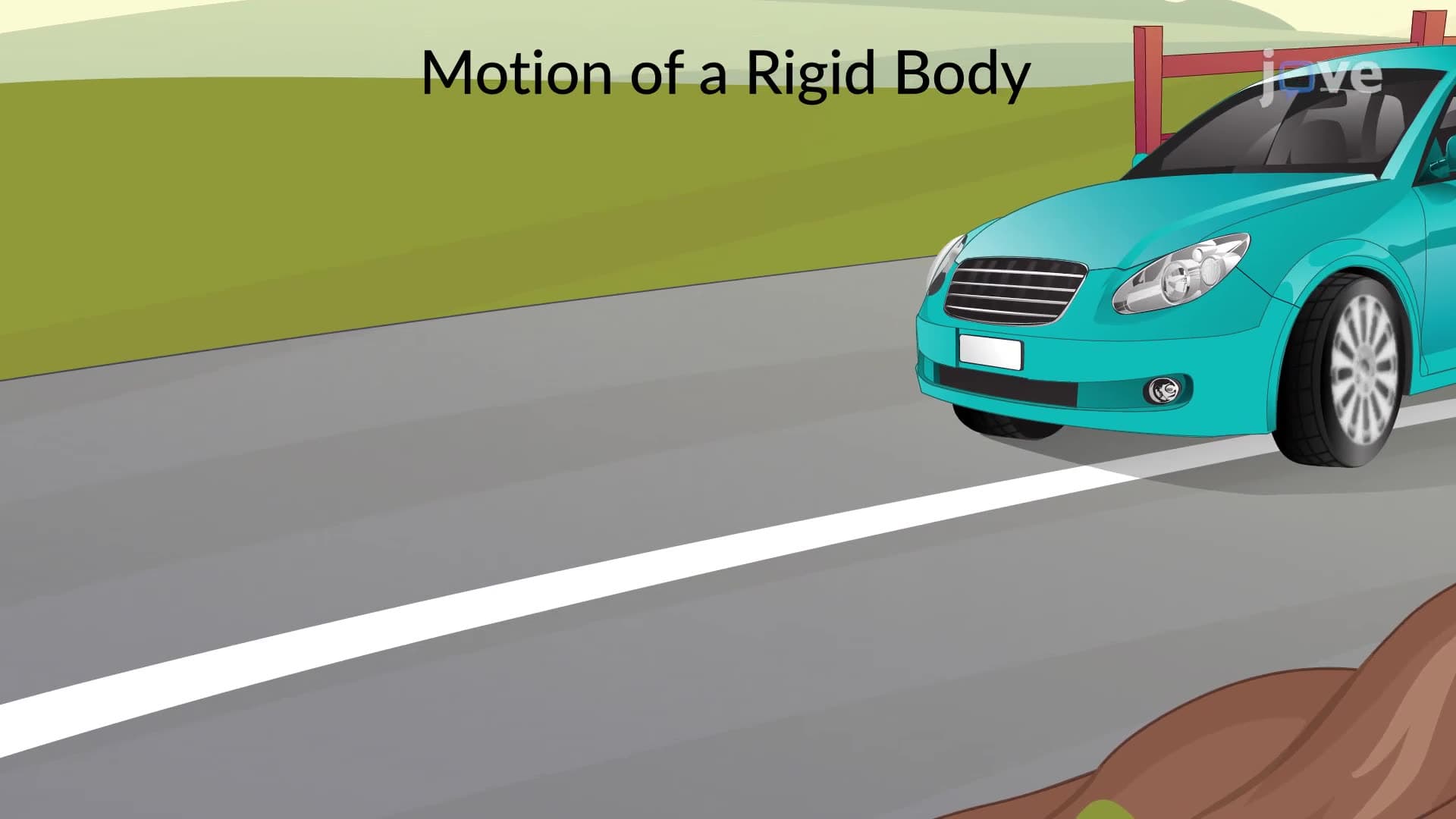
Consider a rolling wheel on a highway - perhaps a semi-truck tire traveling at 65 mph on Interstate 95. The total kinetic energy includes both the translational energy from the truck moving forward and the rotational energy from the wheel spinning about its center. This dual nature explains why anti-lock braking systems (ABS) are so effective - they prevent wheels from locking up and losing their rotational kinetic energy component, which would reduce overall braking efficiency.
The concept becomes even more critical in aerospace applications. NASA engineers analyzing satellite motion must account for both orbital kinetic energy (translational) and spin stabilization energy (rotational). The International Space Station, for example, maintains its orientation through carefully controlled rotational kinetic energy while simultaneously possessing enormous translational kinetic energy as it orbits Earth at approximately 17,500 mph.
The relationship between kinetic energy and angular momentum provides another powerful analytical tool. When the reference point is fixed within the rigid body, the kinetic energy expression simplifies significantly, allowing engineers to use component-form equations that are particularly useful in computer simulations and finite element analysis. This connection proves invaluable for students preparing for the MCAT Physics section, where understanding energy-momentum relationships is essential for success.
Related Micro-courses