Loading subject page…


4,806 views

Video Summary: What Is Torque Free Motion
Ever wonder why a spinning football tumbles through the air in such a predictable pattern? Torque free motion explains the fascinating behavior of rotating objects when no external forces twist them. This fundamental physics concept describes how rigid bodies like satellites, footballs, or even NASA's space stations maintain their angular momentum while freely rotating in space. Understanding what is torque free motion reveals the elegant mathematics behind everyday spinning objects and complex aerospace engineering. Watch the full video on JoVE Coach to master this concept with expert-led visuals and step-by-step explanations.
Torque free motion represents one of the most elegant phenomena in classical mechanics, describing how rigid bodies behave when rotating without external torques. This concept forms the foundation for understanding everything from satellite orientation control to the physics behind a perfectly thrown spiral pass in American football.
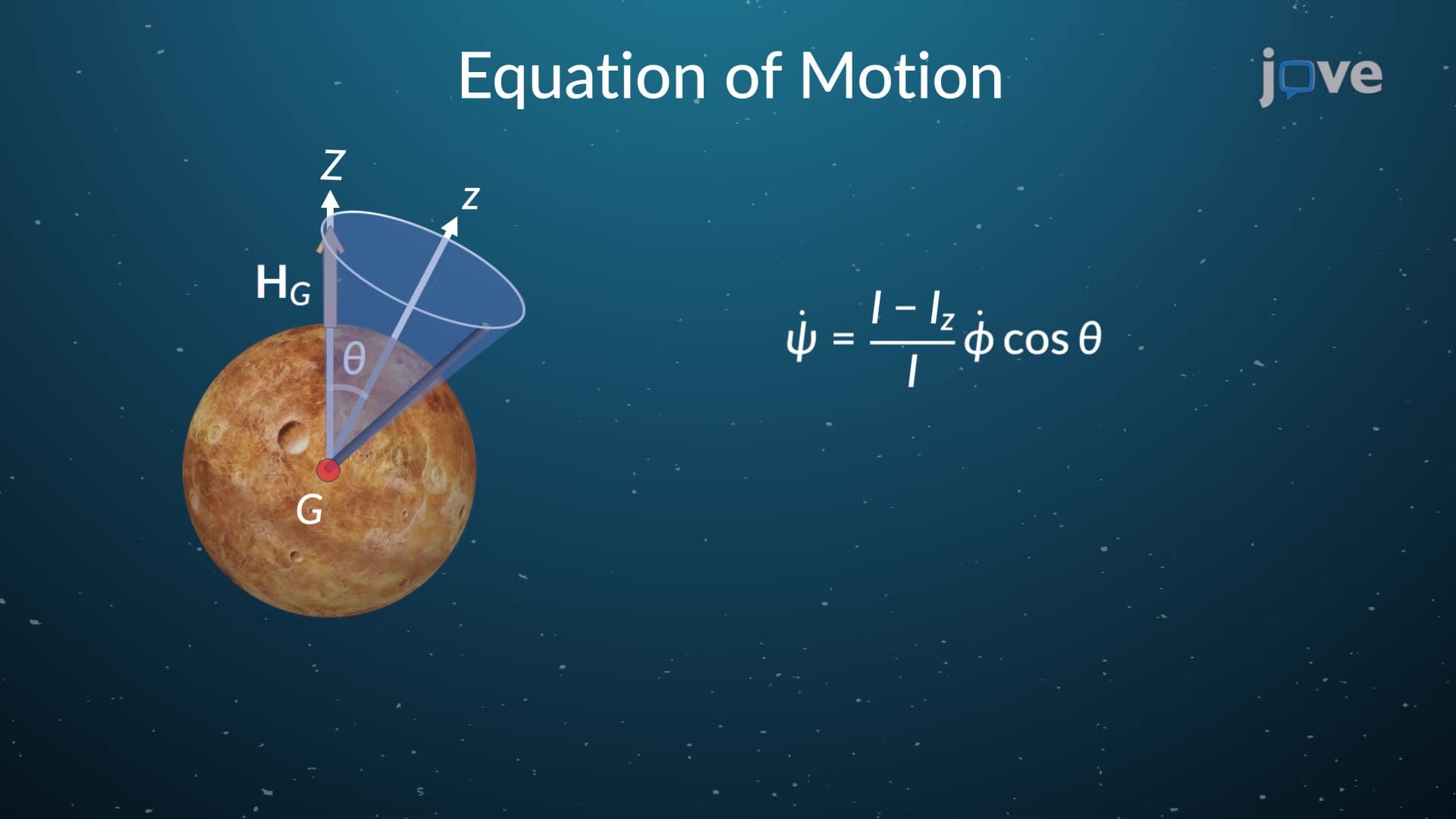
At its core, the torque free motion definition involves a rigid body rotating freely in space with conserved angular momentum. When no external torques act on an object, its angular momentum vector remains fixed in space, even as the object itself may exhibit complex rotational behavior. This principle underlies NASA's satellite stabilization systems and explains why spinning objects in zero gravity maintain their rotational characteristics.
The mathematics of torque-free motion centers on the conservation of angular momentum. For an axisymmetric object-one with rotational symmetry about a particular axis-the moment of inertia about perpendicular axes remains equal. This symmetry creates predictable motion patterns that engineers exploit in gyroscopic systems.
Consider a spinning satellite: its angular momentum vector points in a fixed direction in space, while the satellite body may precess around this fixed direction. The precession frequency depends on the ratio of moments of inertia and the initial spinning rate. This relationship appears frequently on AP Physics C exams and college-level mechanics courses, where students must analyze the motion of spinning tops, gyroscopes, or astronomical objects.
Understanding torque free motion proves crucial in aerospace engineering, where spacecraft must maintain precise orientations without constant fuel consumption. The Hubble Space Telescope uses reaction wheels-essentially controlled spinning masses-that operate on torque-free motion principles to point accurately at distant stars.
In sports science, understanding this concept explains why footballs spiral through the air or why figure skaters can control their spinning speed by adjusting their body position. The conservation laws governing torque-free motion help optimize everything from satellite design to athletic performance analysis.
Students encountering torque-free motion problems in AP Physics, MCAT preparation, or undergraduate mechanics courses should focus on identifying the conserved quantities. The key insight involves recognizing that while individual components of angular velocity may change, the total angular momentum magnitude and direction remain constant in the absence of external torques.
Problem-solving typically involves setting up coordinate systems, applying conservation laws, and analyzing the resulting motion equations. Understanding reference frame transformations becomes essential, as the motion appears different when viewed from rotating versus inertial frames-a concept that frequently appears in standardized physics examinations.
Related Micro-courses