Loading subject page…

- Mechanical Engineering
- Physics Basics
- Gravitational Force
Micro-course: Physics Basics
13,580 views
Learn key concepts and earn your certificate.





Gravitational Force

00:00
01:16
Video Summary: What Is Gravitational Force
Ever wonder why a dropped basketball falls at the same rate as a feather in a vacuum chamber? Gravitational force is the universal attraction between all objects with mass, governing everything from your weight on Earth to NASA's Mars rover trajectories. This fundamental force follows Newton's law of universal gravitation, where the attraction between two masses depends on their masses and distance apart. Understanding gravitational force reveals why the International Space Station orbits Earth and how engineers calculate structural loads in skyscrapers. Watch the full video on JoVE Coach to master this concept with expert-led visuals and step-by-step explanations.
- Understand what is gravitational force and how it operates as a universal attraction between all masses
- Identify the key components of Newton's law of universal gravitation: F = G(m1×m2)/r²
- Analyze the relationship between gravitational force, mass, and distance in real-world scenarios
- Compare gravitational force with other fundamental forces in nature
- Apply gravitational force calculations to solve engineering and physics problems
- Recognize the difference between mass and weight in gravitational contexts
- Evaluate how gravitational acceleration affects objects near Earth's surface
- Explore practical applications of gravitational force in aerospace engineering and structural design
Understanding What is Gravitational Force
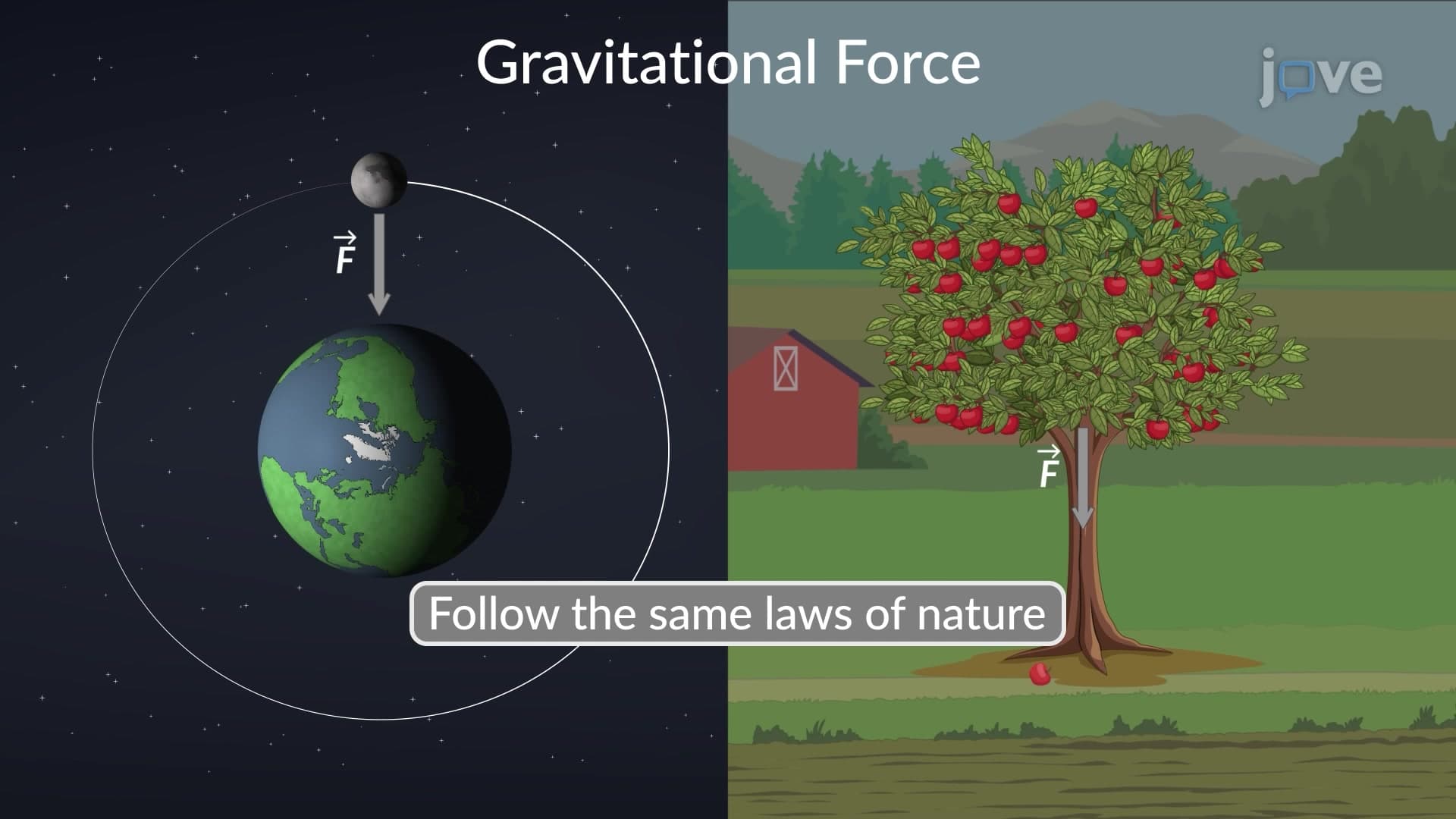
Gravitational force represents one of nature's four fundamental forces, acting as an invisible attraction between any two objects possessing mass. Unlike contact forces such as friction or tension, gravity operates across vast distances without physical contact, making it a "field force." This universal attraction governs phenomena ranging from an apple falling from a tree to the orbital mechanics of GPS satellites that enable precise navigation across the United States.
Newton's Law of Universal Gravitation
Sir Isaac Newton formulated the mathematical relationship describing gravitational attraction: F = G(m1×m2)/r². In this equation, F represents the gravitational force, G is the universal gravitational constant (6.67 × 10⁻¹¹ N⋅m²/kg²), m1 and m2 are the masses of the two objects, and r is the distance between their centers. This inverse square relationship means doubling the distance reduces the force to one-fourth its original value, explaining why astronauts experience weightlessness in orbit despite being only 250 miles above Earth's surface.
Weight vs. Mass: A Critical Distinction
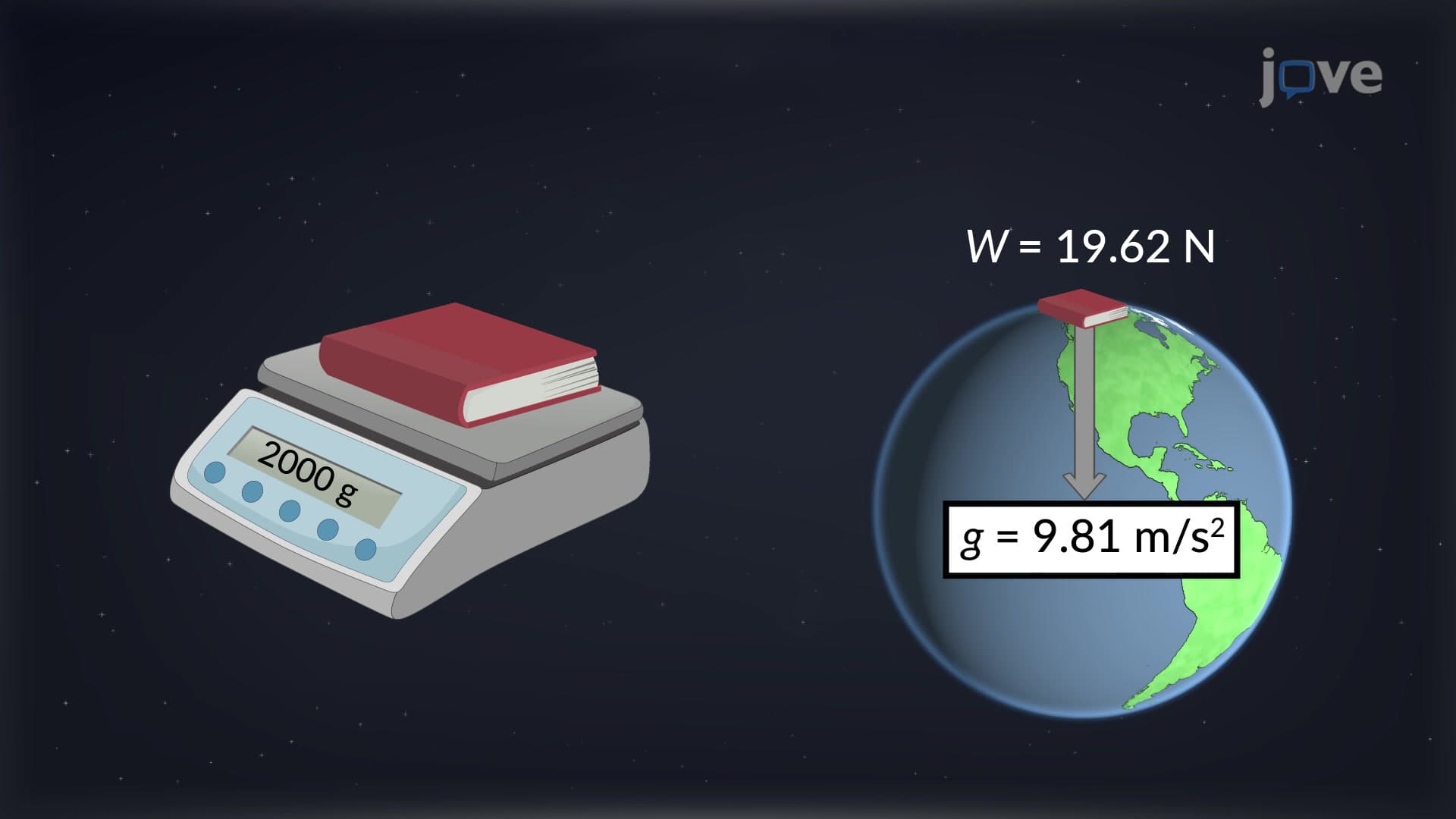
Students often confuse mass and weight, but understanding their difference proves crucial for AP Physics and engineering coursework. Mass measures the amount of matter in an object and remains constant regardless of location. Weight, however, represents the gravitational force Earth exerts on that mass, calculated as W = mg, where g equals 9.8 m/s² near Earth's surface. An astronaut with a mass of 70 kg weighs 686 N (154 lbs) on Earth but only 113 N (25 lbs) on the Moon due to the Moon's weaker gravitational field.
Engineering Applications and Real-World Impact
Gravitational force calculations prove essential in numerous engineering disciplines. Civil engineers must account for gravitational loads when designing bridges like California's Golden Gate Bridge or skyscrapers like New York's One World Trade Center. Aerospace engineers at NASA's Jet Propulsion Laboratory use gravitational force principles to plan spacecraft trajectories, including gravity-assist maneuvers that propel probes like Voyager beyond our solar system. These applications demonstrate how fundamental physics concepts directly impact technological advancement and human exploration.
Frequently Asked Questions
Gravitational force is the natural attraction between any two objects that have mass. It's the force that keeps your feet on the ground, causes objects to fall when dropped, and holds planets in orbit around the Sun. This invisible force acts across any distance and becomes stronger when objects are more massive or closer together.
AP Physics exams frequently include gravitational force problems involving orbital mechanics, weight calculations on different planets, and applying Newton's law of universal gravitation. Students must solve for unknown variables in F = G(m1×m2)/r² and explain conceptual relationships between mass, distance, and gravitational attraction. Free-response questions often combine gravitational force with circular motion and energy conservation principles.
The MCAT Physics section tests gravitational force through problems involving planetary motion, satellite orbits, and gravitational potential energy. Students encounter questions about gravitational acceleration, weight versus mass distinctions, and applications of inverse square relationships. Understanding gravitational force helps solve complex physics passages involving space medicine and astronomical phenomena.
Gravitational force influences countless daily activities, from GPS navigation systems that account for gravitational time dilation to hydroelectric power plants like Hoover Dam that harness gravity's pull on water. Engineers designing roller coasters at theme parks like Six Flags use gravitational force calculations to ensure safety and excitement. Even simple activities like pouring coffee or playing basketball involve gravitational principles.
Basic gravitational force concepts require only algebra and an understanding of proportional relationships. While advanced applications involve calculus, high school students can master fundamental principles using simple mathematical operations. The key lies in understanding conceptual relationships: greater mass means stronger attraction, greater distance means weaker force, and these relationships follow predictable mathematical patterns.
Focus on mastering the gravitational force equation F = G(m1×m2)/r² and practice identifying which variables are given versus unknown. Create concept maps connecting gravitational force to weight, orbital motion, and energy conservation. Work through problems involving different planetary environments and satellite orbits, as these frequently appear on standardized tests and college physics exams.
Gravitational force serves as the foundation for studying orbital mechanics, general relativity, and astrophysics. Students can explore gravitational potential energy, tidal forces, and Einstein's theory of general relativity, which describes gravity as curved spacetime. These advanced topics appear in upper-level physics courses and connect to cutting-edge research in cosmology and space exploration.
Engineering disciplines rely heavily on gravitational force principles for structural analysis, aerospace design, and geotechnical engineering. Understanding how gravity affects material stresses, fluid flow, and mechanical systems proves essential for designing safe, efficient structures and machines. From calculating foundation loads to planning satellite trajectories, gravitational force applications span virtually every engineering field.
Related Micro-courses