Loading subject page…

Micro-course: Physics Basics
13,580 views
Learn key concepts and earn your certificate.




Tension


00:00
01:10
Video Summary: What Is Tension
Ever wonder why the cables on the Golden Gate Bridge don't snap under massive loads? Tension is the invisible force that keeps suspended structures stable and safe. This pulling force acts along strings, cables, and rods when forces pull from opposite ends, making it essential for analyzing everything from elevator cables to suspension bridges. Understanding what is tension helps engineers design structures that can withstand enormous stresses. Watch the full video on JoVE Coach to master this concept with expert-led visuals and step-by-step explanations.
- Understand what is tension and how this pulling force differs from compression and other force types
- Identify tension forces in free-body diagrams and represent them using proper vector notation
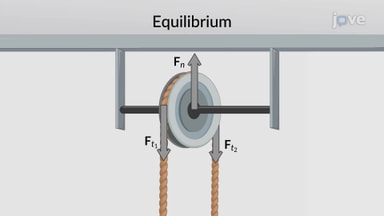
- Analyze equilibrium conditions in systems where tension forces balance other forces like weight and friction
- Apply tension calculations to solve problems involving cables, pulleys, and suspended loads
- Evaluate how angles affect tension magnitude in cable and rope systems
- Recognize the principle that tension remains uniform throughout an ideal, massless cable
- Explore real-world applications of tension in bridges, elevators, and mechanical linkages
- Compare tension forces in static systems versus dynamic loading conditions
Understanding What is Tension: The Fundamentals
Tension represents one of the most crucial force concepts in physics and engineering. Unlike compression forces that push objects together, tension is exclusively a pulling force that acts along the length of flexible connectors like cables, ropes, and chains. When you pull on both ends of a rope, the internal force trying to restore the rope to its original length is tension.
The tension definition becomes clearer when we consider that this force always acts along the direction of the cable or rope, never perpendicular to it. In engineering analysis, tension forces appear as arrows pointing away from the object being analyzed, indicating the pulling action of the connected cable.
Mathematical Representation and Equilibrium
For objects in static equilibrium, the sum of all forces equals zero. When analyzing what is tension in detail, we often use the equilibrium equation: ΣF = 0. In a simple hanging mass scenario, the upward tension force T exactly balances the downward gravitational force mg, giving us T = mg.
This principle becomes more complex with angled cables. Consider a traffic light suspended by two cables at angles θ₁ and θ₂ from the horizontal. Each cable carries tension forces T₁ and T₂, and their vertical components must sum to support the light's weight: T₁sin(θ₁) + T₂sin(θ₂) = mg.
Real-World Applications and Examples
The tension concept appears everywhere in American infrastructure. The Brooklyn Bridge's main cables experience enormous tension forces exceeding 35,000 pounds per square inch. Elevator systems in skyscrapers like the Empire State Building rely on precisely calculated cable tensions to safely transport passengers. Even simple applications like clotheslines demonstrate tension principles-the rope sags under load until tension forces balance the weight.
Academic and Exam Relevance
Understanding tension basics proves essential for success in AP Physics courses, college-level statics classes, and engineering programs. Students frequently encounter tension problems on standardized exams, particularly scenarios involving pulleys, inclined planes, and multi-body systems. The tension study guide approach involves mastering free-body diagrams, applying Newton's laws, and solving simultaneous equations for unknown tension values.
Engineering students at institutions like MIT and Stanford build upon these fundamentals when analyzing complex structural systems, making this tension overview knowledge indispensable for future coursework in mechanics, structural analysis, and machine design.
Frequently Asked Questions
Tension is a pulling force transmitted through cables, ropes, or strings when pulled from opposite ends. Unlike compression (pushing) or shear forces, tension only acts along the length of the connector and always pulls objects toward the cable's attachment point. This makes tension unique among mechanical forces.
Start by drawing clear free-body diagrams showing all forces including tension vectors. Apply Newton's first law (ΣF = 0) for static problems, breaking angled forces into components. Practice common scenarios like Atwood machines and pulley systems that frequently appear on AP Physics 1 and C exams.
College exams typically focus on multi-cable systems, tension in rotating objects, and combined tension-friction problems. Students should master vector resolution, understand that tension is uniform in massless ropes, and practice solving simultaneous equilibrium equations for unknown tension values.
Tension appears in suspension bridges like San Francisco's Golden Gate Bridge, elevator cables in high-rise buildings, power transmission lines, crane operations at construction sites, and even simple applications like towing cables and ziplines at adventure parks across the US.
Tension concepts are very manageable with proper fundamentals in basic algebra and trigonometry. Most high school students successfully master tension problems by focusing on systematic free-body diagrams and step-by-step force analysis rather than memorizing formulas.
Practice drawing accurate free-body diagrams daily and work through progressively complex scenarios starting with single hanging masses, then angled cables, and finally pulley systems. Focus on identifying all forces before attempting mathematical solutions.
MCAT questions often embed tension concepts within biological contexts like muscle forces, tendon mechanics, or medical device applications. The exam tests conceptual understanding rather than complex calculations, focusing on force direction and equilibrium principles.
Progress to dynamic tension problems involving accelerating systems, rotational motion with strings, and elastic deformation under tension loads. These concepts prepare students for advanced mechanics, materials science, and structural engineering coursework.
Related Micro-courses