Loading subject page…


7,241 views


Video Summary: Conservation of Linear Momentum for Explained
Ever wonder why a pool cue ball stops dead when it hits another ball head-on? The conservation of linear momentum for colliding objects explains this fascinating phenomenon that occurs millions of times daily in American bowling alleys, pool halls, and physics classrooms. When external forces like friction are negligible during brief collisions, momentum transfers between objects while the total system momentum remains constant. This fundamental principle governs everything from billiard ball interactions to car crash dynamics. Watch the full video on JoVE Coach to master this concept with expert-led visuals and step-by-step explanations.
Conservation of linear momentum for represents one of physics' most fundamental principles, stating that the total momentum of an isolated system remains constant when no external forces act upon it. This concept becomes particularly powerful when analyzing collisions, where objects exchange momentum in predictable ways that follow strict mathematical relationships.
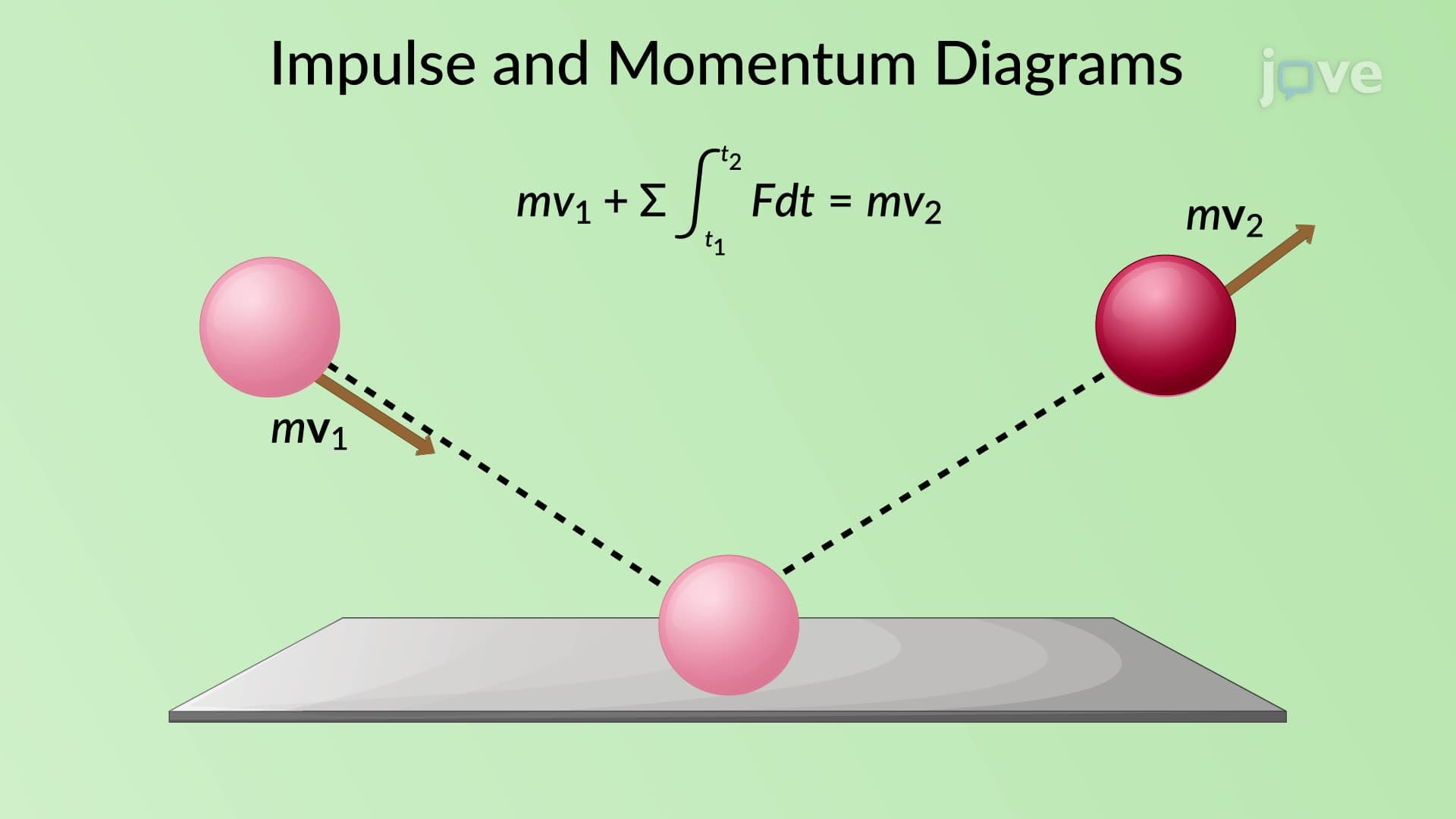
The distinction between impulsive and non-impulsive forces proves crucial for understanding when momentum conservation applies. Impulsive forces act over extremely short time intervals-typically milliseconds-yet produce dramatic changes in an object's motion. Consider a baseball bat striking a ball: the contact lasts roughly 0.001 seconds but completely reverses the ball's direction. During this brief collision, forces like gravity and air resistance become negligible compared to the massive collision force, allowing us to treat the system as isolated.
Non-impulsive forces, such as friction between billiard balls and felt table surfaces, operate continuously over longer periods. While these forces gradually affect motion, their impact during brief collisions remains minimal. This distinction allows physicists and engineers to simplify complex real-world problems by focusing on dominant forces during specific time intervals.
The mathematical expression for momentum conservation states that initial momentum equals final momentum: m1v1i + m2v2i = m1v1f + m2v2f. This equation applies directly to AP Physics problems, college mechanics courses, and MCAT physics sections, where students must calculate velocities before and after collisions.
Real-world applications extend far beyond classroom examples. Automotive engineers use momentum conservation principles when designing crumple zones and airbag systems. NASA mission planners apply these concepts when calculating spacecraft trajectories during gravitational assists. Even sports analysts use momentum conservation to explain why certain batting techniques produce optimal results in Major League Baseball.
Understanding elastic versus inelastic collisions enhances momentum conservation applications. In perfectly elastic collisions, both momentum and kinetic energy are conserved-imagine two steel balls colliding on a smooth surface. Inelastic collisions conserve momentum but not kinetic energy, such as when clay balls stick together after impact. Most real-world collisions fall between these extremes, making momentum conservation a more universally applicable principle than energy conservation.
Related Micro-courses