Loading subject page…


7,241 views

Video Summary: Linear Impulse and Momentum Principle for a Single Particle
Why does a baseball pitcher's follow-through matter so much for velocity? The linear impulse and momentum principle for a single particle explains how force applied over time changes an object's motion. When a pitcher extends their throwing motion, they increase the time during which force acts on the ball, maximizing the impulse and resulting momentum change. This fundamental physics concept governs everything from NASA rocket launches to car safety design. Watch the full video on JoVE Coach to master this concept with expert-led visuals and step-by-step explanations.
The linear impulse and momentum principle for a single particle forms a cornerstone of classical mechanics, bridging Newton's laws with practical motion analysis. Unlike instantaneous force analysis, this principle examines how forces acting over time intervals create momentum changes, making it invaluable for collision analysis, sports biomechanics, and engineering design.
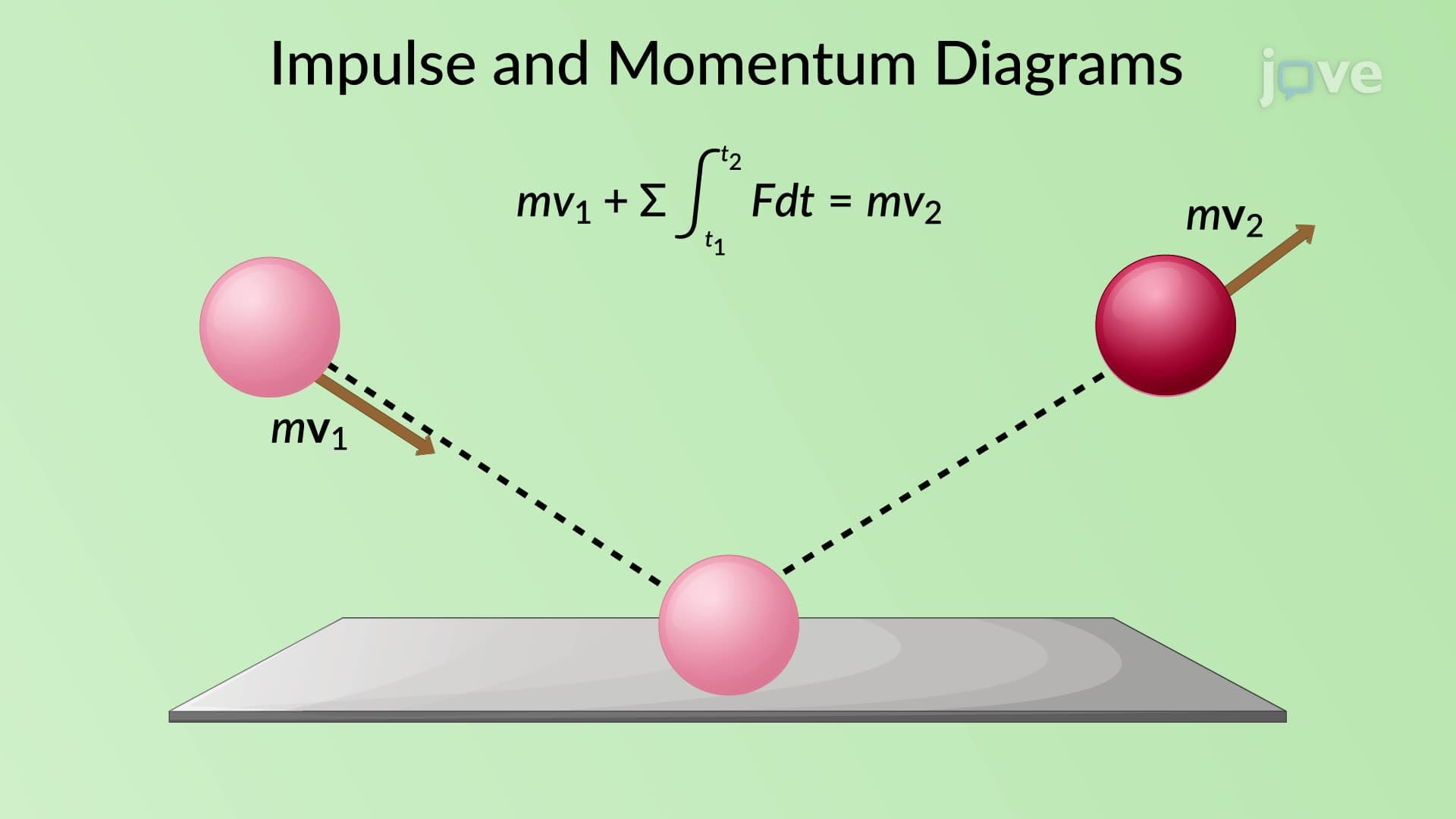
Linear momentum (p = mv) represents a particle's "quantity of motion," combining mass and velocity into a single vector quantity. The principle mathematically states: Initial Momentum + Total Impulse = Final Momentum, or p₁ + ∫F dt = p₂. This integration of Newton's second law over time transforms force analysis into momentum analysis, often simplifying complex problems.
The impulse (J = ∫F dt) measures the cumulative effect of force over time. When force remains constant, impulse simplifies to J = F·Δt, but variable forces require integration. This concept proves essential in AP Physics courses and college mechanics, where students must distinguish between instantaneous and time-averaged effects.
Consider automotive safety systems: airbags extend collision time from milliseconds to tens of milliseconds, dramatically reducing impact forces on passengers. The same impulse (momentum change) occurs, but extended time means lower peak forces. NASA engineers apply this principle when designing spacecraft landing systems, using retro-rockets to provide impulse over extended periods rather than sudden impacts.
In sports biomechanics, golf instructors emphasize "following through" because extended contact time increases impulse, maximizing ball velocity. Professional baseball analysis shows that bat-ball contact duration directly correlates with exit velocity, demonstrating the principle's real-world relevance.
The principle resolves into three scalar equations: J_x = m(v₂ₓ - v₁ₓ), J_y = m(v₂y - v₁y), and J_z = m(v₂z - v₁z). This component approach proves crucial for SAT Subject Tests and college physics exams, where complex motion requires systematic analysis.
Impulse-momentum diagrams provide visual problem-solving tools, separating initial state, applied impulses, and final state. This systematic approach helps students avoid common errors in collision problems and prepares them for advanced topics like angular momentum and rigid body dynamics.
Related Micro-courses