Loading subject page…


7,241 views


Video Summary: Problem Solving with the Linear Impulse and Momentum Principle Single Particle
Ever wonder how engineers calculate the exact speed of elevator cars or construction cranes after they start moving? Problem-solving with the linear impulse and momentum principle (single particle) reveals the physics behind these real-world scenarios. This systematic approach analyzes pulley systems like those found in building elevators across New York City skyscrapers, where wooden boxes and cylinders interact through rope tension and gravitational forces. Watch the full video on JoVE Coach to master this concept with expert-led visuals and step-by-step explanations.
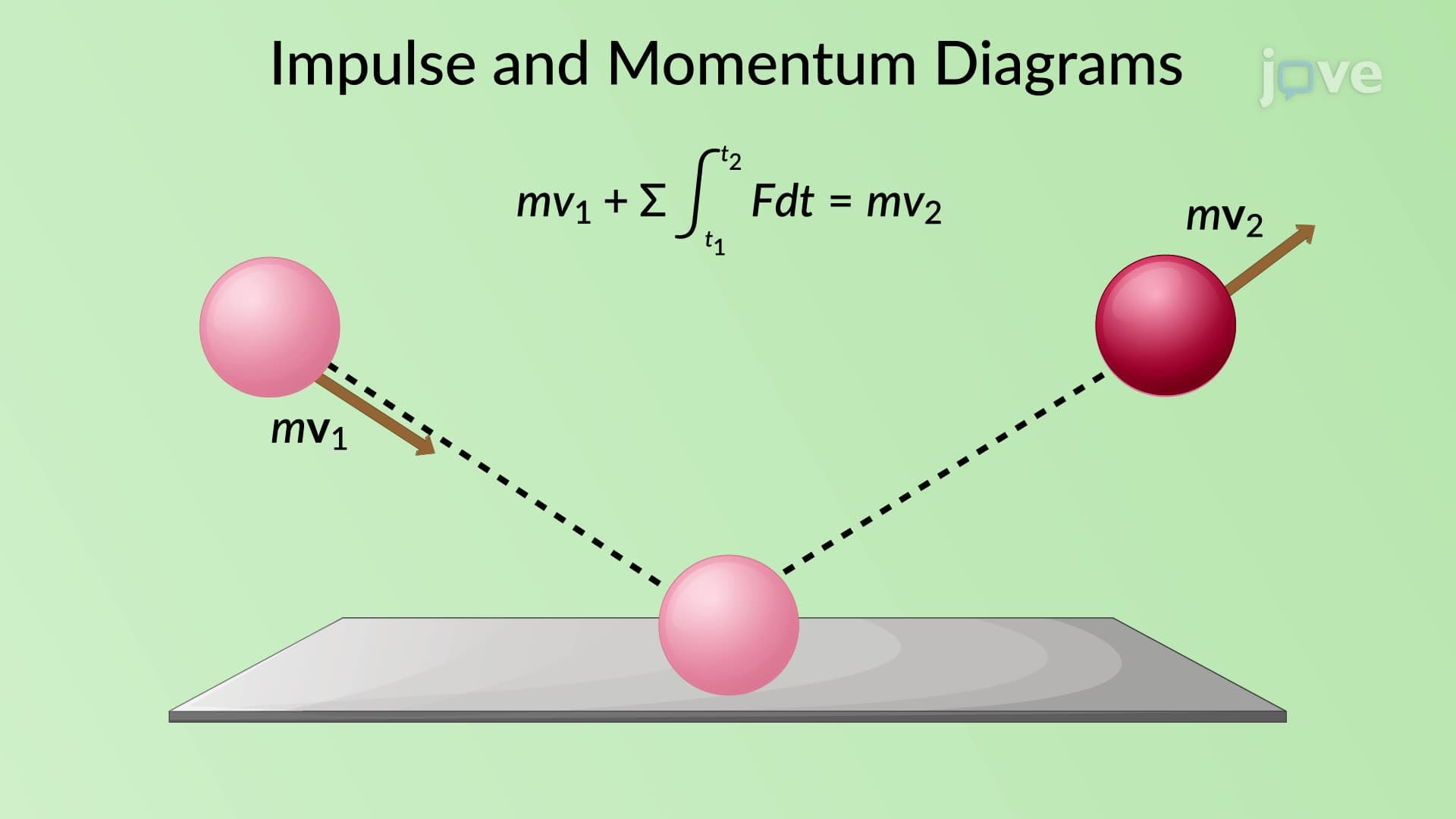
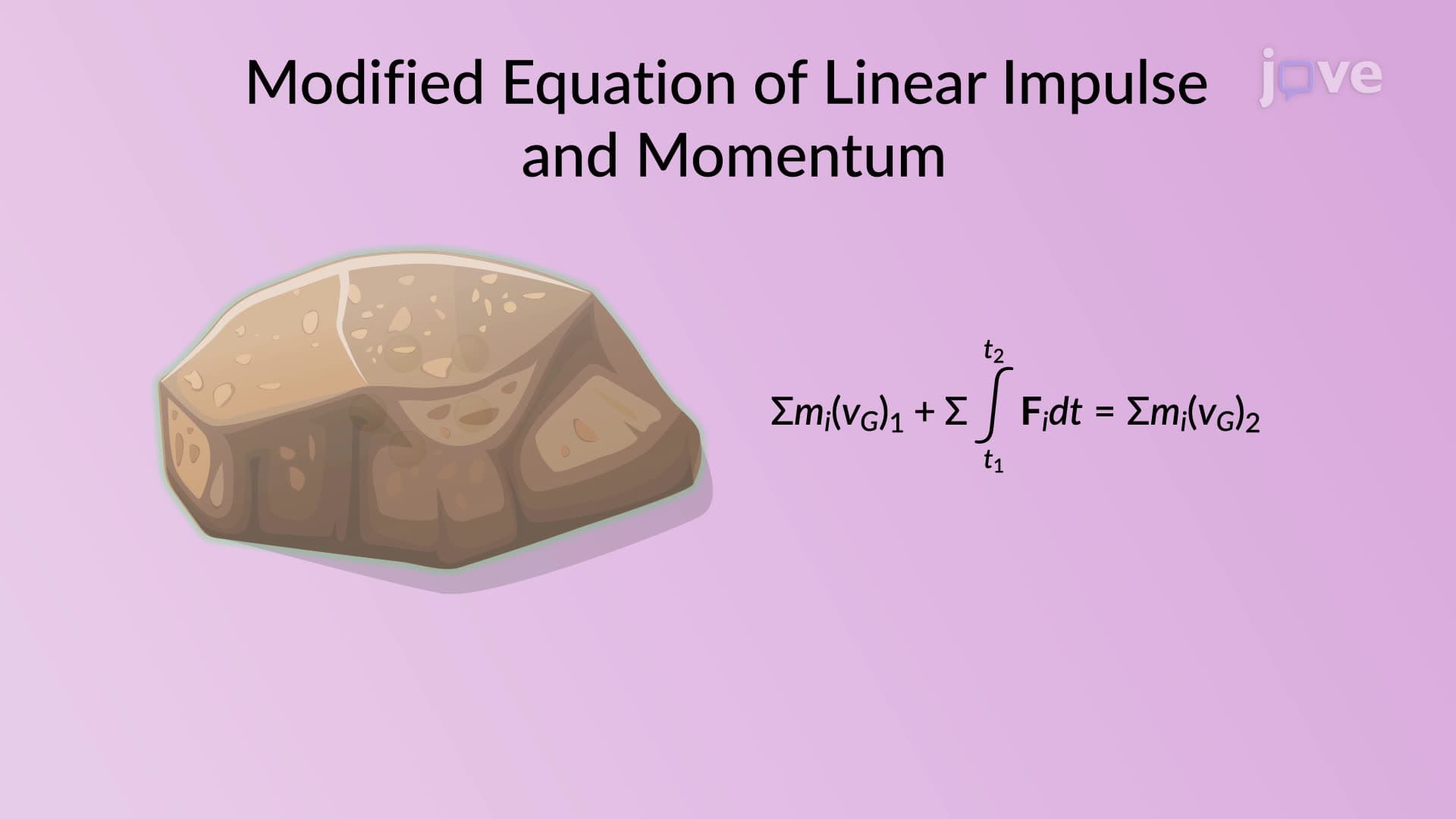
The linear impulse and momentum principle provides a powerful framework for analyzing the motion of objects when forces act over time. Unlike Newton's second law, which focuses on instantaneous acceleration, this principle examines the cumulative effect of forces acting over a time interval. The impulse-momentum theorem states that the impulse applied to an object equals its change in momentum: Impulse = Δp = m(v_final - v_initial).
Successful problem-solving begins with establishing an appropriate coordinate system. For pulley systems, engineers typically define positive directions that simplify calculations-often choosing downward as positive for hanging masses. The constraint equation emerges from the rope's fixed length: if one object moves down by distance x₁, the connected object moves up by distance x₂, where x₁ + x₂ = constant rope length. Taking the time derivative yields the velocity relationship: v₁ + v₂ = 0, meaning the objects move with equal but opposite velocities.
Each object requires a separate free-body diagram showing all acting forces. For a hanging cylinder, two forces typically act: gravitational force (mg downward) and rope tension (T upward). The wooden box experiences its weight, normal forces from contact surfaces, and rope tension. This systematic force identification proves crucial for AP Physics exams and college mechanics courses, where students must demonstrate clear understanding of force interactions.
The impulse-momentum theorem transforms into: (Sum of Forces) × time = mass × velocity_change. For the cylinder: (mg - T) × t = m × v_final, since initial velocity equals zero. Similarly, for the wooden box: (T - mg_box) × t = m_box × v_final_box. These equations, combined with constraint relationships, form a solvable system that appears frequently on MCAT physics sections and engineering statics exams.
This methodology applies to real-world engineering scenarios, from analyzing cable car systems in San Francisco to designing construction hoists for Manhattan building projects. Understanding sign conventions becomes particularly important-negative velocities often indicate motion opposite to the chosen positive direction, not necessarily "wrong" results.
Related Micro-courses