Loading subject page…


7,241 views


Video Summary: What are Types of Impact
Ever wonder why a basketball bounces back when you drop it, but a lump of clay just splats? The types of impact that occur during collisions determine whether objects bounce, stick together, or scatter in different directions. From car crash tests conducted by the National Highway Traffic Safety Administration to NASA's asteroid impact simulations, understanding these collision types is crucial for engineers and physicists. What are types of impact reveals the fundamental physics behind every collision in our world. Watch the full video on JoVE Coach to master this concept with expert-led visuals and step-by-step explanations.
Types of impact form the foundation of collision mechanics, a critical topic in physics that explains how objects interact during contact events. These collision classifications help engineers design safer vehicles, athletes optimize performance, and researchers understand everything from molecular interactions to planetary collisions.
Central impacts represent the simplest collision scenario where two objects collide head-on along a straight line. Think of two billiard balls striking each other directly or a hammer hitting a nail straight down. The velocities before collision are perfectly aligned, making calculations more straightforward for AP Physics students.
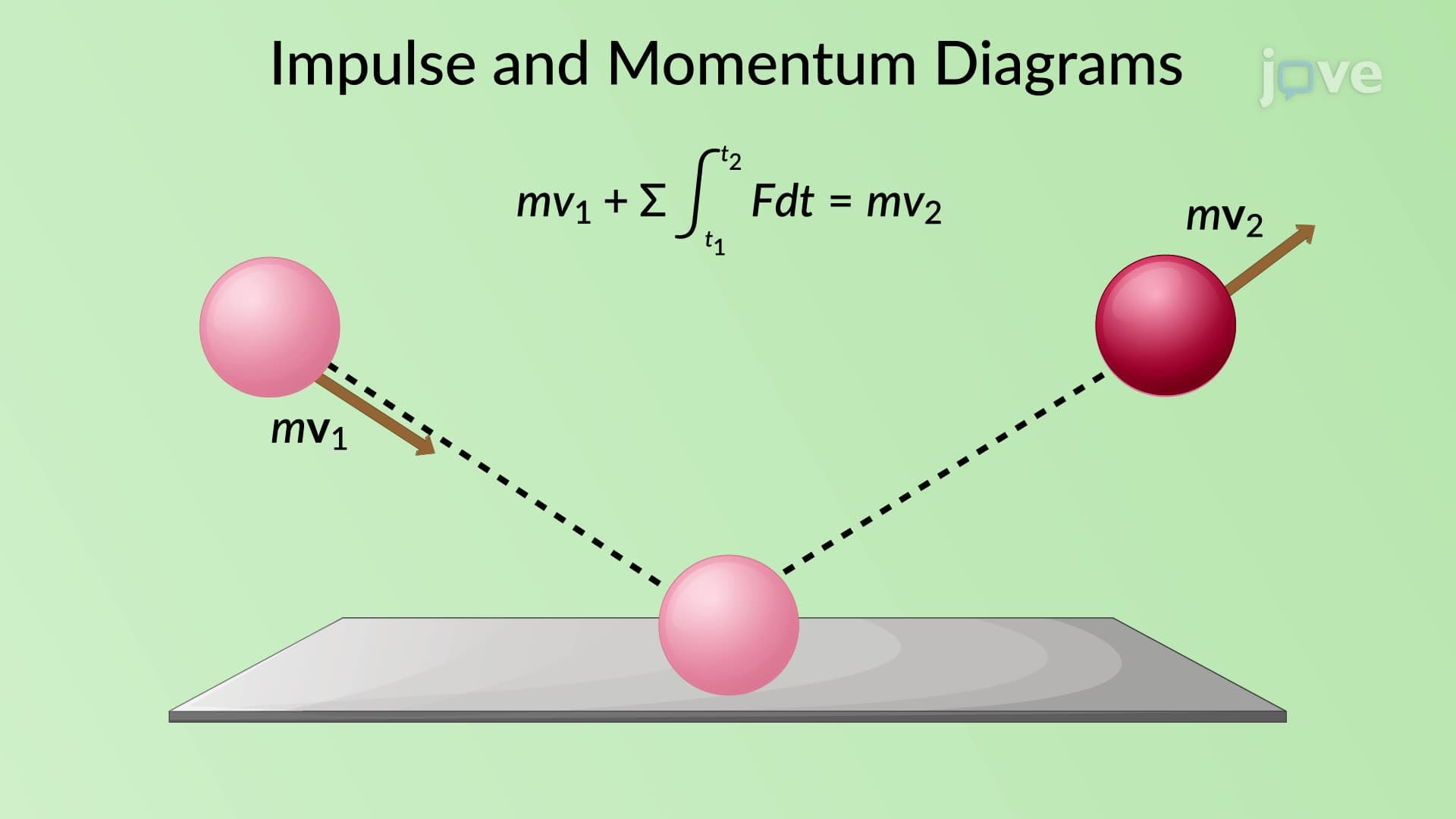
Oblique impacts occur when objects collide at an angle, creating more complex motion patterns. A baseball hit by a bat at an angle, or a car accident where vehicles strike each other's sides, demonstrates oblique collisions. These scenarios require vector analysis and appear frequently on college physics exams, particularly in mechanics courses at universities like MIT and Stanford.
The coefficient of restitution (e) quantifies how "bouncy" a collision is, ranging from 0 to 1. This dimensionless number equals the ratio of relative velocity after impact to relative velocity before impact: e = (velocity after)/(velocity before).
When e = 1, you have a perfectly elastic collision where kinetic energy is completely conserved. However, this theoretical ideal never occurs in reality. Even the most elastic materials like high-quality rubber balls achieve coefficients around 0.9-0.95.
When e = 0, the collision is perfectly plastic, meaning objects stick together after impact. Car crashes often approach this scenario when vehicles crumple and move together post-collision. The National Institute of Standards and Technology uses these principles in crash test analysis.
Understanding impact types proves essential for MCAT physics sections, AP Physics C mechanics, and engineering coursework. Students encounter these concepts in problems involving momentum conservation, energy analysis, and collision dynamics.
Professional applications span automotive safety engineering at companies like Ford and General Motors, sports equipment design for organizations like Wilson Sporting Goods, and aerospace engineering at NASA. The coefficient of restitution helps determine optimal materials for everything from tennis balls to spacecraft heat shields.
Related Micro-courses