Loading subject page…


6,864 views

Video Summary: Equation of Motion General Plane Motion Tutorial
Ever wondered how engineers predict the motion of a car wheel hitting a pothole or a baseball spinning through the air? The equation of motion general plane motion combines both translational and rotational dynamics to describe how rigid bodies move in two dimensions. Consider NASA's Mars rovers navigating rocky terrain-engineers must calculate both the forward motion and wheel rotation to ensure safe traversal. This fundamental physics concept integrates Newton's second law with rotational mechanics, using moment of inertia and angular acceleration to predict complex motions. Watch the full video on JoVE Coach to master this concept with expert-led visuals and step-by-step explanations.
The equation of motion general plane motion represents one of the most practical applications of classical mechanics, describing how rigid bodies move when both translation and rotation occur simultaneously. Unlike simple linear motion or pure rotation, general plane motion combines these effects, making it essential for analyzing real-world scenarios from automotive engineering to aerospace applications.
For general plane motion, we must consider two distinct but related aspects: the translational motion of the center of mass and the rotational motion about the center of mass. The translational component follows Newton's second law: ΣF = ma, where the net external force equals mass times acceleration of the center of mass. This applies independently along both x and y axes.
The rotational component introduces the moment equation: ΣM(cm) = I(cm) × α, where the sum of moments about the center of mass equals the moment of inertia about the center of mass multiplied by angular acceleration. This relationship is crucial for AP Physics and college-level mechanics courses, appearing frequently on exams like the MCAT and engineering fundamentals tests.
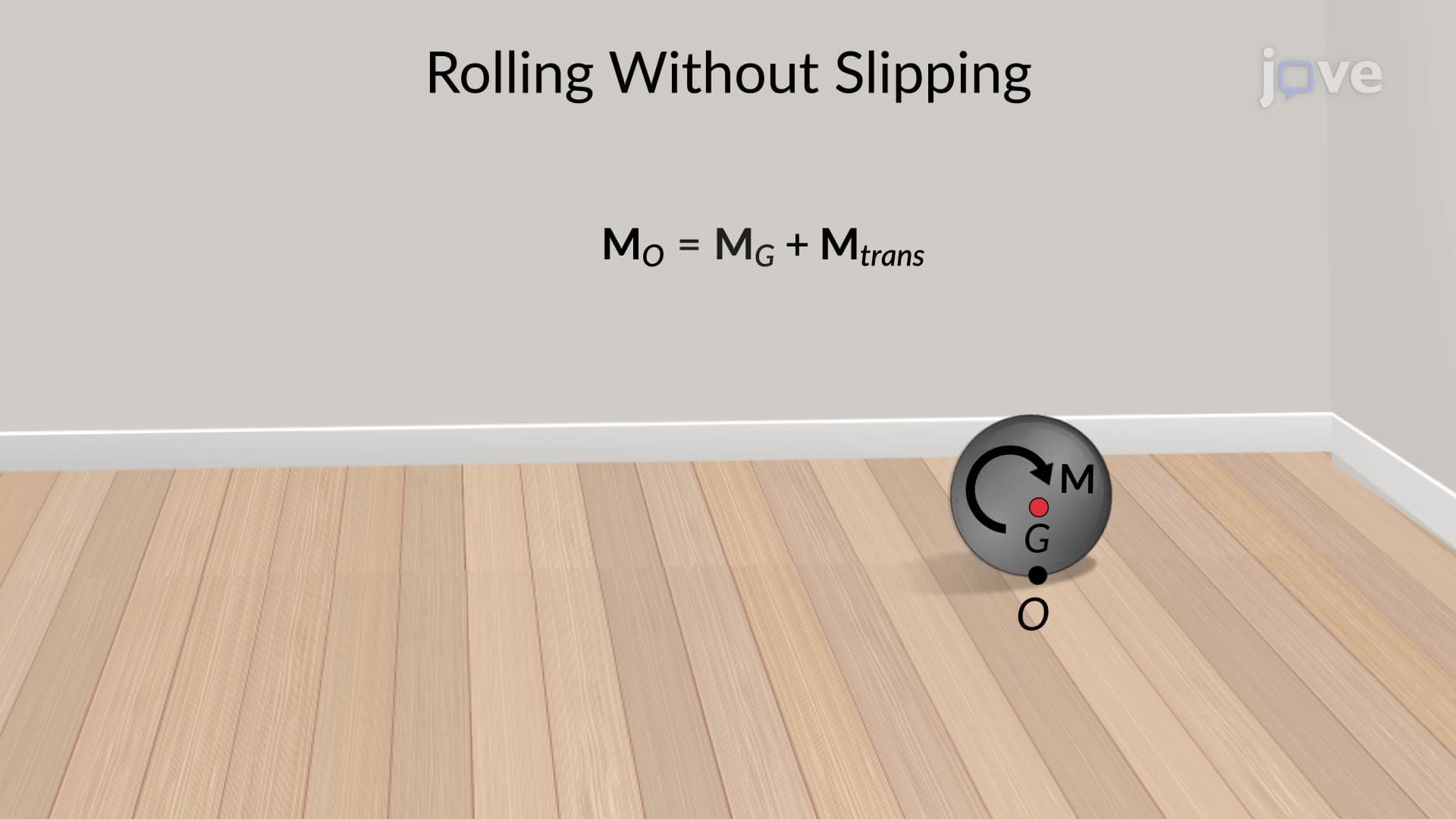
A powerful aspect of general plane motion analysis involves expressing moment equations about any point on or off the body. When we choose a reference point other than the center of mass, the moment equation becomes: ΣM(point) = ΣM(cm) + M(translational). This approach proves invaluable when analyzing contact points or pivot locations.
Consider a wheel rolling down an inclined plane-a classic problem in physics courses. The moment equation about the contact point O includes both the moment due to rotation about the center of mass and the moment created by the translational motion of the center of mass about point O.
The rolling without slipping condition represents a special case where the contact point has zero velocity. This constraint creates a direct relationship between linear and angular motion: v(cm) = r × ω. Using the parallel axis theorem, we can express the moment of inertia about the contact point as I(O) = I(cm) + m × r², simplifying our motion equations significantly.
This concept appears in numerous engineering applications, from automotive brake system design to conveyor belt mechanics. Understanding these relationships helps students excel in courses like AP Physics C: Mechanics and prepares them for advanced engineering coursework.
Related Micro-courses