Loading subject page…


6,864 views


Video Summary: Equation of Motion Rotation About Tutorial
Ever wondered how a car's flywheel maintains smooth engine operation during acceleration? The equation of motion rotation about a fixed axis explains the complex interplay between angular acceleration, moment of inertia, and applied torques in rotating systems. Consider NASA's spacecraft reaction wheels, which use precisely calculated rotational motion equations to maintain orbital positioning. This fundamental physics concept governs everything from automotive flywheels to industrial turbines across American manufacturing. Watch the full video on JoVE Coach to master this concept with expert-led visuals and step-by-step explanations.
The equation of motion rotation about a fixed axis represents one of classical mechanics' most practically important concepts. Unlike simple linear motion, rotational systems involve complex relationships between angular quantities, mass distribution, and applied forces. When dealing with real rotating bodies-from the crankshafts in Ford's Dearborn assembly plants to the turbines at Hoover Dam-engineers must account for non-uniform mass distributions and varying acceleration components.
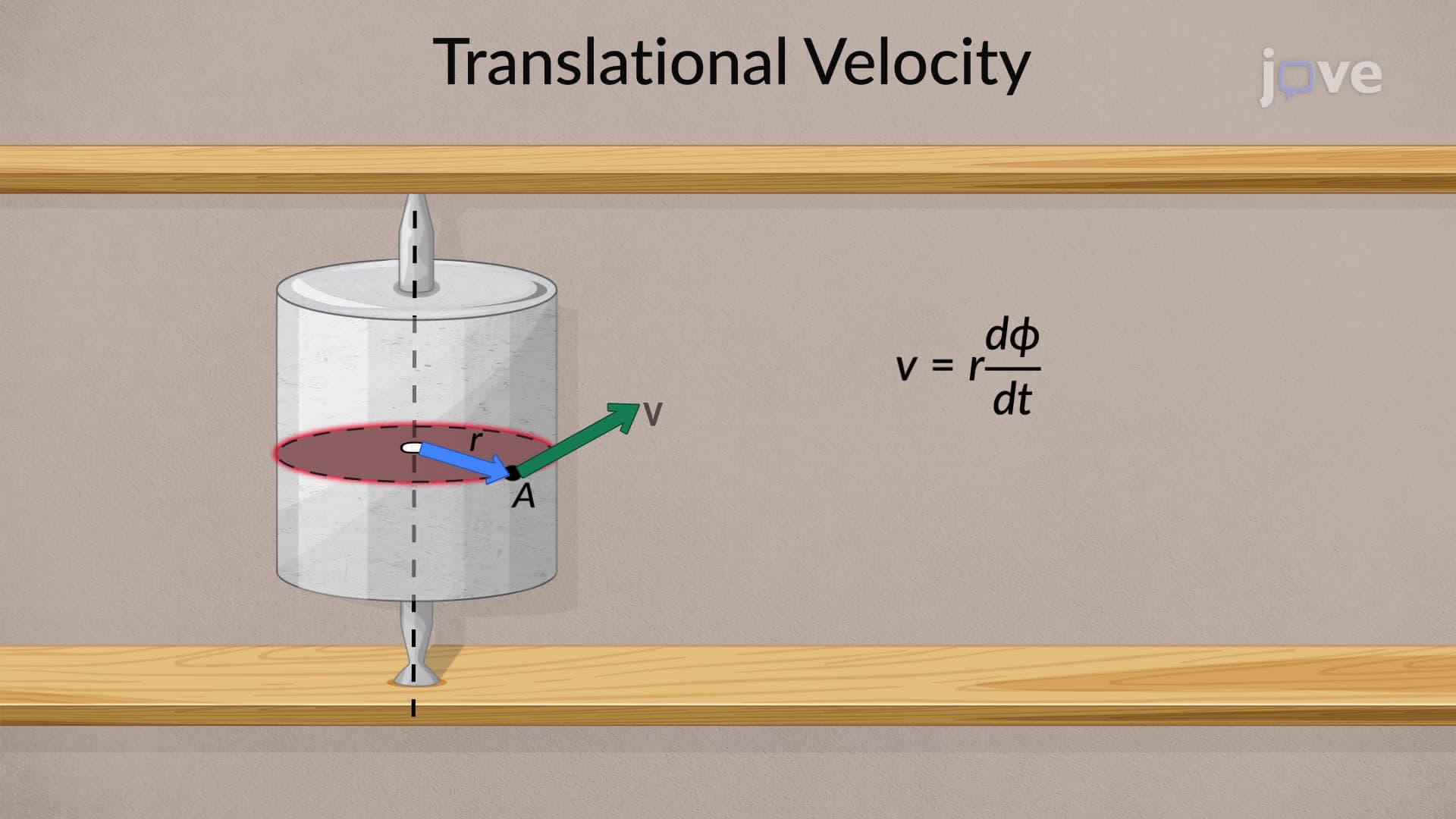
Rotational motion involves two distinct acceleration components. The tangential acceleration component directly relates to angular acceleration through the relationship a(t) = α × r, where α represents angular acceleration and r denotes the radius. This component determines how quickly the rotational speed changes. Meanwhile, the normal (centripetal) acceleration component a(n) = ω² × r always points toward the rotation center, maintaining circular motion. American automotive engineers at companies like General Motors extensively use these relationships when designing balanced rotating assemblies for high-performance engines.
The fundamental equation M = I × α connects applied moment (torque) to angular acceleration through moment of inertia. However, real engineering applications require eliminating unknown constraint forces. By strategically choosing the rotation point, engineers can write moment equations that automatically exclude unknown reaction forces. This technique proves invaluable when analyzing complex machinery like the wind turbines manufactured by GE Renewable Energy across America's wind corridors.
The parallel axis theorem I = I(cm) + m × d² allows engineers to calculate moments of inertia about any axis when the center-of-mass value is known. This relationship becomes crucial in the rotational equation of motion when dealing with offset rotation axes. Students preparing for AP Physics C or college-level mechanics courses frequently encounter problems requiring this theorem's application, particularly in analyzing compound rotating systems.
Understanding these concepts prepares students for advanced coursework in mechanical engineering, aerospace dynamics, and physics. The principles directly apply to SAT Subject Tests, AP Physics examinations, and introductory college physics courses at institutions like MIT, Stanford, and state universities nationwide.
Related Micro-courses