Loading subject page…


1,707 views

Video Summary: Design of Transmission Shafts Stress Analysis Explained
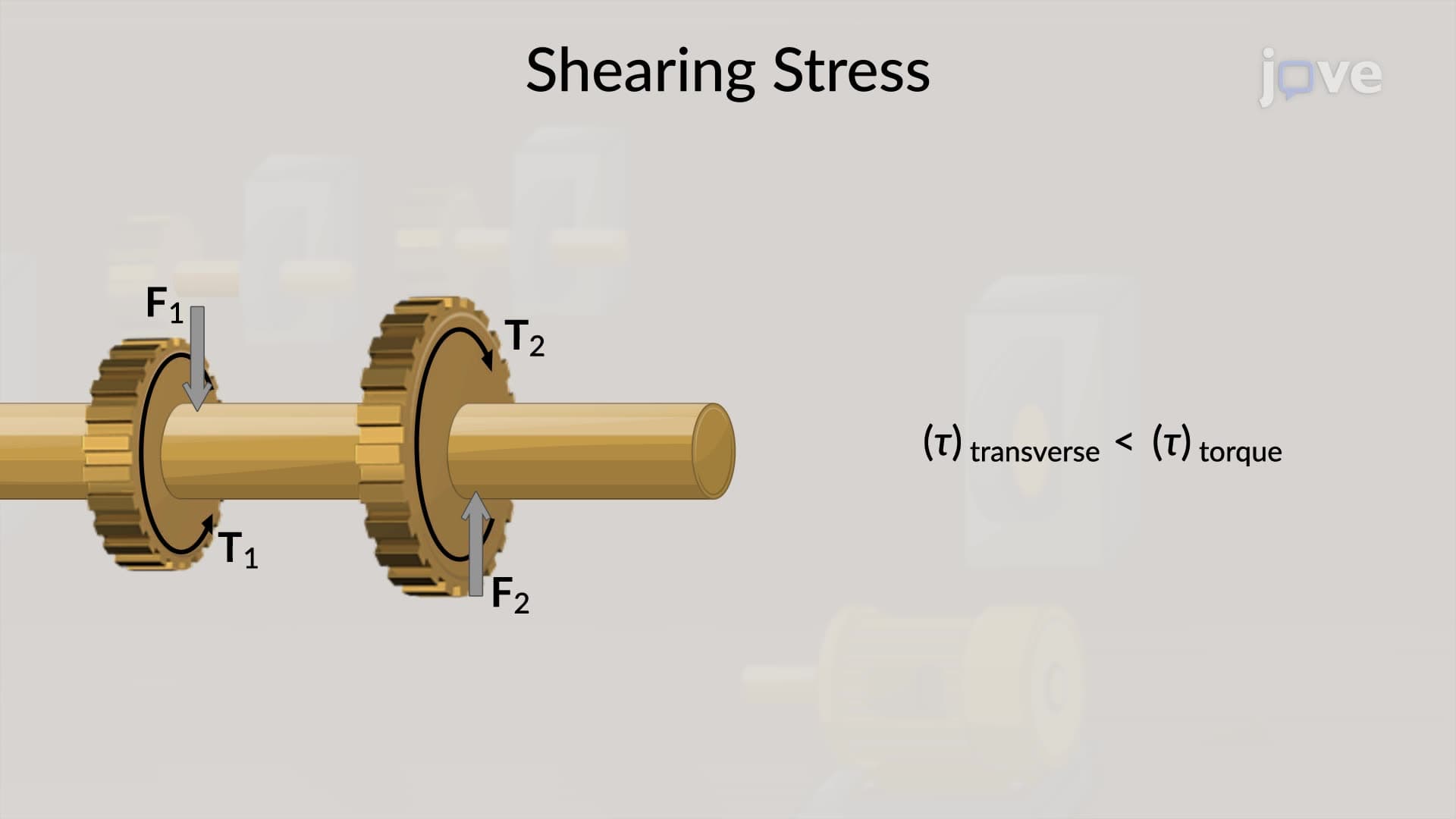
Every time you shift gears in your car, transmission shafts handle enormous stresses from both twisting forces and bending moments. Design of transmission shafts stress analysis determines how engineers calculate these combined stresses to prevent catastrophic failures in automotive drivetrains, industrial machinery, and aircraft propulsion systems. For example, a typical Ford F-150's driveshaft experiences both torsional stress from engine torque and bending stress from road vibrations. Watch the full video on JoVE Coach to master this concept with expert-led visuals and step-by-step explanations.
Design of transmission shafts stress analysis represents a critical intersection of mechanics of materials and machine design, where engineers must account for multiple simultaneous loading conditions. Unlike simple loading scenarios covered in introductory physics courses, transmission shafts experience complex combinations of bending moments and torques that create both normal and shearing stresses throughout the shaft's cross-section.
When power transfers through gear systems-whether in a Caterpillar excavator's drivetrain or a Boeing 737's engine accessories-the meshing gears create force-couple systems that simultaneously bend and twist the connecting shafts. This dual loading condition requires sophisticated analysis because the maximum stress location isn't immediately obvious. The resultant stress state combines normal stresses from bending (calculated using the flexure formula σ = Mc/I) with shearing stresses from torsion (calculated using τ = Tc/J), where engineers must determine the critical combination for safe design.
The maximum normal stress in a transmission shaft occurs at the outer fiber perpendicular to the resultant bending moment vector. This geometric relationship becomes crucial when designing shafts for applications like wind turbine gearboxes, where multiple bending moments from different gear meshes create complex resultant loading patterns. Engineers use Mohr's circle analysis or equivalent stress theories like von Mises criteria to determine the critical stress state that governs shaft sizing.
Modern transmission shaft design extends beyond theoretical stress calculations to include factors like fatigue life, manufacturing tolerances, and material selection. For AP Physics C or college-level Mechanics of Materials courses, students typically work with simplified scenarios involving single-plane bending combined with torsion. However, real applications like automotive CV joints or industrial mixer drives require consideration of dynamic loading, stress concentrations at keyways or splines, and the economic trade-offs between solid and hollow shaft configurations. Hollow shafts offer superior strength-to-weight ratios-explaining their prevalence in aircraft applications-while solid shafts provide manufacturing simplicity for less demanding applications.
Related Micro-courses