Loading subject page…


2,643 views


Video Summary: Physiology Genitourinary System Iii Urine Explained
Did you know that your kidneys filter about 50 gallons of blood daily, yet you only produce 1-2 quarts of urine? The physiology genitourinary system III urine mechanisms explain this remarkable concentration process through the nephron's countercurrent multiplication system and ADH regulation. Students at Johns Hopkins University study these precise water balance controls that prevent dehydration while maintaining electrolyte homeostasis. Watch the full video on JoVE Coach to master this concept with expert-led visuals and step-by-step explanations.
The kidney's ability to produce concentrated urine represents one of the most sophisticated physiological processes in human biology. This system allows humans to survive in diverse environments, from the humid Southeast to the arid Southwest, by precisely controlling water loss. Medical students at institutions like Harvard Medical School and UCLA spend considerable time mastering these concepts, as they're fundamental to understanding fluid and electrolyte disorders.
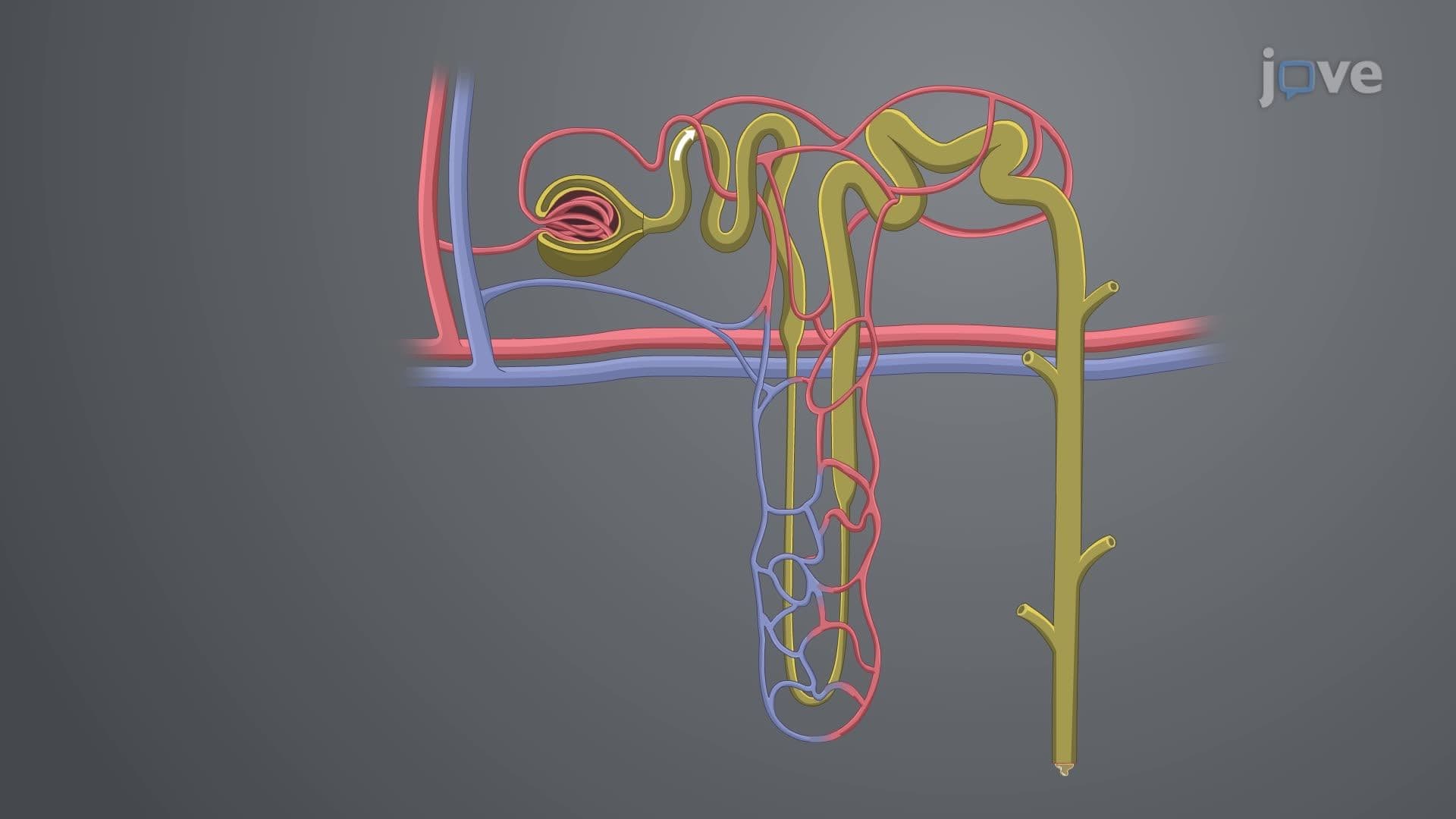
The loop of Henle operates as a biological concentrating machine through countercurrent multiplication. The descending limb's high water permeability allows water to exit into the increasingly hyperosmotic medulla, while the ascending limb actively transports sodium, potassium, and chloride ions without water reabsorption. This creates a concentration gradient reaching 1,200-1,400 mOsm/kg in the inner medulla-four times more concentrated than blood plasma.
This mechanism is frequently tested on the MCAT, where students must explain how disrupting either limb affects overall kidney function. For instance, loop diuretics like furosemide block the sodium-potassium-chloride transporter in the ascending limb, preventing gradient maintenance and causing massive water loss.
Antidiuretic hormone (ADH) serves as the master regulator of water reabsorption. When plasma osmolality rises above 280 mOsm/kg-detected by hypothalamic osmoreceptors-ADH release increases dramatically. The hormone travels to collecting duct cells, triggering aquaporin-2 channel insertion into the apical membrane. These water channels can increase water permeability by 10-fold, producing urine as concentrated as 1,200 mOsm/kg.
Conversely, when you drink a large volume of water, ADH levels plummet within minutes. The collecting ducts become essentially waterproof, producing dilute urine around 50 mOsm/kg-demonstrating the kidney's remarkable 24-fold concentration range.
Understanding these mechanisms helps explain common clinical conditions. Diabetes insipidus, caused by ADH deficiency or resistance, results in massive water loss and life-threatening dehydration. Patients may produce 15-20 liters of dilute urine daily. Conversely, SIADH (syndrome of inappropriate ADH secretion) causes water retention and dangerous hyponatremia.
These concepts appear frequently on AP Biology exams, college physiology midterms, and professional exams like the USMLE Step 1. Students should focus on the relationship between structure and function, particularly how anatomical arrangements enable physiological processes.
Related Micro-courses