Loading video…


 14 Concepts
 291.1K views

Video Summary: Base Quantities and Derived Quantities Explained
Ever wonder why NASA measures rocket velocity in meters per second rather than just "fast"? Base quantities and derived quantities form the foundation of all scientific measurements, from timing Olympic sprinters to calculating fuel efficiency in Tesla vehicles. Base Quantities And Derived Quantities Explained reveals how fundamental measurements like length and time combine to create complex units that describe our physical world. Understanding these concepts is essential for success in physics courses and standardized tests. Watch the full video on JoVE Coach to master this concept with expert-led visuals and step-by-step explanations.
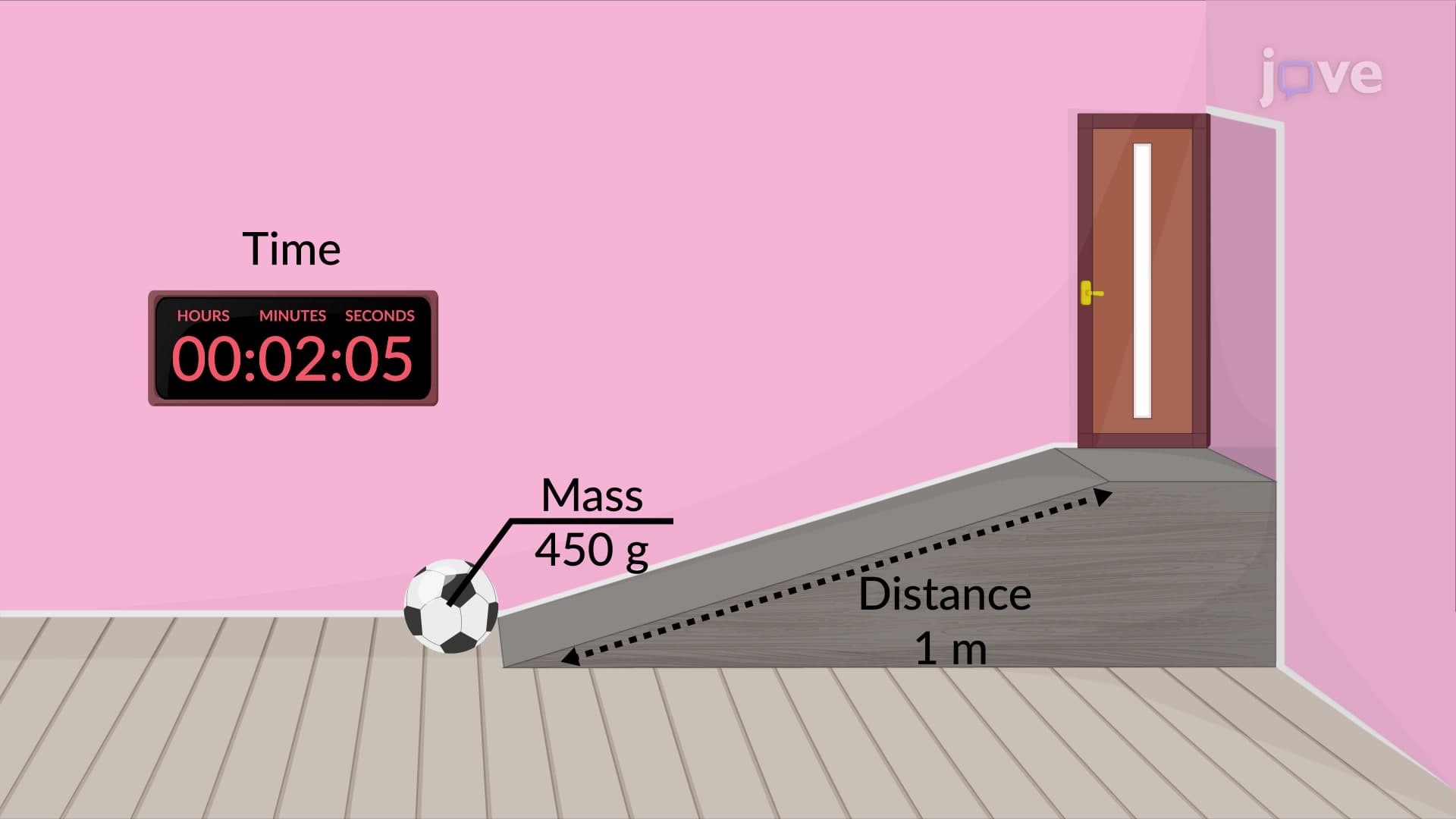
The distinction between base and derived quantities represents one of physics' most fundamental organizational principles. Base quantities serve as the irreducible building blocks of measurement-they cannot be expressed in terms of other physical quantities. The International System of Units (SI) defines seven base quantities: length (meter), mass (kilogram), time (second), electric current (ampere), thermodynamic temperature (kelvin), amount of substance (mole), and luminous intensity (candela).
Consider measuring a football field's dimensions. The 100-yard length represents a base quantity expressed in base units. However, when calculating the field's area (10,800 square feet), you're working with a derived quantity obtained by multiplying two length measurements.
Derived quantities emerge through mathematical operations performed on base quantities. Velocity exemplifies this concept perfectly-it equals displacement (length) divided by time interval. When a NASCAR driver travels 500 miles in 3.5 hours, their average speed of approximately 143 mph represents a derived quantity combining distance and time measurements.
This relationship extends to more complex derived quantities. Acceleration (m/s²) combines velocity and time, while force (kg⋅m/s²) incorporates mass, length, and time. These mathematical relationships prove crucial for AP Physics students, as understanding dimensional relationships helps verify equation correctness and solve complex problems.
The base-derived quantity framework ensures measurement consistency across scientific disciplines. When NASA calculates spacecraft trajectories, engineers use the same fundamental units whether measuring Earth-Moon distances or rocket engine thrust. This standardization prevents costly errors like the 1999 Mars Climate Orbiter loss, caused by unit conversion mistakes between metric and imperial systems.
In medical applications, healthcare professionals rely heavily on derived quantities. Blood pressure measurements (mmHg) derive from force per unit area, while medication dosages often involve concentration units (mg/mL) combining mass and volume base quantities.
Mastering base and derived quantities significantly improves performance on standardized tests including AP Physics, SAT Subject Tests, and college placement exams. Students who understand dimensional analysis can quickly identify incorrect answer choices by checking unit consistency. For instance, if a problem asks for acceleration but an answer choice has velocity units (m/s instead of m/s²), dimensional analysis immediately reveals the error.
Practice identifying quantity types in everyday scenarios-timing your morning commute involves base quantities (time, distance), while calculating fuel efficiency requires derived quantity understanding (miles per gallon combines length and volume measurements).
Related Micro-courses