Loading video…


 14 Concepts
 291.1K views

Video Summary: What Is Dimensional Analysis
Ever wondered how engineers ensure the Space Shuttle doesn't crash due to a unit conversion error? Dimensional analysis is the mathematical tool that prevents such disasters by checking whether physics equations make logical sense. This fundamental concept helps students verify that acceleration truly equals meters per second squared, not just a random collection of numbers. From calculating NASA rocket trajectories to solving basic kinematics problems, dimensional analysis serves as your mathematical safety net. Watch the full video on JoVE Coach to master this concept with expert-led visuals and step-by-step explanations.
Dimensional analysis represents one of the most powerful yet underutilized tools in physics and engineering. At its core, this method involves examining the fundamental units of physical quantities to verify equation validity and solve complex problems. Unlike simple arithmetic, dimensional analysis requires understanding that every measurable quantity possesses inherent characteristics-dimensions-that follow strict mathematical rules.
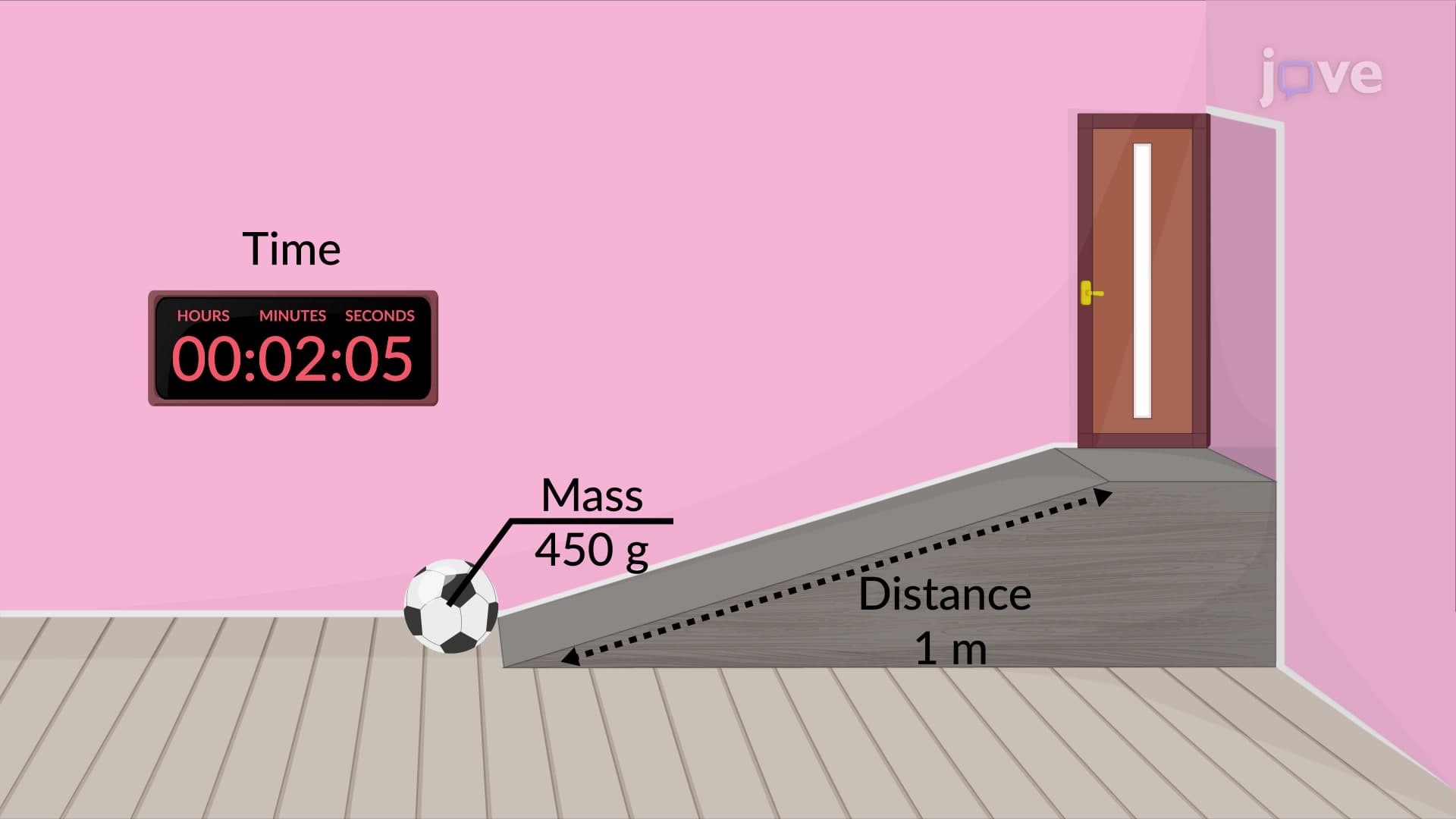
Physical quantities fall into two categories: base and derived. The International System of Units (SI) defines seven base quantities: length [L], mass [M], time [T], electric current [A], temperature [K], amount of substance [mol], and luminous intensity [cd]. From these, we derive all other quantities. Speed, for instance, combines length and time as [LT⁻¹], while acceleration incorporates [LT⁻²]. Understanding this hierarchy proves crucial for AP Physics students and college-level coursework.
Successful dimensional analysis depends on two fundamental principles. First, both sides of any equation must possess identical dimensions-you cannot equate a length to a time. Second, arguments of mathematical functions (trigonometric, logarithmic, exponential) must be dimensionless. These rules prevented the infamous 1999 Mars Climate Orbiter failure, where mixing metric and imperial units caused a $125 million spacecraft to crash.
Beyond equation verification, dimensional analysis helps reconstruct forgotten formulas. Consider a student unsure whether kinetic energy equals (1/2)mv² or (1/2)v²/m. Since energy has dimensions [ML²T⁻²], mass [M], and velocity [LT⁻¹], only the first equation yields the correct dimensional result. This technique proves invaluable during SAT Subject Tests and college physics exams when formula sheets aren't available.
For chemistry students, dimensional analysis becomes essential in stoichiometry and gas law problems. Converting between units, balancing complex equations, and ensuring proper concentration calculations all rely on dimensional consistency. Medical students preparing for the MCAT frequently encounter dimensional analysis in physics passages and chemical calculations.
Related Micro-courses