Loading subject page…

2,001,369 views


Video Summary: What Is Atomic Structure
Ever wonder why gold never rusts but iron does? The answer lies in atomic structure basics and how different elements are built from unique arrangements of subatomic particles. Understanding what is atomic structure reveals that elements like the potassium in bananas or the sodium in table salt each have distinct properties determined by their proton count and electron arrangement. From determining element identity through atomic numbers to explaining how atoms form ions, atomic structure forms the foundation of all chemistry. Watch the full video on JoVE Coach to master this concept with expert-led visuals and step-by-step explanations.
Atomic structure basics form the cornerstone of chemistry education, explaining how all matter around us-from the aluminum in soda cans to the carbon in our bodies-is constructed from remarkably simple building blocks. At its core, atomic structure describes how three types of subatomic particles combine to create the 118 known elements on the periodic table.
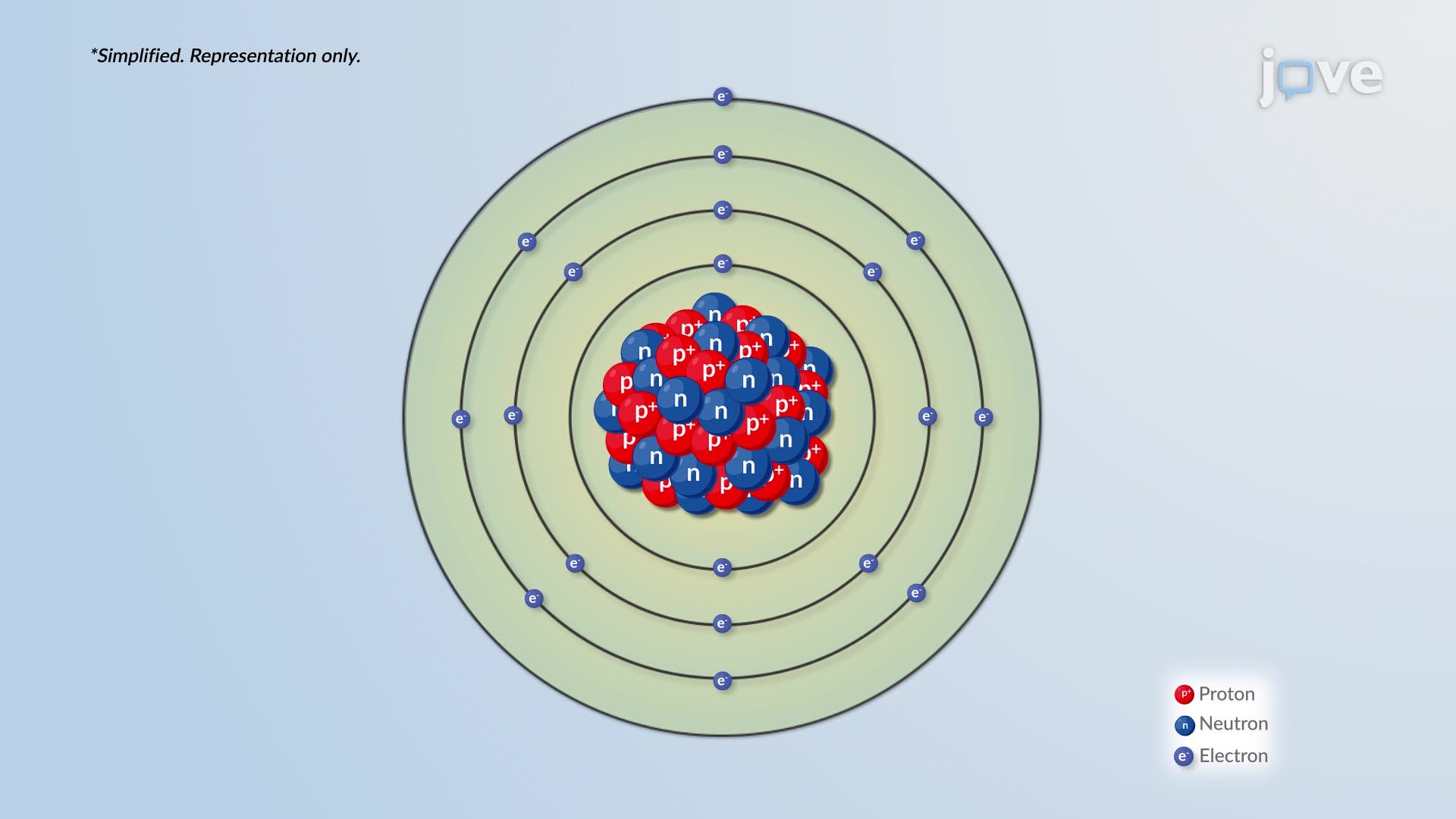
The nucleus atomic structure represents the dense center of every atom, containing protons and neutrons packed into an incredibly small space. Protons, carrying a positive charge, determine an element's identity through the atomic number. For example, all carbon atoms contain exactly 6 protons, whether found in diamond rings or graphite pencils. Neutrons, though electrically neutral, contribute significantly to atomic mass and nuclear stability. The atomic model chemistry shows that while the nucleus occupies less than 0.01% of an atom's volume, it contains over 99% of its mass.
Students preparing for AP Chemistry or college general chemistry courses must understand that proton neutron electron structure governs both physical and chemical properties. The Bohr model atom, while simplified, helps visualize how these particles arrange themselves and explains many phenomena students encounter in laboratory experiments.
Electrons occupy the vast space surrounding the nucleus, creating what chemists call electron clouds or orbitals. Despite their tiny mass (approximately 1/1800th of a proton), electrons determine how atoms bond and react. The atomic particle arrangement of electrons in energy levels explains why sodium (11 protons, 11 electrons) reacts explosively with water, while neon (10 protons, 10 electrons) remains completely inert.
When atoms gain or lose electrons, they become ions-a concept crucial for understanding everything from sports drinks (containing electrolyte ions) to lithium batteries powering smartphones. Cations form when atoms lose electrons (like sodium forming Na+), while anions result from electron gain (chlorine forming Cl-). This principle appears frequently on MCAT chemistry sections and college organic chemistry exams.
Understanding atomic structure explained chemistry connects to practical applications in pharmaceuticals, where drug molecules interact with biological targets based on their atomic composition, and in materials engineering, where atomic structure determines properties of everything from aircraft aluminum to medical implants.
Related Micro-courses