Loading video…


 5 Concepts
 2.6K views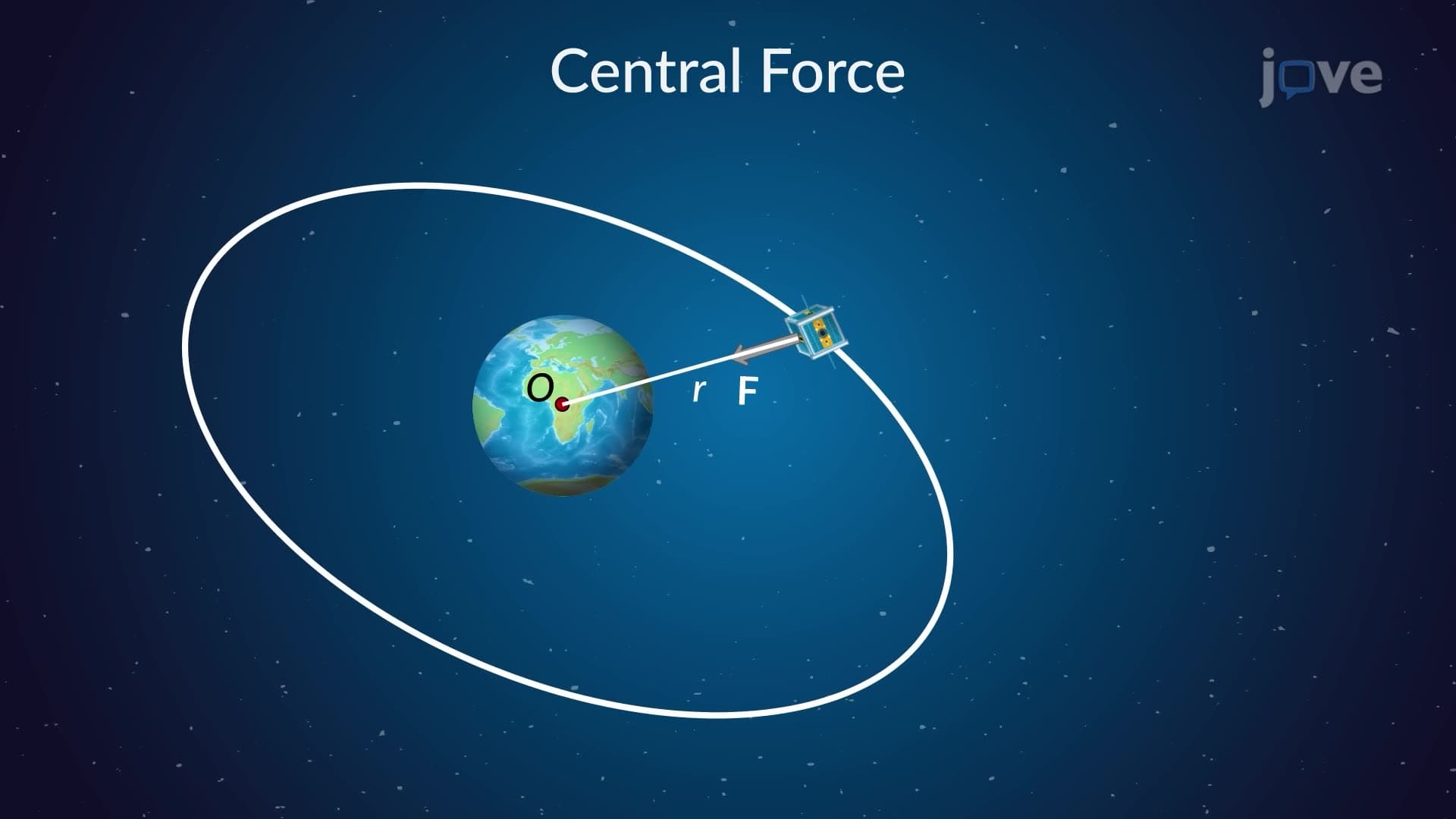

Video Summary: What Is Central Force Motion
Ever wondered how satellites maintain their orbits around Earth or why a NASCAR driver feels pulled outward during high-speed turns? Central force motion governs these phenomena, describing how objects move when acted upon by forces directed toward a fixed point. This fundamental physics concept explains everything from planetary orbits to the motion of electrons around atomic nuclei. NASA engineers use central force motion principles to calculate spacecraft trajectories for missions to Mars and beyond. Watch the full video on JoVE Coach to master this concept with expert-led visuals and step-by-step explanations.
Central force motion represents one of the most elegant and practically important concepts in classical mechanics. At its core, this phenomenon occurs when an object experiences a force that always points directly toward or away from a fixed center point, with the magnitude depending solely on the distance from that center. Unlike linear motion where forces act along straight paths, central force motion creates curved trajectories that follow specific mathematical relationships.
The beauty of central force motion lies in its universality. Whether we're examining the International Space Station orbiting Earth at 17,500 mph or analyzing the behavior of charged particles in a cyclotron at Fermilab, the same fundamental principles apply. This consistency makes central force motion a cornerstone concept for students preparing for AP Physics exams and college-level mechanics courses.
The mathematical description of central force motion requires polar coordinates (r, θ) rather than the familiar Cartesian system. This choice isn't arbitrary-it reflects the natural symmetry of the problem. In polar coordinates, the central force acts only in the radial direction, making the azimuthal (angular) component of force exactly zero. This seemingly simple fact leads to profound consequences.
When students work through central force problems on exams like the MCAT or in undergraduate physics courses, they'll encounter the fundamental equation: r²(dθ/dt) = constant. This relationship, derived from the zero azimuthal force condition, reveals that angular momentum remains conserved throughout the motion. The mathematical elegance becomes apparent when solving orbital mechanics problems that NASA engineers face daily.
One of the most striking features of central force motion involves areal velocity-the rate at which the position vector sweeps out area. As an object moves under central force influence, it traces a path where the area swept per unit time remains constant. This principle, known as Kepler's Second Law in astronomical contexts, explains why comets move fastest when closest to the Sun and slowest at their farthest points.
For students tackling physics problems, understanding areal velocity provides powerful problem-solving tools. SAT Subject Test questions and AP Physics C exams frequently test this concept through orbital motion scenarios. The mathematical relationship dA/dt = (1/2)r²(dθ/dt) = constant becomes invaluable when analyzing satellite trajectories or planetary orbits.
Central force motion principles guide countless technological applications across American industry and research. GPS satellites rely on precise orbital mechanics calculations rooted in central force theory. The Hubble Space Telescope maintains its orbit through careful application of these same principles. At the particle level, the Stanford Linear Accelerator uses central force concepts to bend particle beams along curved paths.
Students preparing for physics exams should focus on recognizing central force motion signatures: radial forces, conservation of angular momentum, and constant areal velocity. These concepts appear regularly in college entrance exams and form the foundation for advanced topics in quantum mechanics and electromagnetism.
Related Micro-courses