Loading video…

 21 Concepts
 2M views

Video Summary: What are Hydrogen Bonds
Ever wonder why ice floats on water or how DNA maintains its double helix structure? Hydrogen bonds explained reveals the secret behind these everyday phenomena. These weak but crucial attractions occur between electronegative atoms like oxygen and partially positive hydrogen atoms, creating the foundation for life processes in the human body. Water's unique properties stem directly from hydrogen bonds. Watch the full video on JoVE Coach to master this concept with expert-led visuals and step-by-step explanations.
Hydrogen bonds represent one of nature's most elegant solutions for molecular stability and function. Unlike covalent bonds that involve electron sharing, hydrogen bonds are intermolecular attractions occurring when a hydrogen atom covalently bonded to an electronegative atom (oxygen, nitrogen, or fluorine) experiences attraction to another electronegative atom nearby.
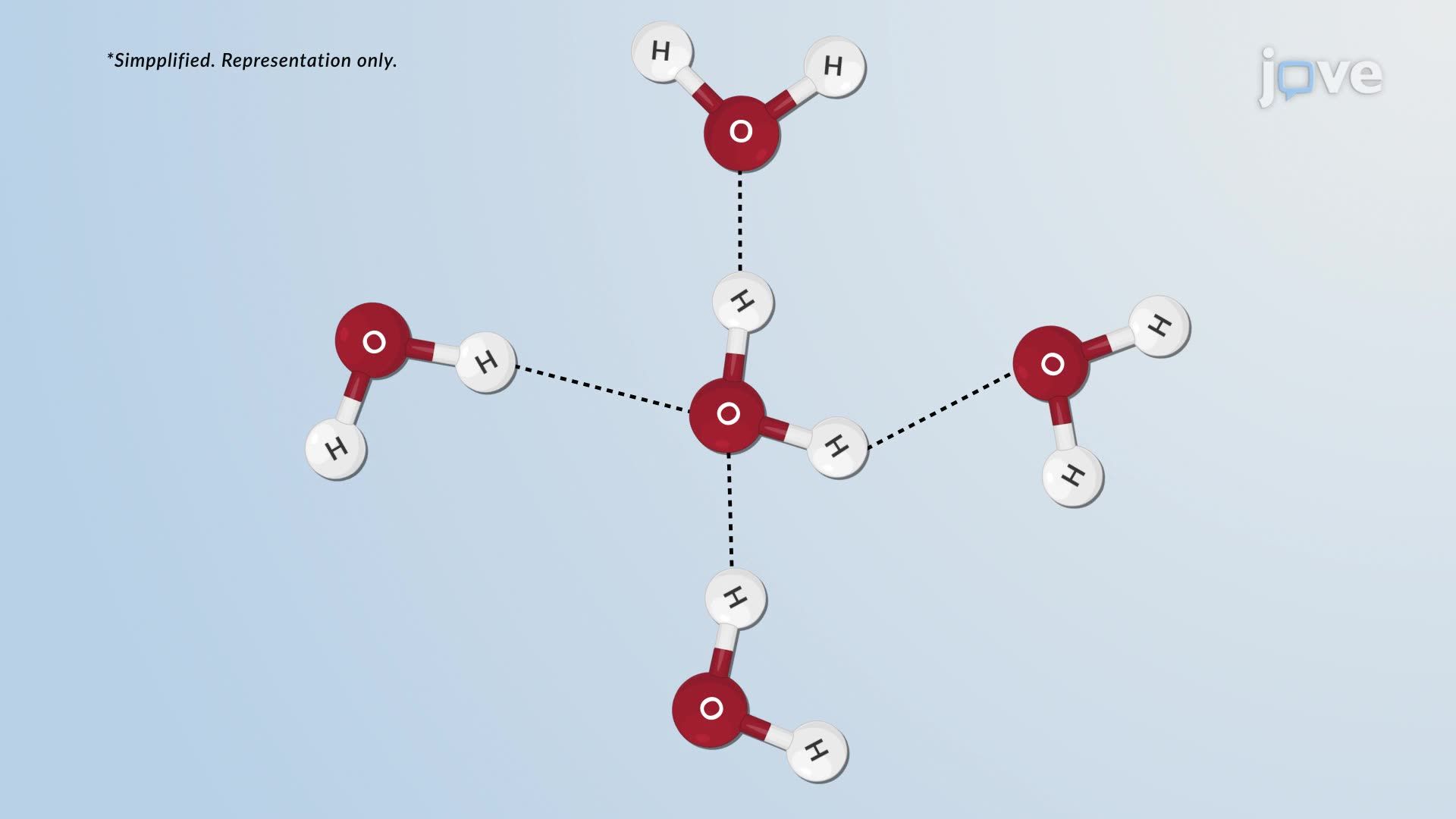
The hydrogen bond definition chemistry students learn emphasizes the partial charge distribution that makes this interaction possible. When hydrogen bonds to highly electronegative atoms like oxygen, the electrons spend more time near the oxygen nucleus, leaving hydrogen with a partial positive charge (δ+). This partially positive hydrogen then attracts lone pairs of electrons on nearby electronegative atoms, creating the hydrogen bond.
H bond donor acceptor relationships follow specific geometric requirements. The donor molecule contains hydrogen covalently bonded to oxygen, nitrogen, or fluorine. The acceptor molecule possesses lone pairs of electrons on electronegative atoms. For maximum hydrogen bond strength, the donor-hydrogen-acceptor angle approaches 180 degrees, though bonds can form at various angles with decreased strength.
In water molecules, each oxygen atom can serve as both donor and acceptor. The oxygen's two lone pairs act as acceptors, while the two hydrogen atoms function as donors. This dual capability allows water hydrogen bonding to create extensive three-dimensional networks, explaining water's unusually high boiling point compared to similar-sized molecules like hydrogen sulfide.
Protein hydrogen bond interactions drive secondary structure formation in biological macromolecules. In alpha helices, hydrogen bonds form between the carbonyl oxygen of one amino acid and the amide hydrogen four positions down the chain. Beta sheets rely on hydrogen bonds between adjacent protein strands, creating stable sheet-like structures.
DNA's double helix stability depends on hydrogen bonding between complementary base pairs. Adenine-thymine pairs share two hydrogen bonds, while guanine-cytosine pairs share three, explaining why GC-rich DNA regions have higher melting temperatures-a principle used in PCR optimization and genetic analysis techniques taught in AP Biology and college biochemistry courses.
Pharmaceutical companies like Pfizer and Merck design drugs considering hydrogen bonding interactions with target proteins. The blood-brain barrier's selectivity partly relies on hydrogen bonding patterns, influencing drug delivery strategies for neurological conditions. In materials science, companies like DuPont engineer polymers with specific hydrogen bonding capabilities to create stronger, more flexible plastics.
Understanding intermolecular hydrogen bonding proves essential for students preparing for the MCAT, where questions often connect molecular interactions to physiological processes. AP Chemistry exams frequently test hydrogen bonding concepts through water properties and protein structure questions, making this fundamental knowledge crucial for academic success.
Related Micro-courses