Loading subject page…

2,001,369 views


Video Summary: What Is Electron Behavior
Did you know that the electrons in your smartphone's lithium-ion battery determine whether it charges efficiently or fails completely? Electron behavior chemistry governs how these tiny particles move between atoms, creating the electrical current that powers everything from Tesla vehicles to NASA's Mars rovers. What is electron behavior becomes crucial when understanding why some materials conduct electricity while others act as insulators. Watch the full video on JoVE Coach to master this concept with expert-led visuals and step-by-step explanations.
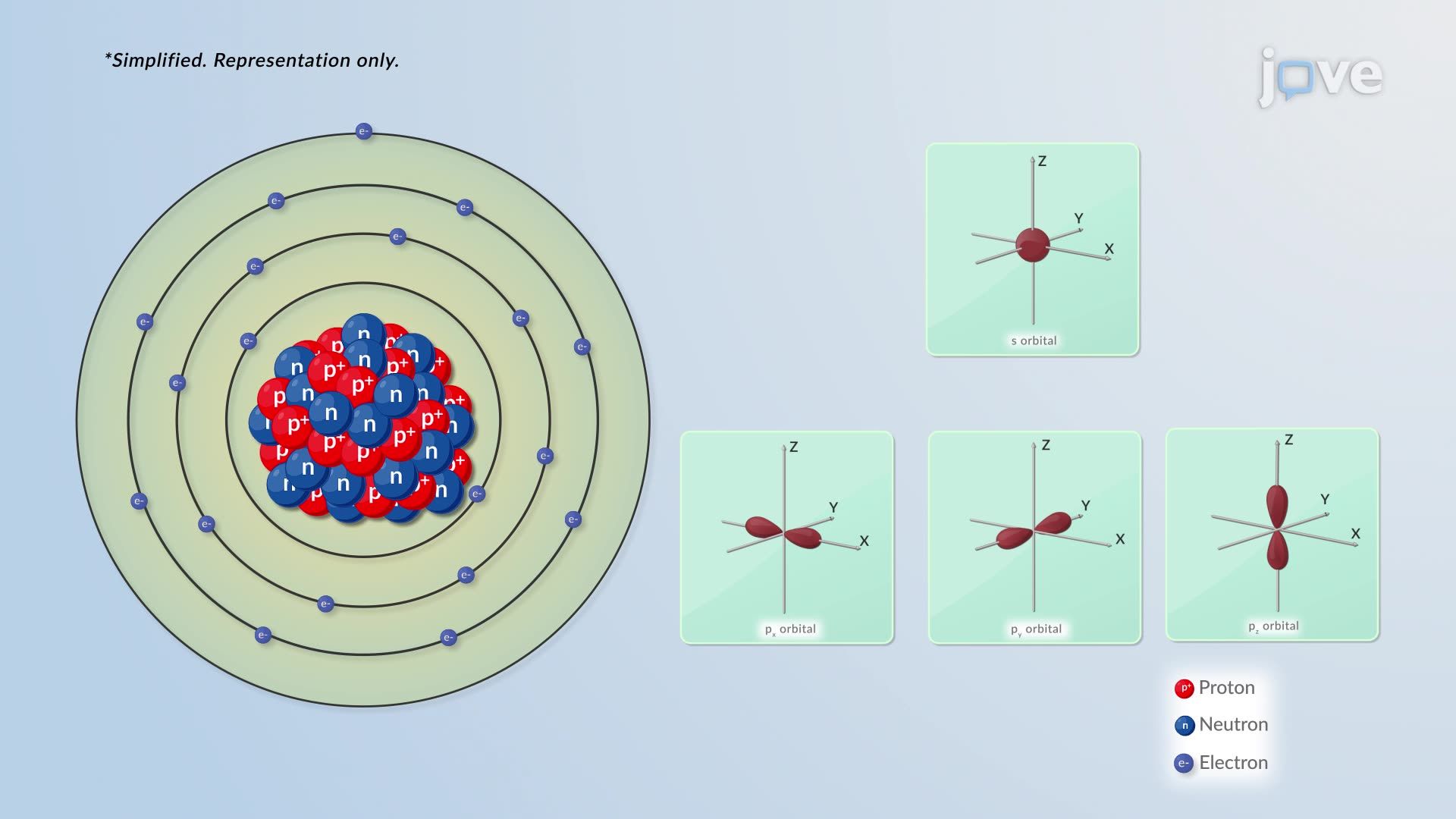
Electron behavior chemistry forms the foundation for understanding how atoms interact, bond, and form the materials around us. Unlike planets orbiting the sun in predictable paths, electrons exhibit quantum electron behavior that defies classical physics. These subatomic particles exist in probability regions called orbitals, where their exact location cannot be pinpointed-only the likelihood of finding them in specific areas.
Electron behavior in atoms follows strict energy rules that determine atomic stability. Electrons closest to the nucleus occupy the lowest energy state (ground state), requiring significant energy input to move to higher levels. This concept appears frequently on AP Chemistry exams and college general chemistry courses, where students must predict electron configurations for elements across the periodic table.
The electron energy levels can be visualized as concentric shells, with the first shell (n=1) holding a maximum of two electrons, the second shell (n=2) accommodating eight electrons, and subsequent shells following the 2n² rule. This pattern explains why noble gases like neon and argon are chemically inert-their outermost shells are completely filled, creating stable electron configurations.
The electron cloud model reveals that valence electrons-those in the outermost shell-dictate an atom's chemical personality. Silicon Valley's semiconductor industry relies entirely on understanding how valence electrons behave in materials like silicon and germanium. When these materials are "doped" with other elements, their electron behavior changes dramatically, enabling the creation of computer chips and solar panels.
Electron orbital behavior becomes particularly important when predicting molecular shapes using VSEPR theory, a topic heavily tested on the MCAT. The wave function electron behavior describes electrons as both particles and waves, explaining phenomena like electron tunneling that makes scanning tunnel microscopes possible-technology used extensively in US research institutions like MIT and Stanford.
Understanding electron behavior enables innovations in everything from LED lighting to MRI machines used in American hospitals. When electrons transition between energy levels, they emit or absorb specific wavelengths of light, principles utilized in medical imaging and astronomical observations at facilities like the Hubble Space Telescope operations center in Maryland.
Related Micro-courses