Loading video…

 21 Concepts
 2M views

Video Summary: What Is Electron Orbital Model
Ever wonder why neon signs glow with specific colors or how MRI machines at hospitals like Mayo Clinic can image your brain? The electron orbital model biology reveals how electrons occupy distinct three-dimensional regions around atomic nuclei, creating the foundation for all chemical behavior we observe. This quantum mechanical model explains why atoms bond in predictable patterns and why elements display unique properties. The electron orbital model replaces outdated planetary models with probability clouds that accurately predict electron locations. Watch the full video on JoVE Coach to master this concept with expert-led visuals and step-by-explanations.
The electron orbital model revolutionized our understanding of atomic structure by replacing the oversimplified planetary model with quantum mechanical probability distributions. Unlike planets orbiting the sun in fixed paths, electrons exist in three-dimensional regions called orbitals where they have a 90% probability of being found. This quantum mechanical orbital approach accurately predicts chemical behavior, making it essential for students preparing for AP Chemistry, college general chemistry courses, and pre-health programs.
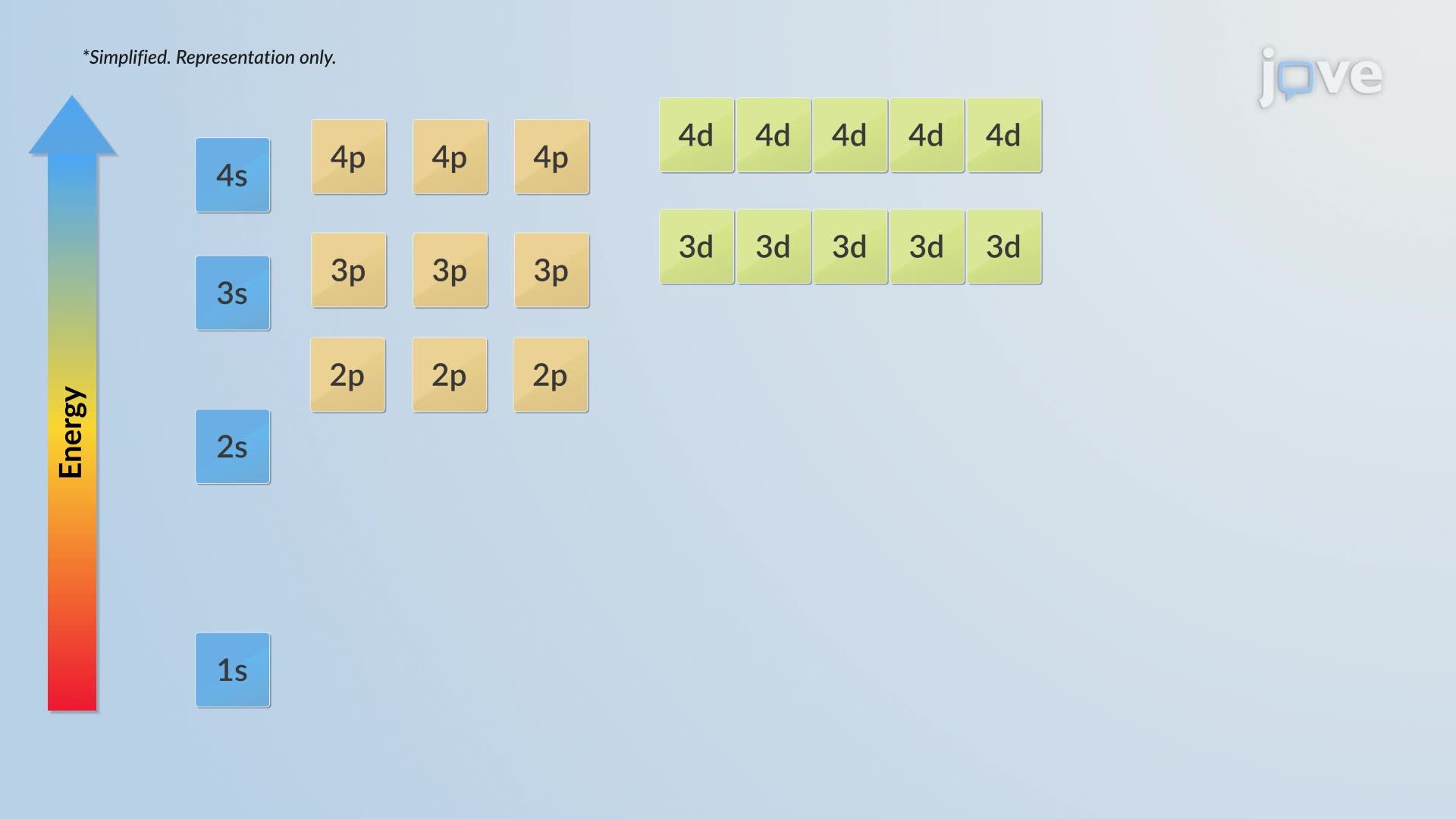
The s p d f orbital model organizes electrons into four distinct orbital types, each with unique shapes and properties. S orbitals are perfectly spherical and exist at every energy level, with the 1s orbital being smallest and closest to the nucleus. P orbitals have distinctive dumbbell shapes oriented along x, y, and z axes, appearing first at the second energy level. D orbitals emerge at the third energy level with complex four-lobed cloverleaf shapes (except for one unique form), while f orbitals begin at the fourth level with even more intricate geometries. These orbital shape electron patterns directly influence how atoms bond-for example, carbon's sp³ hybridization creates tetrahedral geometry in methane.
Understanding how electrons populate orbitals follows three fundamental principles crucial for MCAT success and advanced chemistry courses. The Aufbau principle dictates that electrons fill orbitals from lowest to highest energy, explaining why sodium's eleven electrons occupy 1s², 2s², 2p⁶, 3s¹ rather than random arrangements. Pauli's exclusion principle limits each orbital to two electrons with opposite spins, represented by up and down arrows in orbital diagrams. Hund's rule requires electrons to occupy empty orbitals singly before pairing up, minimizing electron-electron repulsion and maximizing stability.
The electron cloud orbital concept directly applies to medical imaging technologies used in major US hospital systems. MRI machines exploit the magnetic properties of hydrogen nuclei, whose single electrons occupy 1s orbitals. Pharmaceutical companies like Pfizer and Johnson & Johnson rely on orbital theory to design drugs that fit specific receptor shapes. Understanding electron orbital chemistry also explains how LED lights work-electrons dropping from higher to lower orbitals release energy as specific wavelengths of light, enabling everything from smartphone screens to traffic signals across American cities.
Related Micro-courses